








Behavioral Dynamic Capabilities and Financial Resilience in Digital MSMEs: The Dual Role of Financial Sustainability
Abstract
Digital micro, small, and medium enterprises (MSMEs) operate in highly volatile environments characterized by platform dependency, income fluctuations, and rapid technological change, making financial resilience a critical strategic concern. This study examines the role of forward-looking financial behavior in shaping financial resilience among digital MSMEs in Indonesia, with financial sustainability positioned as both a mediating mechanism and a moderating condition. Grounded in Dynamic Capability Theory (DCT), a quantitative explanatory design was employed using survey data from 180 digital MSME owners selected through purposive sampling, analyzed via Partial Least Squares-Structural Equation Modeling (PLS-SEM). The results show that forward-looking financial behavior significantly influences financial sustainability (b = 0.737, p < 0.001) and financial resilience directly (b = 0.373, p < 0.001) and indirectly through financial sustainability (b = 0.275, p < 0.001). Financial sustainability also significantly moderates this relationship (b = 0.143, p = 0.007). These findings confirm that financial resilience is built through the interaction of anticipatory behavioral capabilities and sustainable financial conditions, extending DCT into the microfinance domain and underscoring the importance of long-term financial orientation for digital MSME sustainability.
Keywords
Full Text:
PDFReferences
Bagh, T., Khan, M. A., Naseer, M. M., & Iftikhar, K. (2024). Does financial flexibility drive firm's risk?taking in emerging markets? The moderating role of investment efficiency. Managerial and Decision Economics, 45(8), 5541-5561. https://doi.org/10.1002/mde.4337
Boikos, S., Panagiotidis, T., & Voucharas, G. (2025). Financial literacy, financial development, and economic growth. International Journal of Finance & Economics SPECIAL, 0(0), 1–15. https://doi.org/10.1002/ijfe.70074
Bornay-Barrachina, M., López-Cabrales, Á., & Salas-Vallina, A. (2025). Sensing, seizing, and reconfiguring dynamic capabilities in innovative firms: Why does strategic leadership make a difference?. BRQ Business Research Quarterly, 28(2), 399-420. https://doi.org/10.1177/23409444231185790
Brimble, M., Weaven, S., Wildman, K. L., Blue, L., Bodle, K., & Frazer, L. (2025). Examining the financial and commercial literacy of Australian Indigenous small business owners. Accounting & Finance, 65(1), 667-690. https://doi.org/10.1111/acfi.13343
Browder, R. E., Dwyer, S. M., & Koch, H. (2024). Upgrading adaptation: How digital transformation promotes organizational resilience. Strategic Entrepreneurship Journal, 18(1), 128-164. https://doi.org/10.1002/sej.1483
Chen, J. J., Song, P., & Loi, F. L. (2024). Strategic forward-looking nonearnings disclosure and overinvestment. The British Accounting Review, 56(6), 101431. https://doi.org/10.1016/j.bar.2024.101431
Dainelli, F., & Mengoni, A. (2025). Review of prospective financial statements: Stationary vs. forward-looking assessments. Journal of Risk and Financial Management, 18(6), 290. https://doi.org/10.3390/jrfm18060290
Dubey, R., Bryde, D. J., Dwivedi, Y. K., Graham, G., Foropon, C., & Papadopoulos, T. (2023). Dynamic digital capabilities and supply chain resilience: The role of government effectiveness. International Journal of Production Economics, 258, 108790. https://doi.org/10.1016/j.ijpe.2023.108790
Faro, B., Abedin, B., Cetindamar, D., & Daneshgar, F. (2024). Dynamic capabilities for nimbleness and resilience in a continuous digital transformation: Action design research in an Australian financial services organisation. Journal of Enterprise Information Management, 37(4), 1206-1226. https://doi.org/10.1108/JEIM-10-2023-0567
Foss, N. J. (2020). Behavioral strategy and the COVID-19 disruption. Journal of Management, 46(8), 1322-1329. https://doi.org/10.1177/0149206320945015
Gadi, P. D., Jian, O. Z., Sharma, B., Lee, W. X., Lee, X. Y., Lee, Y. Q., …, & Kee, D. M. H. (2026). TikTok marketing and impulse buying behavior among Gen Z consumers: A case study of SHEIN Malaysia. International Journal of Accounting and Finance in Asia Pacific, 9(1), 121-138. https://doi.org/10.32535/ijafap.v9i1.4395
Garrido, J., Ancizar, J., Benavides, J., & Urbano, D. (2025). Sustainability and earnings quality: The moderating role of institutional factors. Corporate Social Responsibility and Environmental Management, 0(0), 1–18. https://doi.org/10.1002/csr.70311
Ghozali, I. (2021). Partial Least Squares: Konsep, Teknik dan Aplikasi Menggunakan Smart PLS 3.2.9 Untuk Penelitian Empiris (3rd ed.). Badan Penerbit Universitas Diponegoro.
Grego, M., Magnani, G., & Denicolai, S. (2024). Transform to adapt or resilient by design? How organizations can foster resilience through business model transformation. Journal of Business Research, 171, 114359. https://doi.org/10.1016/j.jbusres.2023.114359
Hair, J. F., Hult, G. T. M., Ringle, C. M., & Sarstedt, M. (2022). A Primer on Partial Least Squares Structural Equation Modeling (PLS-SEM) (3rd ed.). SAGE Publications, Inc.
Hillmann, J., & Guenther, E. (2021). Organizational resilience: A valuable construct for management research?. International Journal of Management Reviews, 23(1), 7-44. https://doi.org/10.1111/ijmr.12239
Hock?Doepgen, M., Heaton, S., Clauss, T., & Block, J. (2025). Identifying microfoundations of dynamic managerial capabilities for business model innovation. Strategic Management Journal, 46(2), 470-501. https://doi.org/10.1002/smj.3663
Huang, C., Kouretas, G. P., Nguyen, T. D., & Zhang, Y. (2026). Organization capital and firm resilience to cash flow shocks. Financial Review, 61(2), 451-470. https://doi.org/10.1111/fire.70024
Kantabutra, S., & Ketprapakorn, N. (2021). Toward an organizational theory of resilience: An interim struggle. Sustainability, 13(23), 13137. https://doi.org/10.3390/su132313137
Koporcic, N., Kukkamalla, P. K., Markovic, S., & Maran, T. (2026). Resilience of small and medium-sized enterprises in times of crisis: An umbrella review. Review of Managerial Science, 20(1), 301-329. https://doi.org/10.1007/s11846-025-00883-0
Lanciano, E., Previati, D., Ricci, O., & Santilli, G. (2025). Financial literacy and sustainable finance decisions among Italian households. Journal of Economics and Business, 134, 106220. https://doi.org/10.1016/j.jeconbus.2024.106220
Liu, Z., & Chen, J. K. (2025). Mediating effects of financial resilience between family economic adversity and mental health: Population heterogeneity in multiple subgroups. Psychology Research and Behavior Management, 1371-1389. https://doi.org/10.2147/PRBM.S517706
Liu, Z., Chen, J. K., & Xiao, J. J. (2025). Financial resilience: A scoping review, conceptual synthesis and theoretical framework. International Journal of Bank Marketing, 43(7), 1541-1576. https://doi.org/10.1108/IJBM-12-2024-0735
Mancebón?Torrubia, M. J., Ximénez?de?Embún, D. P., & Álvarez?Farizo, B. (2024). The drivers of adult financial literacy: Exploring the role of attitudes towards finance. European Journal of Education, 59(4), e12712. https://doi.org/10.1111/ejed.12712
Mendonça, J. A., Roberto, F. R. A., Kai, D. A., & Benitez, G. B. (2025). The lock?in effect on ESG and business performance relationship: A critical examination and meta?analysis. Corporate Social Responsibility and Environmental Management, 32(5), 6912-6936. https://doi.org/10.1002/csr.70062
Morris, T., Kamano, L., & Therrien, V. (2025). Factors and determinants of financial behaviors that undermine financial well?being: A qualitative study. Journal of Consumer Affairs, 59(3), e70025. https://doi.org/10.1111/joca.70025
Muhammad, S. S., Dey, B. L., Kamal, M. M., Samuel, L., & Alzeiby, E. A. (2025). Digital transformation or digital divide? SMEs' use of AI during global crisis. Technological Forecasting and Social Change, 217, 124184. https://doi.org/10.1016/j.techfore.2025.124184
Munoz, A., Billsberry, J., & Ambrosini, V. (2022). Resilience, robustness, and antifragility: Towards an appreciation of distinct organizational responses to adversity. International Journal of Management Reviews, 24(2), 181-187. https://doi.org/10.1111/ijmr.12289
?ri, D., Szabó, I., K?, A., & Kovács, T. (2024). Digitalizing in crisis: the role of organizational resilience in SMEs’ digitalization. Journal of Enterprise Information Management, 37(4), 1185-1205. https://doi.org/10.1108/JEIM-03-2023-0141
Peetz, J., Robson, J., & Xuereb, S. (2021). The role of income volatility and perceived locus of control in financial planning decisions. Frontiers in Psychology, 12, 638043. https://doi.org/10.3389/fpsyg.2021.638043
Rifani, S. K., Arif, N. F., Wijaya, R. S., & Rahman, F. H. (2025). The impact of digital marketing, market orientation, entrepreneurial competencies, and entrepreneurship characteristics on the fashion MSMEs performance in Yogyakarta. International Journal of Applied Business & International Management, 10(1), 84–102. https://doi.org/10.32535/ijabim.v10i1.3879
Sumarlinah, Y., Sukesi, S., & Sugiyanto, S. (2022). The role of digital marketing, service quality, product quality on purchasing power through the satisfaction of Probolinggo MSME followers during the COVID-19 pandemic. International Journal of Applied Business and International Management, 7(1), 96–105. https://doi.org/10.32535/ijabim.v7i1.1444
Supramono, S., Damayanti, T. W., & Adhitya, D. (2025). Dynamic capabilities and financial behavior to accelerate MSME performance recovery and its impacts on business sustainability. Journal of Innovation and Entrepreneurship, 14(1), 10. https://doi.org/10.1186/s13731-024-00456-7
Sutton, J., & Arku, G. (2022). Regional economic resilience: towards a system approach. Regional Studies, Regional Science, 9(1), 497-512. https://doi.org/10.1080/21681376.2022.2092418
Teece, D. J. (2016). Dynamic capabilities and entrepreneurial management in large organizations: Toward a theory of the (entrepreneurial) firm. European Economic Review, 86, 202-216. https://doi.org/10.1016/j.euroecorev.2015.11.006
Teece, D. J. (2018). Dynamic capabilities as (workable) management systems theory. Journal of Management & Organization, 24(3), 359-368. https://doi.org/10.1017/jmo.2017.75
Teece, D. J., Pisano, G., & Shuen, A. (1997). Dynamic capabilities and strategic management. Strategic Management Journal, 18(7), 509-533. https://doi.org/10.1002/(SICI)1097-0266(199708)18:7%3C509::AID-SMJ882%3E3.0.CO;2-Z
Tongtong, Z., Said, J., Zakaria, N. B., & Li, X. (2025). Strengthening financial resilience in Chinese Public Hospitals: Dynamic capabilities perspective. Asian Journal of Environment-Behaviour Studies, 10(30), 59-74. https://doi.org/10.21834/aje-bs.v10i30.464
Yu, S., & Sekiguchi, T. (2024). Platform-dependent entrepreneurship: A systematic review. Administrative Sciences, 14(12), 326. https://doi.org/10.3390/admsci14120326
Zeng, X., & Rojniruttikul, N. (2025). The impact of the forward-looking strategy on the sustainable development of enterprises under the background of digital economy—Based on dynamic regulation. Sustainability, 17(1), 272. https://doi.org/10.3390/su17010272
DOI: https://doi.org/10.32535/ijafap.v9i2.4385
Refbacks
- There are currently no refbacks.
Copyright (c) 2026 Bunyamin Bunyamin, Hanif Mauludin, Kadarusman Kadarusman

This work is licensed under a Creative Commons Attribution-NonCommercial-ShareAlike 4.0 International License.
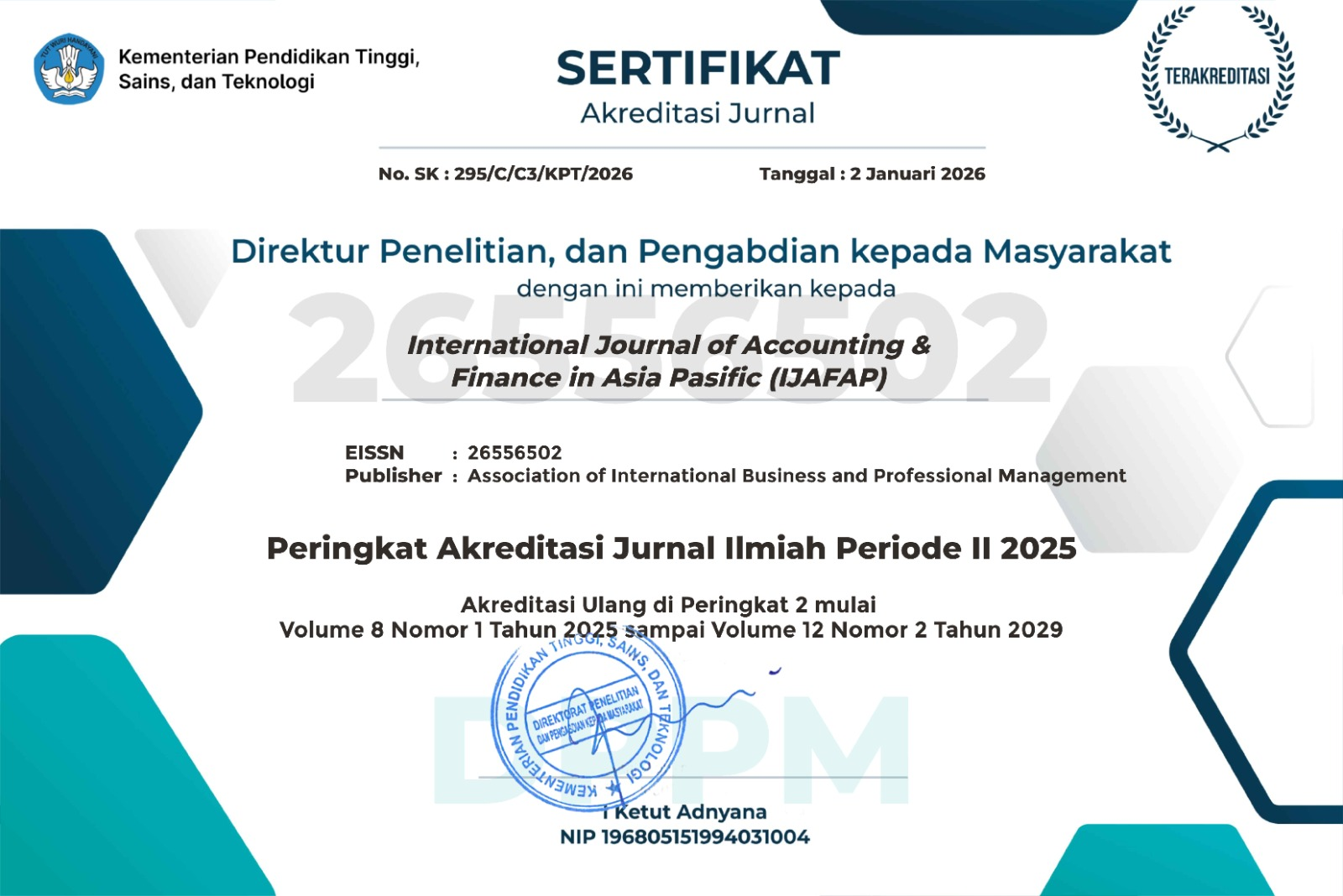
International Journal of Accounting and Finance in Asia Pacific (IJAFAP)
ISSN 2684-9763 (Print) | ISSN 2655-6502 (Online)
DOI Prefix: 10.32535 by CrossRef
Published by AIBPM Publisher
JL. Kawi No. 23, Bareng, Klojen, Kota Malang, Jawa Timur, Indonesia
Email: adm.ijafap@gmail.com
Phone: +62 896-8679-1980
Website: https://ejournal.aibpmjournals.com/index.php/IJAFAP
Governed by
Association of International Business and Professional Management
Email: admin@aibpm.org
Website: https://www.aibpm.org/
Indexed by


Licensing Information

International Journal of Accounting and Finance in Asia Pacific (IJAFAP) is licensed under a Creative Commons Attribution-NonCommercial-ShareAlike 4.0 International License.