








The Mediating Role of Environmental Sustainable Development Between Corporate Social Responsibility and Green Innovation
Abstract
Amid the escalating global climate crisis, recycling firms are increasingly expected to integrate social responsibility with environmentally sustainable practices and green innovation. This study examines the mediating role of environmental sustainable development (ESD) in the relationship between corporate social responsibility (CSR) and green innovation (GI) in Indonesia’s recycling industry. Using a quantitative survey, data were collected from 129 recycling companies and analyzed through SEM-PLS. The results show that CSR positively affects ESD (? = 0.684; p < 0.001) and GI (? = 0.343; p < 0.001), while ESD also positively affects GI (? = 0.401; p < 0.001). The indirect effect of CSR on GI through ESD is significant (? = 0.271; p < 0.001), indicating partial mediation because the direct CSR–GI path remains significant. These findings suggest that CSR contributes to green innovation more effectively when translated into resource-saving, waste-reducing, and environmentally sustainable development practices. The study extends CSR and green innovation literature and offers practical guidance for recycling firms seeking to align sustainability commitments with competitive, low-carbon innovation strategies.
Keywords
Full Text:
PDFReferences
Abdurrohman, A., Sunardi, S., & Subiyantoro, E. (2026). Exploring corporate business sustainability through green investment in Indonesia using a moderated mediation approach. Discover Sustainability, 7(1), 221. https://doi.org/10.1007/s43621-025-02564-0
Agustiani, S. A., Sabihaini, S., & Effendi, M. I. (2025). How environmental effort drives performance through competitive advantage in the Indonesian recycling industry. Asian Management and Business Review, 5(2), 452-470. https://doi.org/10.20885/AMBR.vol5.iss2.art13
Akinsemolu, A. A., & Onyeaka, H. (2025). The role of green education in achieving the sustainable development goals: A review. Renewable and Sustainable Energy Reviews, 210, 115239. https://doi.org/10.1016/j.rser.2024.115239
Al-Ali, H. A., & O’Mahony, B. (2025). Corporate social responsibility and environmental performance: The mediating role of green capabilities and green innovation. Journal of Asia Business Studies, 19(4), 973-997. https://doi.org/10.1108/JABS-08-2024-0472
Albitar, K., Nasrallah, N., Hussainey, K., & Wang, Y. (2024). Eco-innovation and corporate waste management: The moderating role of ESG performance. Review of Quantitative Finance and Accounting, 63(2), 781-805. https://doi.org/10.1007/s11156-024-01281-5
Alhemimah, A., Ali, M., Badghish, S., Latan, H., & Lopes de Sousa Jabbour, A. B. (2025). The interplay of green capabilities, organizational culture and green marketing strategy to explain green competitive advantage. Journal of Economic and Administrative Sciences, 1-23. https://doi.org/10.1108/JEAS-04-2024-0107
Ali, A. A. (2026). Impact of integrating sustainability into strategic management on financial and sustainability performance—Literature review. Sustainability, 18(8), 4137. https://doi.org/10.3390/su18084137
Augustin?Behravesh, S. A., Gomez?Trujillo, A. M., Perdomo?Charry, G., Djunaedi, M. K. D., & Ong, A. K. S. (2025). Sustainability strategies and corporate legitimacy: Analyzing firm performance through green innovation and technological turbulence. Business Strategy and the Environment, 34(7), 8500-8515. https://doi.org/10.1002/bse.70040
Bekele, W. T., Durie, A. D., & Kibret, A. T. (2026). Environmental sustainability mediates the nexus between strategic orientations and firm performance in emerging markets manufacturing firms. Discover Sustainability, 7, 1-32. https://doi.org/10.1007/s43621-026-02612-3
Bhatti, A. A., Rehman, J., Shamsi, M. I., & Shamim, K. (2025). Triple bottom-line: A critical review and need for strategic renewal. Pakistan Business Review, 27(1), 1-28. https://doi.org/10.22555/pbr.v27i1.1368
Boota, M., Khan, M., Ali, S., Rafiq, M., Khan, W., Zahid, A., & Maqbool, S. (2025). Green knowledge management as a catalyst for green organizational performance: Unraveling the mediation of green innovation under the lens of RBV. Journal of the Knowledge Economy, 1-28. https://doi.org/10.1007/s13132-025-02779-6
Din, A. U., Yang, Y., Khan, M. I. M., & Khuram, W. (2024). Innovative technological solutions for environmental sustainability in Chinese engineering practices. Engineering, Technology & Applied Science Research, 14(2), 13648-13657. https://doi.org/10.48084/etasr.6935
Dungtripop, W., Lakkanawanit, P., Sawatdikun, T., Suttipun, M., & Surbakti, L. P. (2025). The impact of corporate reporting quality on sustainable growth through integrated reporting lens in Thai listed companies. Journal of Risk and Financial Management, 18(5), 248. https://doi.org/10.3390/jrfm18050248
Dzage, E. J., Hussain, M. R., Dapaah, P. O., & Mustapha, Y. (2024). Corporate social responsibility, sustainable environmental practices and green innovation; perspectives from the Ghanaian manufacturing industry. International Journal of Corporate Social Responsibility, 9(1), 4. https://doi.org/10.1186/s40991-024-00090-2
Fitriasari, P. (2023). The impact of sustainability corporate governance on corporate environmental disclosure. International Journal of Accounting and Finance in Asia Pacific, 6(3), 17–31. https://doi.org/10.32535/ijafap.v6i1.2176
Gloria, J. V. (2025). Green innovation as a mediator of green transformational leadership, green supply chain management on green perceived organizational support toward sustainable competitive advantage in sustainable firms in the Philippines. Discover Sustainability, 6(1), 1180. https://doi.org/10.1007/s43621-025-02063-2
Gurler, H. E. (2026). The impact of corporate social responsibility on green innovation: do industry, data type and region matter? A meta-analysis research: HE Gurler. Environment, Development and Sustainability, 28(3), 7595-7621. https://doi.org/10.1007/s10668-024-05277-y
Hair, J. F., Howard, M. C., & Nitzl, C. (2020). Assessing measurement model quality in PLS-SEM using confirmatory composite analysis. Journal of business research, 109, 101-110. https://doi.org/10.1016/j.jbusres.2019.11.069
Haldorai, A. (2025). Literature review on global trends and thematic insights in the stakeholder theory, CSR and sustainability. Journal of Enterprise and Business Intelligence, 5(2), 98-107. https://doi.org/10.53759/5181/JEBI202505010
Handoyo, S. (2024). The determinants of resource efficiency and its implications for emission reduction performance. Social Sciences & Humanities Open, 10, 101155. https://doi.org/10.1016/j.ssaho.2024.101155
Kraus, S., Rehman, S. U., & García, F. J. S. (2020). Corporate social responsibility and environmental performance: The mediating role of environmental strategy and green innovation. Technological forecasting and social change, 160, 120262. https://doi.org/10.1016/j.techfore.2020.120262
Laily, N., Asyik, N. F., Wahyuni, D. U., Sari, J., & Rusdiyanto, R. (2025). The role of Green Business Strategy in mediating the relationship between environmental orientation and SMEs. The Southern African Journal of Entrepreneurship and Small Business Management, 17(1), 978.
Mahajan, R., Lim, W. M., Sareen, M., Kumar, S., & Panwar, R. (2023). Stakeholder theory. Journal of Business Research, 166, 114104. https://doi.org/10.1016/j.jbusres.2023.114104
Mansour, M., Aman, N., Al-Ghazali, B. M., & Shah, S. H. A. (2022). Perceived corporate social responsibility, ethical leadership, and moral reflectiveness impact on pro-environmental behavior among employees of small and medium enterprises: A double-mediation model. Frontiers in Psychology, 13, 967859. https://doi.org/10.3389/fpsyg.2022.967859
Marietza, F., & Nadia, M. (2021). The influence of green innovation and CSR on sustainable development mediated by green performance. Global Financial Accounting Journal, 5(1), 24-36. https://doi.org/10.37253/gfa.v5i1.4708
Mazur-Wierzbicka, E., & Swiatkiewicz, O. (2023). Sustainable Development and Corporate Social Responsibility (1st ed.). Routledge.
Mishra, A. K. (2025). Discussion on the impact of the green innovation strategy on corporate financial performance in the automotive sector. SAIM Journal of Social Science and Technology, 2(1), 1-5. https://doi.org/10.70320/sacm.2025.v02i01.001
Monir, M. M. S., Gebremeskel, A. N., & Doan, K. H. (2022). Value based classification technique for sustainable business models (SBMs). In R. Pamfilie, V. Dinu, C. Vasiliu, D. Ple?ea, L. T?chiciueds (Eds.), New Trends in Sustainable Business and Consumption (pp. 230-237). ASE. https://doi.org/10.24818/BASIQ/2022/08/030
Moroki, F. O., & Pesak, P. J. (2026). Driving sustainable waste management through CSR and green accounting. International Journal of Accounting and Finance in Asia Pacific, 9(1), 181–197. https://doi.org/10.32535/ijafap.v9i1.4407
Mukhtar, B., Shad, M. K., Woon, L. F., & Waqas, A. (2023). ESG Practices to Foster Green Innovation with Moderating Role of Innovation Orientation: A Conceptual Framework for the Manufacturing Organizations. Research Square, 1-22. https://doi.org/10.21203/rs.3.rs-3228870/v1 (Preprints)
Neumann, K., Bettinazzi, E. L., Mahoney, J. T., Snoeren, P., & Zollo, M. (2025). The adaptive capacity of stakeholder-oriented firms with social purpose vis-à-vis shareholder primacy firms: A comparative assessment. Long Range Planning, 59(1), 102592.
Ng, C.-H., & Cheah, J. S. S. (2025). A conceptual framework for synergizing marketing and environmental innovation to enhance sustainable business performance. International Journal of Accounting and Finance in Asia Pacific, 8(2), 101–115. https://doi.org/10.32535/ijafap.v8i2.3928
Nogueira, E., Gomes, S., & Lopes, J. M. (2025). Unveiling triple bottom line's influence on business performance. Discover Sustainability, 6(1), 43. https://doi.org/10.1007/s43621-025-00804-x
Novitasari, M., & Agustia, D. (2023). Competitive advantage as a mediating effect in the impact of green innovation and firm performance. Business: Theory and Practice, 24(1), 216–226. https://doi.org/10.3846/btp.2023.15865
Rosilawati, Y., & Rahmawati, F. (2023). Environmental development program of CSR: Analysis of waste bank in Karya Mulia Village, Palembang, Indonesia. In E3S Web of Conferences (Vol. 440, p. 01008). EDP Sciences. https://doi.org/10.1051/e3sconf/202344001008
Sarfraz, M., Ozturk, I., Yoo, S., Raza, M. A., & Han, H. (2023). Toward a new understanding of environmental and financial performance through corporate social responsibility, green innovation, and sustainable development. Humanities and Social Sciences Communications, 10(1), 297. https://doi.org/10.1057/s41599-023-01799-4
Sarstedt, M., Ringle, C. M., & Hair, J. F. (2021). Partial least squares structural equation modeling. In Handbook of Market Research (pp. 587-632). Springer International.
Shang, K. (2026). Balancing corporate social responsibility, environmental policies, and stakeholder expectations for sustainable development: a stakeholder?centric analysis. Sustainable Development, 34, 1491-1500. https://doi.org/10.1002/sd.70204
Sidharta, E. A., Asyik, N. F., Rusdiyanto, R., Burhan, U., & Susilo, H. (2026). Green innovation, company's ability, and corporate social responsibility: Evidence from Indonesia's recycling industry. Heritage and Sustainable Development, 8(1), 17. https://doi.org/10.37868/hsd.v8i1.1371
Sidharta, E. A., Asyik, N. F., Rusdiyanto, R., Susilo, H., & Mustakim, M. (2025). The role of green innovation in strengthening CSR to enhance sustainable performance in the era of the global climate crisis. Complex Systems Informatics and Modeling Quarterly, (44), 66–85. https://doi.org/10.7250/csimq.2025-44.05
Simmou, W., Govindan, K., Sameer, I., Hussainey, K., & Simmou, S. (2023). Doing good to be green and live clean!-Linking corporate social responsibility strategy, green innovation, and environmental performance: Evidence from Maldivian and Moroccan small and medium-sized enterprises. Journal of Cleaner Production, 384, 135265. https://doi.org/10.1016/j.jclepro.2022.135265
Siregar, I. F., Ismail, T., Taqi, M., & Soleha, N. (2024). Influence of ESG on sustainability reporting: Mediation rule of green innovation and investor sentiment. IJEEP: International Journal of Energy Economics and Policy, 14(1), 452-463. https://doi.org/10.32479/ijeep.14988
Urbanek, G. (2022). Rudiments of sustainable competitive advantage in the digital age. Annales Universitatis Mariae Curie-Sk?odowska, Sectio H Oeconomia, 56(5), 247-263.
Wahyuningrum, I. F. S., Djajadikerta, H. G., Trireksani, T., Budihardjo, M. A., & Sriningsih, S. (2026). Environmental disclosure in Indonesia: a study of manufacturing and mining companies. Asian Journal of Accounting Research, 1-15. https://doi.org/10.1108/AJAR-11-2023-0367
Zahid, Z., Zhang, J., Shahzad, M. A., Junaid, M., & Shrivastava, A. (2024). Green Synergy: Interplay of corporate social responsibility, green intellectual capital, and green ambidextrous innovation for sustainable performance in the industry 4.0 era. Plos One, 19(8), e0306349. https://doi.org/10.1371/journal.pone.0306349
DOI: https://doi.org/10.32535/ijafap.v9i2.4402
Refbacks
- There are currently no refbacks.
Copyright (c) 2026 Sabihaini Sabihaini, Januar Eko Prasetio, SUYATNO LADIQI, HAMIZAH BINTI ABDUL RAHMAN, Rusdiyanto Rusdiyanto

This work is licensed under a Creative Commons Attribution-NonCommercial-ShareAlike 4.0 International License.
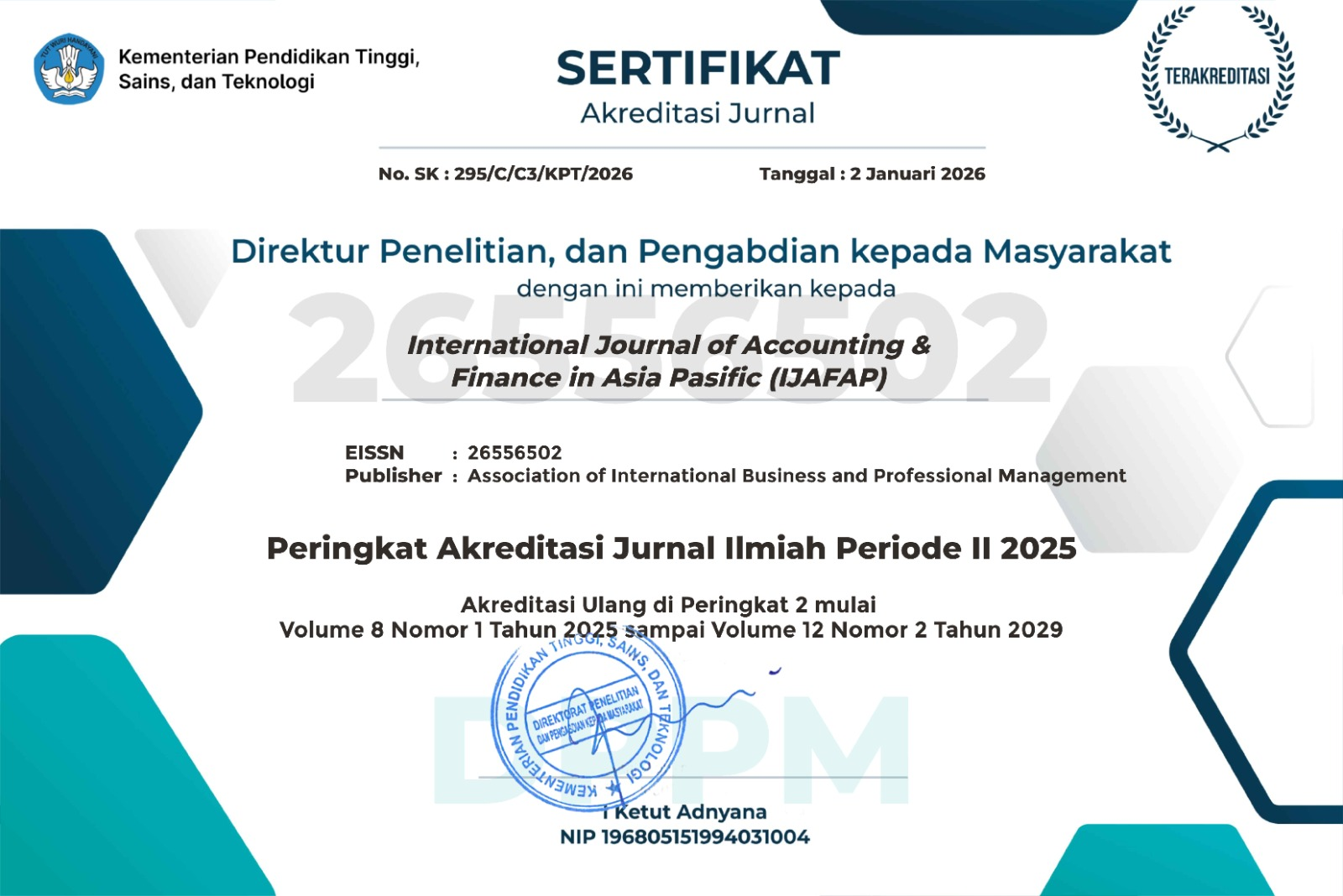
International Journal of Accounting and Finance in Asia Pacific (IJAFAP)
ISSN 2684-9763 (Print) | ISSN 2655-6502 (Online)
DOI Prefix: 10.32535 by CrossRef
Published by AIBPM Publisher
JL. Kawi No. 23, Bareng, Klojen, Kota Malang, Jawa Timur, Indonesia
Email: adm.ijafap@gmail.com
Phone: +62 896-8679-1980
Website: https://ejournal.aibpmjournals.com/index.php/IJAFAP
Governed by
Association of International Business and Professional Management
Email: admin@aibpm.org
Website: https://www.aibpm.org/
Indexed by


Licensing Information

International Journal of Accounting and Finance in Asia Pacific (IJAFAP) is licensed under a Creative Commons Attribution-NonCommercial-ShareAlike 4.0 International License.