








Sustainability Risk Diffusion Through Clean Energy, Transition Risk, and ESG Market Connectedness in Malaysia
Abstract
Climate change and the global low-carbon transition have intensified sustainability-related risks across financial markets, yet evidence on how such risks diffuse into emerging Asian economies remains limited. This study examines the dynamic connectedness and volatility spillovers among the NASDAQ Clean Edge Green Energy Index (CELS), the Transition Risk Index (TRI), and Malaysia's FTSE4Good Bursa Malaysia Index (F4GBM) during 2019-2025. This quantitative econometric study applies a hybrid framework combining the Dynamic Conditional Correlation-Generalized Autoregressive Conditional Heteroskedasticity (DCC-GARCH) model and the Diebold–Yilmaz connectedness index to daily returns. The results show that CELS is a persistent net transmitter of volatility, TRI is a policy-sensitive net receiver, and F4GBM alternates between absorbing and transmitting shocks. The total connectedness index rises from about 4% in late 2023 to above 8% by mid-2025, signaling deeper integration between climate-related risks and ESG market performance. The study concludes that investors should incorporate transition-risk indicators into diversification and hedging strategies, while policymakers should strengthen ESG disclosure, green taxonomies, and macroprudential climate-finance governance.
Keywords
Full Text:
PDFReferences
Alessandro, A., Maski, G., & Pangestuty, F. W. (2023). The implementation of sustainable finance: A case study in bank performance. International Journal of Accounting and Finance in Asia Pacific, 6(1), 27–37. https://doi.org/10.32535/ijafap.v6i1.2074
AlGhazali, A., Belghouthi, H. E., Mensi, W., McIver, R., & Kang, S. H. (2024). Oil price shocks, sustainability index, and green bond market spillovers and connectedness during bear and bull market conditions. Economic Analysis and Policy, 82, 1097–1115. https://doi.org/10.1016/j.eap.2024.10.016
Arif, M., Hasan, M., Alawi, S. M., & Naeem, M. A. (2021). COVID–19 and time–frequency connectedness between green and conventional financial markets. Global Finance Journal, 49, 100650. https://doi.org/10.1016/j.gfj.2021.100650
Armeanu, D. ?., Gherghina, ?. C., Andrei, J. V., & Jolde?, C. C. (2025). Exploring connectedness among clean energy, cleantech, and climate change: Empirical evidence in the wake of contemporary asymmetrical crisis. Mitigation and Adaptation Strategies for Global Change, 30(6), 49. https://doi.org/10.1007/s11027-025-10233-w
Bollerslev, T. (1986). Generalized autoregressive conditional heteroskedasticity. Journal of Econometrics, 31(3), 307–327. https://doi.org/10.1016/0304-4076(86)90063-1
Calvin, K., Dasgupta, D., Krinner, G., Mukherji, A., Thorne, P. W., Trisos, C., ... & Orendain, D. J. (2023). IPCC, 2023: Climate Change 2023: Synthesis Report. Contribution of Working Groups I, II and III to the Sixth Assessment Report of the Intergovernmental Panel on Climate Change [Core Writing Team, H. Lee and J. Romero (eds.)]. IPCC, Geneva, Switzerland. https://doi.org/10.59327/ipcc/ar6-9789291691647
Cocca, T., Gabauer, D., & Pomberger, S. (2024). Clean energy market connectedness and investment strategies: New evidence from DCC-GARCH R² decomposed connectedness measures. Energy Economics, 136, 107680. https://doi.org/10.1016/j.eneco.2024.107680
Diebold, F. X., & Yilmaz, K. (2012). Better to give than to receive: Predictive directional measurement of volatility spillovers. International Journal of Forecasting, 28(1), 57–66. https://doi.org/10.1016/j.ijforecast.2011.02.006
Diebold, F. X., & Yilmaz, K. (2014). On the network topology of variance decompositions: Measuring the connectedness of financial firms. Journal of Econometrics, 182(1), 119–134. https://doi.org/10.1016/j.jeconom.2014.04.012
Dogan, M. (2025). From risk to resilience: Wavelet-quantile evidence on geopolitical shocks and clean energy markets. Journal of Environmental Management, 394, 127577. https://doi.org/10.1016/j.jenvman.2025.127577
Engle, R. F. (2002). Dynamic conditional correlation: A simple class of multivariate generalized autoregressive conditional heteroskedasticity models. Journal of Business & Economic Statistics, 20(3), 339–350. https://doi.org/10.1198/073500102288618487
Ezuma, R. E. M. R., & Matthew, N. K. (2022). The perspectives of stakeholders on the effectiveness of green financing schemes in Malaysia. Green Finance, 4(3), 450–473. https://doi.org/10.3934/GF.2022022
Gaies, B. (2025). Risky finance, riskier climate: When financial instability meets climate risks on the bridge of sustainability uncertainty. The North American Journal of Economics and Finance, 80, 102492. https://doi.org/10.1016/j.najef.2025.102492
Hambel, C., & Ploeg, F. V. D. (2025). Policy transition risk, carbon premiums, and asset prices. Journal of Monetary Economics, 152, 103780. https://doi.org/10.1016/j.jmoneco.2025.103780
Jian, O. Z., Baliyan, M., Gadi, P. D., Siva-Muniandy, S. T., Azman, S., Yusoff, S. M, …, & Kee, D. M. H. (2024). The role of sustainability perception in consumer behavior: A study of packaging, ingredients, and brand awareness in the soft drinks industry. International Journal of Accounting & Finance in Asia Pacific, 7(2), 274–288 https://doi.org/10.32535/ijafap.v7i2.3251
Lu, X., Huang, N., Mo, J., & Ye, Z. (2023). Dynamics of the return and volatility connectedness among green finance markets during the COVID-19 pandemic. Energy Economics, 125, 106860. https://doi.org/10.1016/j.eneco.2023.106860
Maheresmi, M., Probohudono, A. N., Arifin, T., & Widarjo, W. (2023). Do tax avoidance and firm ownership matter for sustainable finance disclosure? Evidence from the listed banks in ASEAN countries. International Journal of Professional Business Review, 8(4), e01559. https://doi.org/10.26668/businessreview/2023.v8i4.1559
Mensi, W., Boubaker, F. Z., Al-Yahyaee, K. H., & Kang, S. H. (2018). Dynamic volatility spillovers and connectedness between global, regional, and GIPSI stock markets. Finance Research Letters, 25, 230–238. https://doi.org/10.1016/j.frl.2017.10.032
Mnif, E., Naifar, N., & Jarboui, A. (2025). The role of bitcoin, sustainable investments, and financial stability in the transition to a green economy. Quality & Quantity, 60(1), 1391–1415. https://doi.org/10.1007/s11135-025-02294-5
Oliveira, K., Dias, R., Galvão, R., Varela, M., & Palma, C. (2024). Extreme events cause market efficiency or inefficiency? Evidence from precious metals and green stock indices. Revista de Gestão Social e Ambiental, 18(1), e6375. https://doi.org/10.24857/rgsa.v18n1-118
Rao, A., Lucey, B., Kumar, S., & Lim, W. M. (2023). Do green energy markets catch cold when conventional energy markets sneeze? Energy Economics, 127, 107035. https://doi.org/10.1016/j.eneco.2023.107035
Reboredo, J. C., & Ugolini, A. (2022). Climate transition risk, profitability and stock prices. International Review of Financial Analysis, 83, 102271. https://doi.org/10.1016/j.irfa.2022.102271
?ahinler, A. N., Ozbugday, F. C., Basci, S., & Omay, T. (2024). Static and dynamic connectedness between green bonds and clean energy markets. In J. Thewissen, Ö. Arslan-Ayaydin, W. Westerman, A. Dorsman (Eds.), The ESG Framework and the Energy Industry: Demand and Supply, Market Policies and Value Creation (pp. 137–158). Springer International. https://doi.org/10.1007/978-3-031-48457-5_8
Sen, C., & Chakrabarti, G. (2024). Exploring the risk dynamics of US green energy stocks: A green time-varying beta approach. Energy Economics, 139, 107951. https://doi.org/10.1016/j.eneco.2024.107951
Sin, L. G., Chien, N. W., Liu, J. X., Li, W. C., Zhang, L. X., Li, X. T., ..., & Kee, D. M. H. (2025). Driving sustainable growth: The key success factors of a bank in Malaysia. International Journal of Accounting and Finance in Asia Pacific, 8(1), 142–158. https://doi.org/10.32535/ijafap.v8i1.3829
Ullah, A., Liu, X., Zeeshan, M., & Shah, W. U. (2024). Evaluating growth and crisis risk dynamics of sustainable climate exchange-traded funds. Sustainability, 16(22), 10049. https://doi.org/10.3390/su162210049
Xu, D., Hu, Y., Corbet, S., Hou, Y. G., & Oxley, L. (2024). Green bonds and traditional and emerging investments: Understanding connectedness during crises. The North American Journal of Economics and Finance, 72, 102142. https://doi.org/10.1016/j.najef.2024.102142
Yousfi, M., & Bouzgarrou, H. (2024). Quantile network connectedness between oil, clean energy markets, and green equity with portfolio implications. Environmental Economics and Policy Studies, 27(4), 583–614. https://doi.org/10.1007/s10018-024-00393-5
Yuan, X., Qin, M., Zhong, Y., & Nicoleta-Claudia, M. (2023). Financial roles in green investment based on the quantile connectedness. Energy Economics, 117, 106481. https://doi.org/10.1016/j.eneco.2022.106481
Zeng, H. (2026). Risk transmission and diversification strategies between US real estate investment trusts (REITs) and green finance indices. Kybernetes, 55(1), 128–154. https://doi.org/10.1108/K-12-2023-2653
Zeng, H., Abedin, M. Z., Lucey, B., & Ma, S. (2025). Tail risk contagion and multiscale spillovers in the green finance index and large US technology stocks. International Review of Financial Analysis, 97, 103865. https://doi.org/10.1016/j.irfa.2024.103865
Zhang, W., He, X., & Hamori, S. (2022). Volatility spillover and investment strategies among sustainability-related financial indexes: Evidence from the DCC-GARCH-based dynamic connectedness and DCC-GARCH t-copula approach. International Review of Financial Analysis, 83, 102223. https://doi.org/10.1016/j.irfa.2022.102223
DOI: https://doi.org/10.32535/ijafap.v9i2.4410
Refbacks
- There are currently no refbacks.
Copyright (c) 2026 Rinda Siaga Pangestuti

This work is licensed under a Creative Commons Attribution-NonCommercial-ShareAlike 4.0 International License.
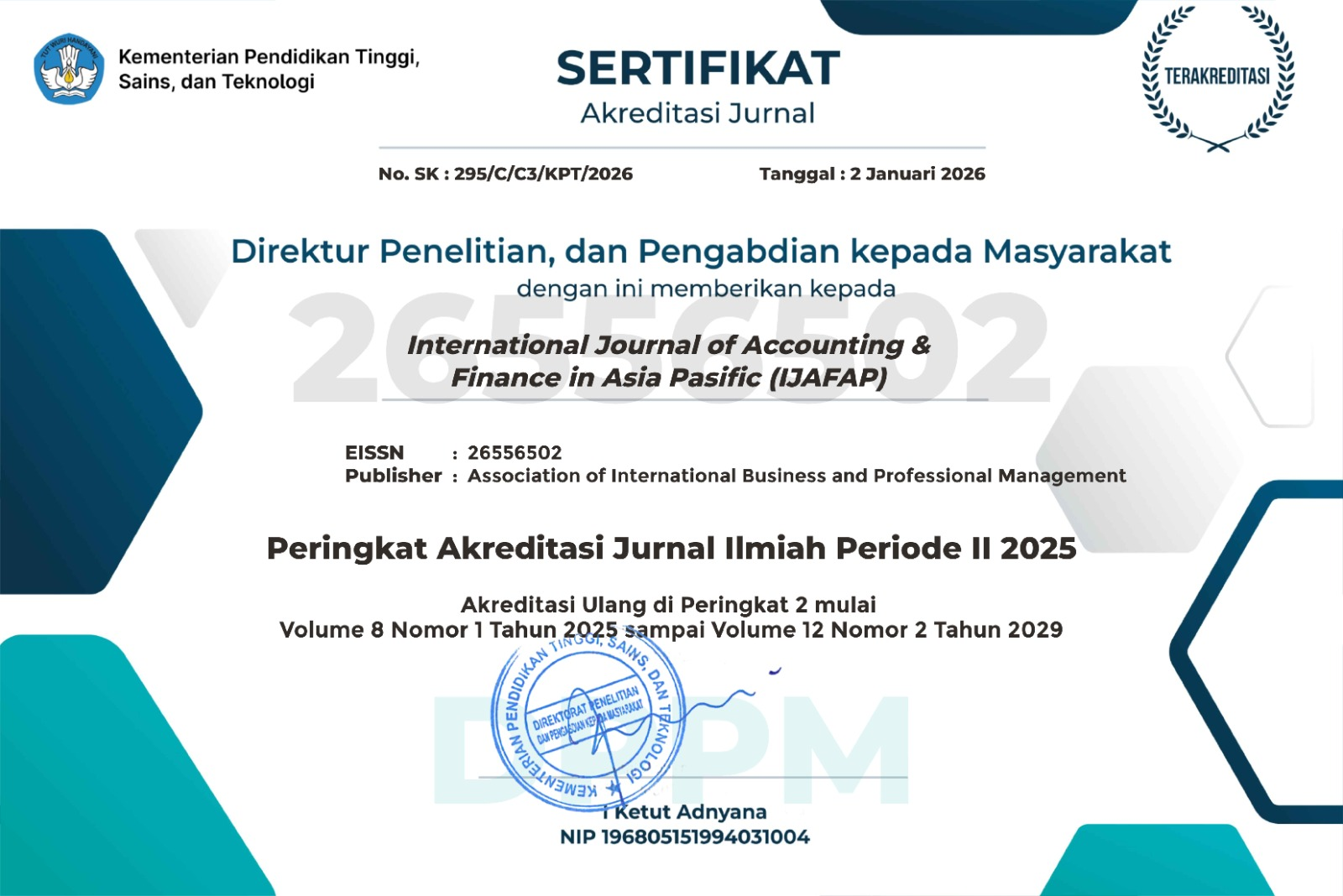
International Journal of Accounting and Finance in Asia Pacific (IJAFAP)
ISSN 2684-9763 (Print) | ISSN 2655-6502 (Online)
DOI Prefix: 10.32535 by CrossRef
Published by AIBPM Publisher
JL. Kawi No. 23, Bareng, Klojen, Kota Malang, Jawa Timur, Indonesia
Email: adm.ijafap@gmail.com
Phone: +62 896-8679-1980
Website: https://ejournal.aibpmjournals.com/index.php/IJAFAP
Governed by
Association of International Business and Professional Management
Email: admin@aibpm.org
Website: https://www.aibpm.org/
Indexed by


Licensing Information

International Journal of Accounting and Finance in Asia Pacific (IJAFAP) is licensed under a Creative Commons Attribution-NonCommercial-ShareAlike 4.0 International License.