








Understanding Continuance Intention in E-Wallet Services: Security, Trust, and Technology Factors in Malaysia
Abstract
The rapid growth of financial technology has increased the adoption of digital payment systems, with the Touch ’n Go (TNG) e-wallet becoming a leading platform in Malaysia. Understanding the factors driving continued usage is essential for sustaining user engagement and competitiveness. This study examines the influence of perceived security, trust, perceived usefulness, and perceived ease of use on users’ intention to continue using the TNG e-wallet. A quantitative research design was employed using a structured online questionnaire administered to active TNG e-wallet users in Malaysia. Data were collected from 104 respondents and analyzed using descriptive statistics, reliability analysis, correlation analysis, and multiple regression analysis. The findings indicate that all four factors positively influence continuance intention, with trust emerging as the strongest predictor (? = 0.409), followed by perceived ease of use (? = 0.245), perceived usefulness (? = 0.221), and perceived security (? = 0.137). The regression model explained 83.6% of the variance in continuance intention (R² = 0.836). The findings highlight the importance of fostering user trust, strengthening security measures, and enhancing the usability and practical value of digital payment platforms. The study provides practical insights for fintech providers seeking to improve customer retention and long-term engagement in the increasingly competitive e-wallet market.
Keywords
Full Text:
PDFReferences
Ahmed, W., Farooq, O., & Shahzaib, R. (2025). The rise of digital wallets: Customer trust, security concerns, and adoption in retail transactions. Inverge Journal of Social Sciences, 4(3), 337-350. https://doi.org/10.63544/ijss.v4i3.171
Boon, V., Arief, U. B. A. R., Vikniswaran, A., Raman, L. H., Lukman, J. A., & Lok, Y. H. (2022). E-payment transaction and consumer behaviour: a study of Touch'n Go e-Wallet during the COVID-19 pandemic in Malaysia. Advances in Global Economics and Business Journal, 3(2), 80-97. https://doi.org/10.51748/agebj.v3i2.67
Chawla, D., & Joshi, H. (2019). Consumer attitude and intention to adopt mobile wallet in India–An empirical study. International Journal of Bank Marketing, 37(7), 1590-1618. https://doi.org/10.1108/ijbm-09-2018-0256
Davis, F. D. (1989). Technology acceptance model: TAM. Al-Suqri, MN, Al-Aufi, AS: Information Seeking Behavior and Technology Adoption, 205(219), 5.
Edeh, F. O., Aryani, D. N., Subramaniam, T. A., Kee, D. M. H., Samarth, T., Nair, R. K., …, & Teh, Y. C. (2021). Impact of COVID-19 pandemic on consumer behavior towards the intention to use e-wallet in Malaysia. International Journal of Accounting & Finance in Asia Pasific, 4(3), 42–59. https://doi.org/10.32535/ijafap.v4i3.1205
Fareed, T. (2023). A systemic review of payment technologies with a special focus on digital wallets. Financial Technologies and DeFi: A Revisit to the Digital Finance Revolution, 89-97. https://doi.org/10.1007/978-3-031-17998-3_6
Flavián, C., Guinalíu, M., & Gurrea, R. (2006). The role played by perceived usability, satisfaction and consumer trust on website loyalty. Information & Management, 43(1), 1-14. https://doi.org/10.1016/j.im.2005.01.002
Gefen, D., Karahanna, E., & Straub, D. W. (2003). Trust and tam in online shopping: An integrated model1. MIS Quarterly, 27(1), 51-90. https://doi.org/10.2307/30036519
Haedar, S., & Marsasi, E. G. (2025). How perceived usefulness, ease of use, and quality affect e-wallet intention in Gen Y and Z: A TAM Perspective. SENTRALISASI, 14(2), 70-98. https://doi.org/10.33506/sl.v14i2.4233
Jingnan, J., Teo, P. C., Ho, T. C., & Hooi Ling, C. (2023). The behavioral intention of young Malaysians towards cashless society: Value-based adoption model. Cogent Business & Management, 10(2), 2244756. https://doi.org/10.1080/23311975.2023.2244756
Kaur, S., & Arora, S. (2021). Role of perceived risk in online banking and its impact on behavioral intention: Trust as a moderator. Journal of Asia Business Studies, 15(1), 1-30. https://doi.org/10.1108/JABS-08-2019-0252
Kee, D. M. H., Kum, Y. L., Lee, J. H., Lee, N. C., Lee, X. T., & Muckar, D. S. (2024). Riding the fintech wave: Exploring service satisfaction and trust among Generations Y and Z. International Journal of Accounting & Finance in Asia Pasific, 7(3), 342–360. https://doi.org/10.32535/ijafap.v7i3.3275
Khando, K., Islam, M. S., & Gao, S. (2022). The emerging technologies of digital payments and associated challenges: A systematic literature review. Future Internet, 15(1), 21. https://doi.org/10.3390/fi15010021
Kiew, J. P., Evelyn, T. T. L., Ngian, E. T., & Sally, L. H. C. (2022). Perceived trust, convenience and promotion for the adoption of e-wallet. International journal of academic research in business & social science, 12(9), 374-385. https://doi.org/10.6007/ijarbss/v12-i9/14591
Kim, D. J., Ferrin, D. L., & Rao, H. R. (2009). Trust and satisfaction, two stepping stones for successful e-commerce relationships: A longitudinal exploration. Information Systems Research, 20(2), 237-257. https://doi.org/10.1287/isre.1080.0188
Ladeira, W. J., Jafar, S. H., & Santini, F. O. (2026). A meta-analysis of technological adoption of financial services: investigating risk and trust perception effects. International Journal of Bank Marketing, 44(3), 393-421. https://doi.org/10.1108/IJBM-02-2025-0156
Lai, P. C., & Liew, E. J. (2021). Towards a cashless society: The effects of perceived convenience and security on gamified mobile payment platform adoption. Australasian Journal of Information Systems, 25. https://doi.org/10.3127/ajis.v25i0.2809
Lim, H. L., Kuek, T. Y., Yeoh, G. L., Yeap, P. Y., Yang, D. W., Xu, K., Mulchand, S. G., & Thakur, G. (2022). Factors affecting users’ behavioral intention toward Touch ’n Go e-wallet in Malaysia. International Journal of Applied Business and International Management, 7(3), 108–120. https://doi.org/10.32535/ijabim.v7i3.2069
Lim, W., Munikrishnan, U. T., Leong, C. M., Hiew, L. C., Leong, M. W., & Yang, L. (2024). Do you want a secure e-wallet? Understanding the role of risk and security in e-wallet continuance intention. Information & Computer Security, 32(3), 304-321. https://doi.org/10.1108/ICS-05-2023-0085
Moghavvemi, S., Mei, T. X., Phoong, S. W., & Phoong, S. Y. (2021). Drivers and barriers of mobile payment adoption: Malaysian merchants' perspective. Journal of Retailing and Consumer Services, 59, 102364. https://doi.org/10.1016/j.jretconser.2020.102364
Nawang, W. R. W., Abdillih, M. A. A. M., & Mursidi, A. (2025). Embracing e-wallet applications among Generation Z in Malaysia: The mediating role of trust. Journal of Nusantara Studies, 10(1), 373-398. https://doi.org/10.24200/jonus.vol10iss1pp373-398
Nugraha, A. L. (2025). The role of transaction security perception in reducing the risk of churn for e-wallet users in Indonesia. Journal of Digital Business and Data Science, 2(2), 76-94. https://doi.org/10.59261/jdbs.v2i2.24
Ooi, K. B., & Tan, G. W. H. (2016). Mobile technology acceptance model: An investigation using mobile users to explore smartphone credit card. Expert Systems with Applications, 59, 33-46. https://doi.org/10.1016/j.eswa.2016.04.015
Othman, M., Jantan, J., & Husain, M. Z. (2026). Adoption of Touch’N Go eWallet among Polytechnic Metro Johor Bahru Students. Tropical Scientific Journal, 5(2), 140-152.
Roslan, R., Ayub, A. F. M., Ghazali, N., & Zulkifli, N. N. (2021). The influence of perceived ease of use, perceived usefulness, social influence, and perceived enjoyment towards continuance intention in using a gamified e-quiz mobile application. Journal of Institutional Research South East Asia, 19(2).
Samsudin, A. E., & Kasiran, M. K. (2023). Use of e-wallet and security of digital transactions. Journal of Information Systems and Digital Technologies, 5(2), 155-169. https://doi.org/10.31436/jisdt.v5i2.416
Spreitzer, G. M., & Mishra, A. K. (1999). Giving up control without losing control: Trust and its substitutes’ effects on managers’ involving employees in decision making. Group & Organization Management, 24(2), 155-187. https://doi.org/10.1177/1059601199242003
Utomo, F. S., Suryana, N., & Azmi, M. S. (2025). Factors influencing user adoption of mobile payment system: an integrated model of perceived usefulness, ease of use, financial literacy, and trust. Journal of Digital Market and Digital Currency, 2(2), 135-156. https://doi.org/10.47738/jdmdc.v2i2.31
Venkatesh, V., & Bala, H. (2008). Technology acceptance model 3 and a research agenda on interventions. Decision Sciences, 39(2), 273-315. https://doi.org/10.1111/j.1540-5915.2008.00192.x
DOI: https://doi.org/10.32535/ijafap.v9i2.4662
Refbacks
- There are currently no refbacks.
Copyright (c) 2026 Tan Lay Hong

This work is licensed under a Creative Commons Attribution-NonCommercial-ShareAlike 4.0 International License.
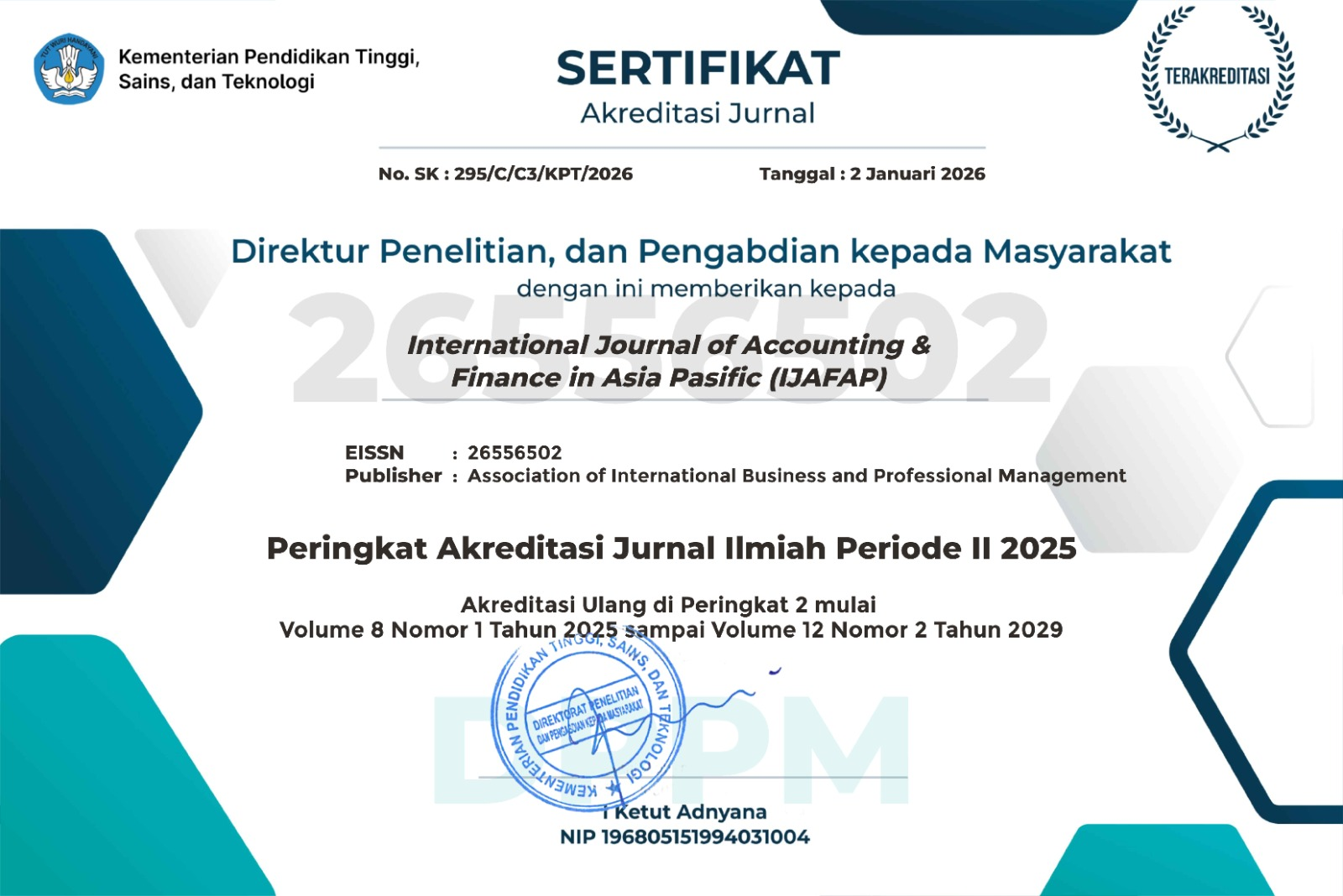
International Journal of Accounting and Finance in Asia Pacific (IJAFAP)
ISSN 2684-9763 (Print) | ISSN 2655-6502 (Online)
DOI Prefix: 10.32535 by CrossRef
Published by AIBPM Publisher
JL. Kawi No. 23, Bareng, Klojen, Kota Malang, Jawa Timur, Indonesia
Email: adm.ijafap@gmail.com
Phone: +62 896-8679-1980
Website: https://ejournal.aibpmjournals.com/index.php/IJAFAP
Governed by
Association of International Business and Professional Management
Email: admin@aibpm.org
Website: https://www.aibpm.org/
Indexed by


Licensing Information

International Journal of Accounting and Finance in Asia Pacific (IJAFAP) is licensed under a Creative Commons Attribution-NonCommercial-ShareAlike 4.0 International License.