






 Email this article
 From Personal and Environmental Values to Green Beauty Loyalty: The Role of Satisfaction and Green Reward
Abstract
Growing environmental awareness among Generation Z has increased demand for sustainable consumption, particularly in the cosmetics industry. However, the mechanisms through which value orientation influences green beauty loyalty remain unclear. This study examines the effects of altruistic and egoistic values on green beauty loyalty, with green satisfaction as a mediating variable and green reward as both a direct predictor and moderating factor. A quantitative approach was employed using data collected from 280 Indonesian Generation Z consumers who have prior experience with green cosmetic products. The data were measured using a seven-point Likert scale and analyzed through Partial Least Squares Structural Equation Modeling (PLS-SEM). The findings reveal that egoistic value (? = 0.424, p = 0.006) and altruistic value (? = 0.443, p = 0.003) significantly enhance green satisfaction, which strongly influences green beauty loyalty (? = 0.788, p < 0.001), indicating full mediation. However, the direct effects of both values on loyalty are not significant. Green reward exerts a significant direct effect on loyalty (? = 0.402, p < 0.001) but does not moderate the satisfaction–loyalty relationship (p = 0.980). These results highlight the pivotal role of satisfaction and suggest that reward mechanisms function as independent drivers of sustainable consumer loyalty, offering both theoretical and managerial implications.
Keywords
Full Text:
PDFReferences
Ajzen, I. (1991). The theory of planned behavior. Organizational Behavior and Human Decision Processes, 50(2), 179-211. https://doi.org/10.4135/9781446249215.n22
Andika, A., Nadia, N., Luthfiana, D. N., & Aulia, F. B. (2023). Green cosmetics and Generation Z in Indones?a: The role of the IMB model in predicting purchase intention. Asia Pacific Management and Business Application, 12(2), 159–186. https://doi.org/10.21776/ub.apmba.2023.012.02.3
Braimah, S. M., Amoako, G. K., Abubakari, A., Ampong, G. O. A., & Ofori, K. S. (2023). Green perceived value and consumer attitudes in the light of the SDGs: a replication study from a developing economy. Society and Business Review, 18(2), 345-362. https://doi.org/10.1108/SBR-03-2022-0088
Brigitta, M. Y. F., Effendi, M. I., Sugandini, D., & Suryono, I. A. (2023). The influence of brand satisfaction and luxury brand attachment on customer advocacy through brand loyalty on Zalora marketplace. International Journal of Applied Business and International Management, 8(3), 437–451. https://doi.org/10.32535/ijabim.v8i3.2095
Cho, H., Jo, D., & Kim, H. (2024). Understanding consumer perception towards sustainable apparel: A parallel mediation analysis on satisfaction and trust. Sustainability, 16(16), 6835. https://doi.org/10.3390/su16166835
De Groot, J. I., & Steg, L. (2008). Value orientations to explain beliefs related to environmental significant behavior: How to measure egoistic, altruistic, and biospheric value orientations. Environment and Behavior, 40(3), 330-354. https://doi.org/10.1177/0013916506297831
Dewi, A. A. D. R., Tahu, G. P., Kusuma, I. G. N. A. G. T., & Ribek, P. K. (2025). The role of patient satisfaction in mediating quality and accessibility to health service utilization. International Journal of Applied Business and International Management, 10(3), 574–599. https://doi.org/10.32535/ijabim.v10i3.4312
Gelderman, C. J., Schijns, J., Lambrechts, W., & Vijgen, S. (2021). Green marketing as an environmental practice: The impact on green satisfaction and green loyalty in a business?to?business context. Business Strategy and the Environment, 30(4), 2061-2076. https://doi.org/10.1002/bse.2732
Gomes, S., Lopes, J. M., & Nogueira, S. (2023). Willingness to pay more for green products: A critical challenge for Gen Z. Journal of Cleaner Production, 390, 136092. https://doi.org/10.1016/j.jclepro.2023.136092
González-Viralta, D., Veas-González, I., Egaña-Bruna, F., Vidal-Silva, C., Delgado-Bello, C., & Pezoa-Fuentes, C. (2023). Positive effects of green practices on the consumers' satisfaction, loyalty, word-of-mouth, and willingness to pay. Heliyon, 9(10). https://doi.org/10.1016/j.heliyon.2023.e20353
Hair, J. F., Hult, G. T. M., Ringle, C. M., Sarstedt, M., Danks, N. P., & Ray, S. (2021). Partial least squares structural equation modeling (PLS-SEM) using R: A workbook. Springer International Publishing.
Imaningsih, E. S. (2019). The effect of green perceived quality, green perceived risk on green satisfaction and green trust on the body shop product. Journal of Marketing and Consumer Research, 55(1), 71-78.
Imaningsih, E. S., Tjiptoherijanto, P., Heruwasto, I., & Aruan, D. T. H. (2019). Linking of egoistic, altruistic, and biospheric values to green loyalty: The role of green functional benefit, green monetary cost and green satisfaction. Journal of Asian Finance, Economics and Business, 6(2), 277–286. https://doi.org/10.13106/jafeb.2019.vol6.no2.277
Imaningsih, E. S., Tjiptoherijanto, P., Heruwasto, I., & Aruan, D. T. H. (2020). Exploring values orientation to build green loyalty: The role of egoistic, supply chain management, and biospheric. International Journal of Supply Chain Management, 9(2), 656–663.
Imbayani, I. G. A., & Gama, A. W. S. (2024). The impact of hedonic shopping motivation, discounts, and urge to buy impulsively on impulse buying: S-O-R perspective. International Journal of Applied Business and International Management, 9(3), 349–364. https://doi.org/10.32535/ijabim.v9i3.3438
Kim, K., & Ahn, S. J. (2017). Rewards that undermine customer loyalty? A motivational approach to loyalty programs. Psychology & Marketing, 34(9), 842-852. https://doi.org/10.1002/mar.21026
Le, T. M., Vu, K. H., Le, B. N., & Luu, T. M. N. (2025). Factors affecting green cosmetic’s brand loyalty: The mediating effect of brand love. Procedia Computer Science, 253, 277-286. https://doi.org/10.1016/j.procs.2025.01.091
Limbu, Y. B., & Ahamed, A. J. (2023). What influences green cosmetics purchase intention and behavior? A systematic review and future research agenda. Sustainability, 15(15), 11881. https://doi.org/10.3390/su151511881
Nastasoiu, A., & Vandenbosch, M. (2019). Competing with loyalty: How to design successful customer loyalty reward programs. Business Horizons, 62(2), 207-214. https://doi.org/10.1016/j.bushor.2018.11.002
Ocho, A. M., Virador, L. B., Morales, M. R., Bahalla, J. A., Genille Grace Gumapac, G. G. G., & Mosqueda, L. (2025). Do green practices influence perceived sustainable performance? Empirical evidence from hotels and resorts in the Philippines. International Journal of Applied Business and International Management, 10(1), 101–115. https://doi.org/10.32535/ijabim.v10i1.3528
Oliver, R. L. (1980). A cognitive model of the antecedents and consequences of satisfaction decisions. Journal of Marketing Research, 17(4), 460-469. https://doi.org/10.1177/002224378001700405
Prakash, G., Sharma, S., Kumar, A., & Luthra, S. (2024). Does the purchase intention of green consumers align with their zero-waste buying behaviour? An empirical study on a proactive approach towards embracing waste-free consumption. Heliyon, 10(3). https://doi.org/10.1016/j.heliyon.2024.e25022
Prayoga, I. M. S., Giantari, I. G. A. K., Setiawan, P. Y., & Widagda, I. K. G. N. J. A. (2025). Enhancing Green Loyalty: The Role of Green Rewards, Image, and Perceived Value with Green Satisfaction as a Mediator. International Journal of Sustainability Development Plan, 20, 699-707. https://doi.org/10.18280/ijsdp.200219
Royani, I., & Imaningsih, E. S. (2024). Determinants of green purchase intentions for eco-friendly skincare products. Journal of Applied Business, Taxation and Economics Research, 4(2), 267-287. https://doi.org/10.54408/jabter.v4i2.367
Saputra, D., van den Broek, M., & Marcelina, N. (2024). Navigating greenwashing: Exploring the impact of trust, perceived value, and green satisfaction on brand loyalty towards local sustainable cosmetic. Asia Pacific Management and Business Application, 13(2), 129-144. https://doi.org/10.21776/ub.apmba.2024.013.02.3
Schwartz, S. H. (2012). An overview of the Schwartz theory of basic values. Online readings in Psychology and Culture, 2(1). https://doi.org/10.9707/2307-0919.1116
Septiarini, E., Djulius, H., & Juhana, D. (2025). Strengthening Green Loyalty: How Green Marketing, Green Perceived Value, and Environmental Concern Drive Green Satisfaction (A Study of Uniqlo’s Consumer in Bandung Metropolitan). International Journal of Quantitative Research and Modeling, 6(1), 74-85. https://doi.org/10.46336/ijqrm.v6i1.883
Sun, H., Samad, S., Rehman, S. U., & Usman, M. (2022). Clean and green: the relevance of hotels' website quality and environmental management initiatives for green customer loyalty. British Food Journal, 124(12), 4266-4285. https://doi.org/10.1108/BFJ-09-2021-1002
Transparency Market Research. (2024). Green Cosmetic Products Market. Transparency Market Research. https://www.transparencymarketresearch.com/green-cosmetic-products-market.html
Widiarti, L. P., Widnyana, I. W., Mitariani, N. W. E., & Wijana, I. M. D. (2025). Patient satisfaction as a mediator of service quality, hospital image, and loyalty among participants of Indonesia’s BPJS Kesehatan Program. International Journal of Applied Business and International Management, 10(2), 368–388. https://doi.org/10.32535/ijabim.v10i2.4005
Wu, H. C., Cheng, C. C., & Ai, C. H. (2021). What drives green experiential loyalty towards green restaurants?. Tourism Review, 76(5), 1084-1103. https://doi.org/10.1108/TR-02-2019-0079
Wu, H. C., Cheng, C. C., Chen, Y. C., & Hong, W. (2018). Towards green experiential loyalty: driving from experiential quality, green relationship quality, environmental friendliness, green support and green desire. International Journal of Contemporary Hospitality Management, 30(3), 1374-1397. https://doi.org/10.1108/IJCHM-10-2016-0596
Zhang, N., Guo, M., Bu, X., & Jin, C. (2023). Understanding green loyalty: a literature review based on bibliometric-content analysis. Heliyon, 9(7). https://doi.org/10.1016/j.heliyon.2023.e18029
DOI: https://doi.org/10.32535/ijabim.v11i1.4499
Refbacks
- There are currently no refbacks.

Copyright (c) 2026 I Made Surya Prayoga, Made Pradnyan Permana Usadi, I Komang Suryadnya Diputra

This work is licensed under a Creative Commons Attribution-NonCommercial-ShareAlike 4.0 International License.
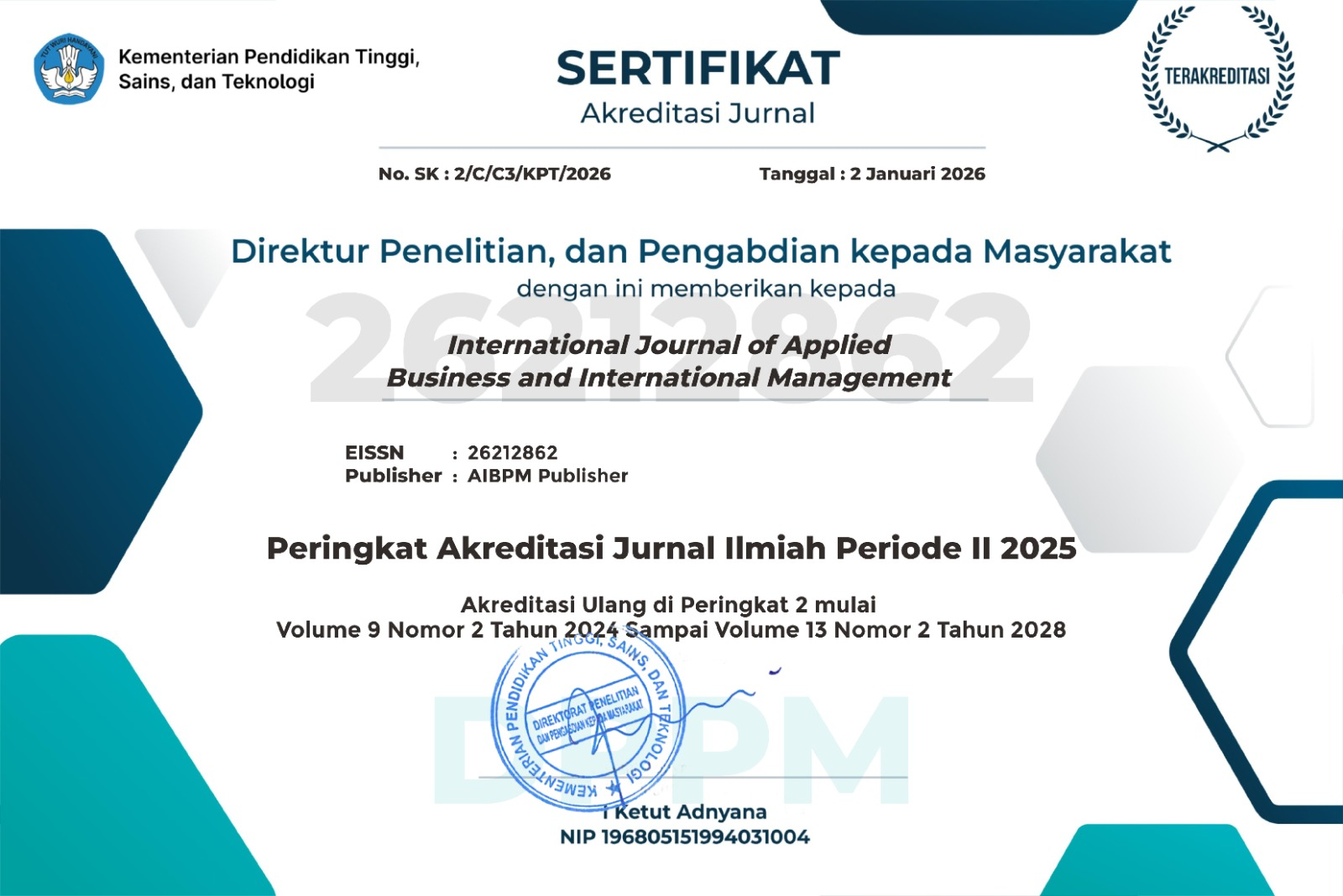
International Journal of Applied Business and International Management (IJABIM)
ISSN 2614-7432 (Print) | ISSN 2621-2862 (Online)
DOI Prefix: 10.32535 by CrossRef
Published by AIBPM Publisher
JL. Kawi No. 23, Bareng, Kec. Klojen, Kota Malang, Jawa Timur, Indonesia
Email: journal.ijabim@gmail.com
Phone: +62 341 366222
Website: https://aibpmpublisher.com/
Governed by
Association of International Business and Professional Management
Email: admin@aibpm.org
Website: https://www.aibpm.org/


Licensing Information

The International Journal of Applied Business and International Management (IJABIM) is licensed under a Creative Commons Attribution-NonCommercial-ShareAlike 4.0 International License .
Follow Us:

