



Plagiarism and Text Similarity Policy
The International Journal of Applied Business and International Management (IJABIM) is committed to maintaining the originality and integrity of the scholarly record. Submitted manuscripts may be screened using similarity-detection software such as iThenticate or Turnitin as part of the journal's editorial assessment.
A similarity score is used as an editorial screening indicator and does not, by itself, determine whether plagiarism has occurred. Similarity reports are assessed in context, including the nature and extent of matched text, the location of the overlap, appropriate quotation and citation, attribution of ideas or data, and any overlap with the authors' previously published work.
Plagiarism
Plagiarism includes the use of another person's words, ideas, data, results, images, or other intellectual contributions without appropriate acknowledgement or attribution. This includes substantial unattributed copying as well as the presentation of another person's work as one's own.
Authors are responsible for ensuring that all sources are properly cited and that quotations, paraphrases, data, figures, and other material derived from existing works are presented in accordance with accepted scholarly practice.
Text Similarity and Editorial Assessment
Similarity reports are reviewed by the editorial team rather than interpreted solely on the basis of a numerical percentage. Legitimate similarities may arise from correctly cited quotations, reference lists, commonly used methodological descriptions, institutional names, standard terminology, or previously published material that has been appropriately acknowledged.
Where potentially problematic overlap is identified, the Editor will assess its extent and significance. Depending on the circumstances, authors may be asked to revise the manuscript, provide clarification, improve attribution or citation, or address concerns regarding overlapping material.
Editorial Action
Minor or inadvertent problems involving attribution, quotation, or limited text overlap may be addressed through revision where the scholarly integrity and originality of the manuscript are not compromised.
Manuscripts containing substantial unattributed copying, misappropriation of ideas or data, or other serious forms of plagiarism may be rejected. Where appropriate, the journal may seek clarification from the authors or take further action in accordance with its publication-ethics procedures.
If significant plagiarism is identified after publication, the matter will be investigated and may result in a correction, retraction, or other appropriate editorial action, depending on the nature and extent of the problem.
Text Recycling and Redundant Publication
Authors should disclose and appropriately cite relevant prior publications, including their own work. Substantial reuse of previously published text, data, analyses, or findings without appropriate citation or disclosure may constitute inappropriate text recycling or redundant publication.
Legitimate reuse of limited material, such as descriptions of established methods, will be evaluated in context. Manuscripts should nevertheless provide sufficient original scholarly contribution and should not duplicate substantially work that has already been published or submitted elsewhere.
Post-Publication Concerns
Concerns regarding plagiarism or substantial overlap in published IJABIM articles will be assessed in accordance with the journal's publication ethics and Crossmark and Post-Publication Update Policy .
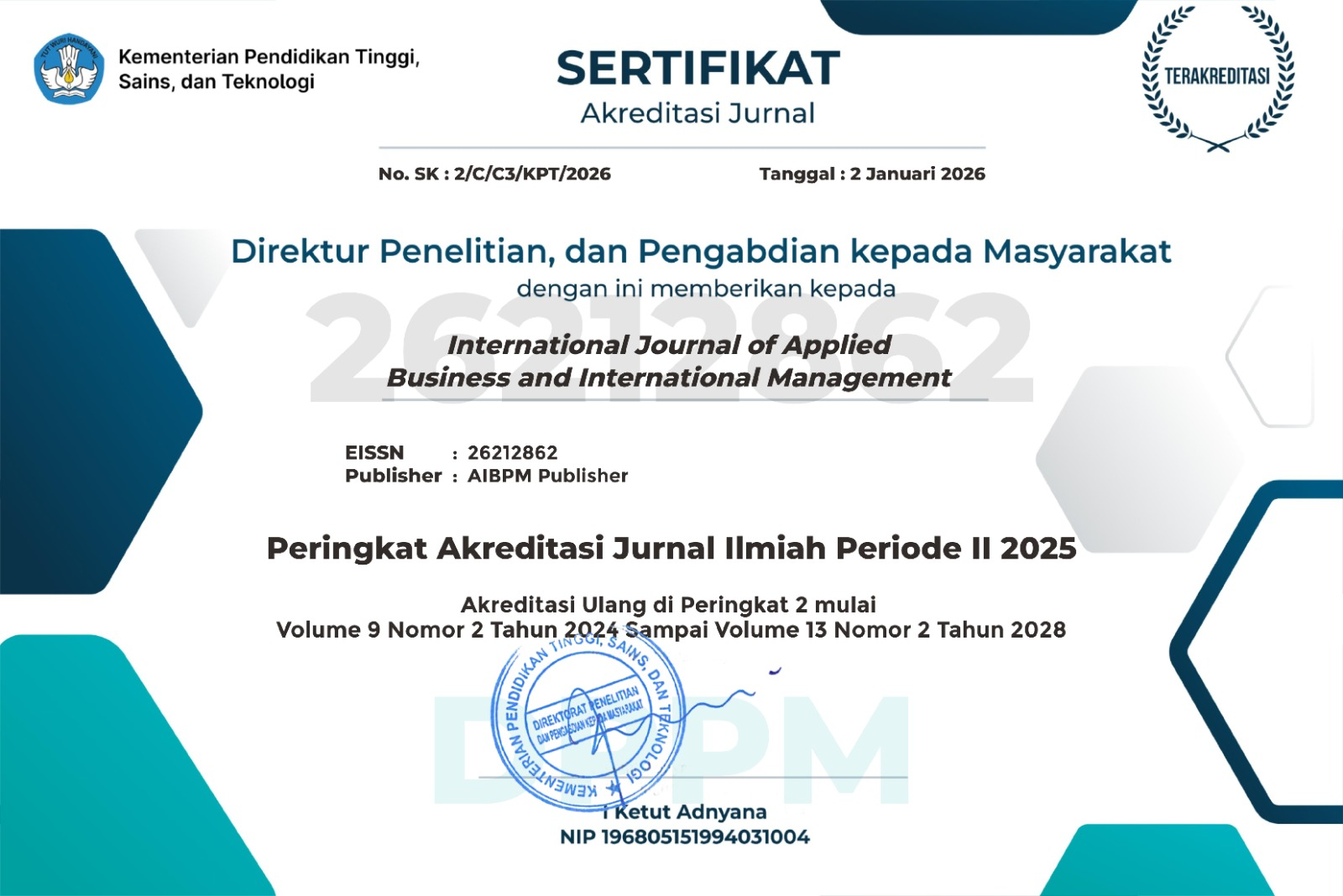
International Journal of Applied Business and International Management (IJABIM)
ISSN 2614-7432 (Print) | ISSN 2621-2862 (Online)
DOI Prefix: 10.32535 by CrossRef
Published by AIBPM Publisher
JL. Kawi No. 23, Bareng, Kec. Klojen, Kota Malang, Jawa Timur, Indonesia
Email: journal.ijabim@gmail.com
Phone: +62 341 366222
Website: https://aibpmpublisher.com/
Governed by
Association of International Business and Professional Management
Email: admin@aibpm.org
Website: https://www.aibpm.org/


Licensing Information

The International Journal of Applied Business and International Management (IJABIM) is licensed under a Creative Commons Attribution-NonCommercial-ShareAlike 4.0 International License .
Follow Us:

