






 Email this article
 Digital Self-Regulation, Workplace Agility, and Technostress: A Sequential Pathway to Employee Productivity in Emerging Economies
Abstract
Keywords
Full Text:
PDFReferences
Ahmad, M. O., Ahmad, I., Rana, N. P., & Khan, I. S. (2023). An empirical investigation on business analytics in software and systems development projects. Information Systems Frontiers, 25(2), 917–927. https://doi.org/10.1007/s10796-022-10253-w
Alqudah, I. H. A., Carballo-Penela, A., & Ruzo-Sanmartín, E. (2022). High-performance human resource management practices and readiness for change: An integrative model including affective commitment, employees’ performance, and the moderating role of hierarchy culture. European Research on Management and Business Economics, 28(1), 100177. https://doi.org/10.1016/j.iedeen.2021.100177
Andrulli, R., & Gerards, R. (2023). How new ways of working during COVID-19 affect employee well-being via technostress, need for recovery, and work engagement. Computers in Human Behavior, 139, 107560. https://doi.org/10.1016/j.chb.2022.107560
Antara News. (2024). 92 persen pekerja kantor di Indonesia gunakan AI. https://www.antaranews.com/berita/4147815/microsoft-92-persen-karyawan-kantoran-di-indonesia-gunakan-ai
Badan Pusat Statistik Kota Makassar. (2024). Economic growth of Makassar city in the third quarter of 2024. https://makassarkota.bps.go.id/en/pressrelease/2024/12/16/84/economic-growth-of-makassar-city-in-the-third-quarter-of-2024.html
Badan Pusat Statistik Kota Makassar. (2024). Pertumbuhan ekonomi Kota Makassar triwulan III tahun 2024. https://makassarkota.bps.go.id/id/pressrelease/2024/12/16/84/pertumbuhan-ekonomi-kota-makassar-triwulan-iii-tahun-2024.html
Benlian, A. (2020). A daily field investigation of technology-driven spillovers from work to home. MIS Quarterly, 44(3), 1259–1300. https://doi.org/10.25300/MISQ/2020/14911
Berger, M., Schäfer, R., Schmidt, M., Regal, C., & Gimpel, H. (2024). How to prevent technostress at the digital workplace: A Delphi study. Journal of Business Economics, 94(7-8), 1051-1113. https://doi.org/10.1007/s11573-023-01159-3
Blanka, C., Krumay, B., & Rueckel, D. (2022). The interplay of digital transformation and employee competency: A design science approach. Technological Forecasting and Social Change, 178, 121575. https://doi.org/10.1016/j.techfore.2022.121575
Bourlakis, M., Nisar, T. M., & Prabhakar, G. (2023). How technostress may affect employee performance in educational work environments. Technological Forecasting and Social Change, 193, 122674. https://doi.org/10.1016/j.techfore.2023.122674
Califf, C. B., Sarker, S., & Sarker, S. (2020). The bright and dark sides of technostress: A mixed-methods study involving healthcare IT. MIS Quarterly, 44(2), 809–856. https://doi.org/10.25300/MISQ/2020/14818
Carey, K. B., Neal, D. J., & Collins, S. E. (2004). A psychometric analysis of the self-regulation questionnaire. Addictive Behaviors, 29(2), 253–260. https://doi.org/10.1016/j.addbeh.2003.08.001
Chatterjee, S., Chaudhuri, R., Vrontis, D., & Giovando, G. (2023). Digital workplace and organization performance: Moderating role of digital leadership capability. Journal of Innovation & Knowledge, 8, 100334. https://doi.org/10.1016/j.jik.2023.100334
Cosa, M., & Torelli, R. (2024). Digital transformation and flexible performance management: A systematic literature review of the evolution of performance measurement systems. Global Journal of Flexible Systems Management, 25(3), 445–466. https://doi.org/10.1007/s40171-024-00409-9
Demerouti, E. (2025). Job demands-resources and conservation of resources theories: How do they help to explain employee well-being and future job design? Journal of Business Research, 192, 115296. https://doi.org/10.1016/j.jbusres.2025.115296
Demerouti, E., Roth, C., Ebner, K., Soucek, R., & Moser, K. (2024). Toward a better understanding of self-regulation promoting interventions: When performance management and job crafting meet. Human Resource Management, 63(5), 849–867. https://doi.org/10.1002/hrm.22236
Ertiö, T., Eriksson, T., Rowan, W., & McCarthy, S. (2024). The role of digital leaders’ emotional intelligence in mitigating employee technostress. Business Horizons, 67(4), 399–409. https://doi.org/10.1016/j.bushor.2024.03.004
Hair, J. F., Hult, G. T. M., Ringle, C. M., Sarstedt, M., Danks, N., & Ray, S. (2022). Partial least squares structural equation modeling (PLS-SEM): An emerging tool in business research. European Business Review, 34(1), 1–27. https://doi.org/10.1108/EBR-10-2021-0193
Inoue, A., Kawakami, N., Shimomitsu, T., Tsutsumi, A., Haratani, T., Yoshikawa, T., & Odagiri, Y. (2014). Development of a short version of the New Brief Job Stress Questionnaire. Industrial Health, 52(6), 535–540. https://doi.org/10.2486/indhealth.2014-0114
Jundt, D. K., & Shoss, M. K. (2023). A process perspective on adaptive performance: Research insights and new directions. Group & Organization Management, 48(2), 405–435. https://doi.org/10.1177/10596011231161404
Koopmans, L., Bernaards, C. M., Hildebrandt, V. H., De Vet, H. C. W., & Van der Beek, A. J. (2014). Construct validity of the Individual Work Performance Questionnaire. Journal of Occupational and Environmental Medicine, 56(3), 331–337. https://doi.org/10.1097/JOM.0000000000000113
Lee, Y. (2023). ICT use, internal communication satisfaction, and engagement of working-from-home employees: The moderating role of affiliative tendency. Computers in Human Behavior, 138, 107472. https://doi.org/10.1016/j.chb.2022.107472
Liu, P., Zhang, F., Liu, Y., Liu, S., & Huo, C. (2024). Enabling or burdening? The double-edged sword impact of digital transformation on employee resilience. Computers in Human Behavior, 157, 108220. https://doi.org/10.1016/j.chb.2024.108220
López-Cabarcos, M. Á., Vázquez-Rodríguez, P., & Quiñoá-Piñeiro, L. M. (2022). An approach to employees’ job performance through work environmental variables and leadership behaviours. Journal of Business Research, 140, 361-369. https://doi.org/10.1016/j.jbusres.2021.11.006
Marsh, E., Perez Vallejos, E., & Spence, A. (2022). The digital workplace and its dark side: An integrative review. Computers in Human Behavior, 128, 107118. https://doi.org/10.1016/j.chb.2021.107118
Microsoft & LinkedIn. (2024). Work Trend Index 2024: AI at work in Indonesia. Microsoft News Center. https://news.microsoft.com/id-id/2024/06/11/microsoft-and-linkedin-release-the-2024-work-trend-index-on-the-state-of-ai-at-work-in-indonesia/
Microsoft News Center. (2025). Creating the enablers for Indonesia’s AI future. https://news.microsoft.com/source/asia/2025/03/12/creating-the-enablers-for-indonesias-ai-future/
Milani, R., Sommovigo, V., Ghirotto, L., & Setti, I. (2024). Individual differences in learning agility at work: A mixed methods study to develop and validate a new scale. Human Resource Development Quarterly, 35(4), 455–475. https://doi.org/10.1002/hrdq.21528
Orhan, M. A., Castellano, S., Khelladi, I., Marinelli, L., & Monge, F. (2021). Technology distraction at work: Impacts on self-regulation and work engagement. Journal of Business Research, 126, 341–349. https://doi.org/10.1016/j.jbusres.2020.12.048
Petermann, M. K. H., & Zacher, H. (2022). Workforce agility: Development and validation of a multidimensional measure. Frontiers in Psychology, 13, 841862. https://doi.org/10.3389/fpsyg.2022.841862
Petermann, M., & Zacher, H. (2022). Workforce agility: Development and validation of a multidimensional measure. Frontiers in Psychology, 13, 841862. https://doi.org/10.3389/fpsyg.2022.841862
Pflügner, K., Maier, C., Thatcher, J. B., Mattke, J., & Weitzel, T. (2024). Deconstructing technostress: A configurational approach to explaining job burnout and job performance. MIS Quarterly, 48(2), 679–698. https://doi.org/10.25300/MISQ/2023/16978
Salo, M., Pirkkalainen, H., Chua, C. E. H., & Koskelainen, T. (2022). Formation and mitigation of technostress in the personal use of IT. MIS Quarterly, 46(2), 1073–1108. https://doi.org/10.25300/MISQ/2022/14950
Schlaegel, C., Gunkel, M., & Taras, V. (2023). COVID-19 and individual performance in global virtual teams: The role of self-regulation and individual cultural value orientations. Journal of Organizational Behavior, 44(1), 102–131. https://doi.org/10.1002/job.2671
Shi, S., Chen, Y., & Cheung, C. M. K. (2023). How technostressors influence job and family satisfaction: Exploring the role of work-family conflict. Information Systems Journal, 33(4), 953–985. https://doi.org/10.1111/isj.12431
Tang, G., Abu Bakar, R., & Omar, S. (2024). Positive psychology and employee adaptive performance: Systematic literature review. Frontiers in Psychology, 15, 1417260. https://doi.org/10.3389/fpsyg.2024.1417260
Tang, P. M., Koopman, J., Yam, K. C., De Cremer, D., Zhang, J. H., & Reynders, P. (2023). The self-regulatory consequences of dependence on intelligent machines at work: Evidence from field and experimental studies. Human Resource Management, 62(5), 721–744. https://doi.org/10.1002/hrm.22154
Taser, D., Aydin, E., Ozer Torgaloz, A., & Rofcanin, Y. (2022). An examination of remote e-working and flow experience: The role of technostress and loneliness. Computers in Human Behavior, 127, 107020. https://doi.org/10.1016/j.chb.2021.107020
Tomprou, M., & Lee, M. K. (2022). Employment relationships in algorithmic management: A psychological contract perspective. Computers in Human Behavior, 126, 106997. https://doi.org/10.1016/j.chb.2021.106997
Tru?a, C., Maican, C. I., Cazan, A.-M., Lix?ndroiu, R. C., Dovleac, L., & Maican, M. A. (2023). Always connected @ work: Technostress and well-being with academics. Computers in Human Behavior, 143, 107675. https://doi.org/10.1016/j.chb.2023.107675
Umair, A., Conboy, K., & Whelan, E. (2023). Examining technostress and its impact on worker well-being in the digital gig economy. Internet Research, 33(4), 206-242. https://doi.org/10.1108/INTR-03-2022-0214
Vuchkovski, D., Zalaznik, M., Mitr?ga, M., & Pfajfar, G. (2023). A look at the future of work: The digital transformation of teams from conventional to virtual. Journal of Business Research, 163, 113912. https://doi.org/10.1016/j.jbusres.2023.113912
DOI: https://doi.org/10.32535/ijabim.v10i3.4518
Refbacks
- There are currently no refbacks.

Copyright (c) 2026 Eka Suhartini, Alim Syariati

This work is licensed under a Creative Commons Attribution-NonCommercial-ShareAlike 4.0 International License.
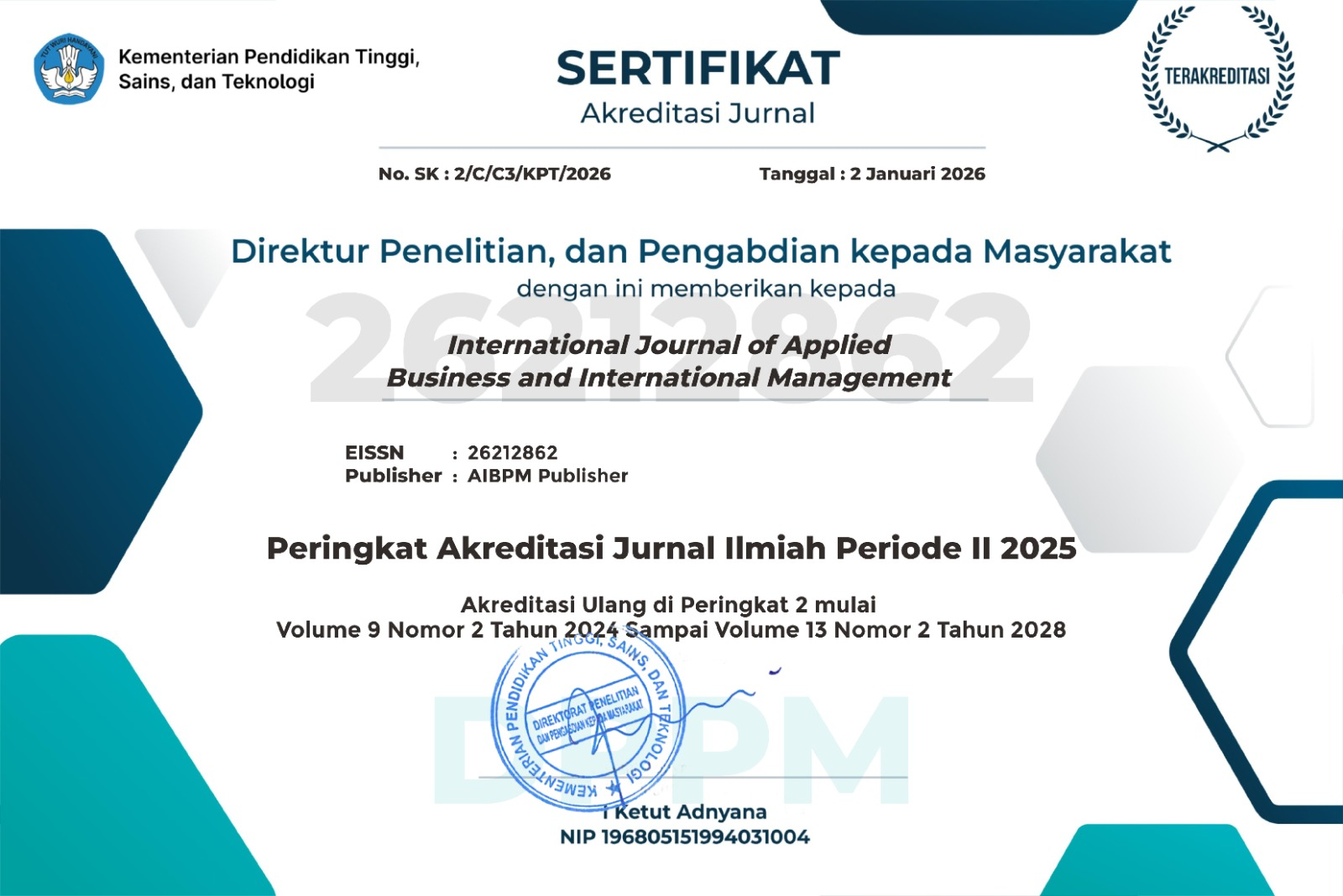
International Journal of Applied Business and International Management (IJABIM)
ISSN 2614-7432 (Print) | ISSN 2621-2862 (Online)
DOI Prefix: 10.32535 by CrossRef
Published by AIBPM Publisher
JL. Kawi No. 23, Bareng, Kec. Klojen, Kota Malang, Jawa Timur, Indonesia
Email: journal.ijabim@gmail.com
Phone: +62 341 366222
Website: https://aibpmpublisher.com/
Governed by
Association of International Business and Professional Management
Email: admin@aibpm.org
Website: https://www.aibpm.org/


Licensing Information

The International Journal of Applied Business and International Management (IJABIM) is licensed under a Creative Commons Attribution-NonCommercial-ShareAlike 4.0 International License .
Follow Us:

