






 Email this article
 Integrating Tri Hita Karana into Entrepreneurial Orientation for Business Sustainability in Balinese MSMEs
Abstract
Business sustainability often varies depending on cultural perspectives. This study aims to explore business sustainability through the lens of entrepreneurial orientation practices, specifically from the Tri Hita Karana (THK) cultural perspective in Bali. The research employs a qualitative approach, with respondents including owners and managers of Micro, Small, and Medium Enterprises (MSMEs), community leaders, and academics from Bali. The findings of the study reveal that business sustainability, as seen through the THK cultural perspective in Bali, encompasses entrepreneurial orientation practices such as maintaining a harmonious relationship with God by seeking taksu, fostering harmonious relationships with others through memyamabraya, and protecting the natural environment and its resources by safeguarding the earth. Business sustainability, viewed through the lens of cultural values, can help maintain long-term business viability in Bali; however, it tends not to promote growth at the scale of larger companies. The findings of this study indicate that MSMEs in Bali, with a deep understanding of their culture, tend to preserve traditional business practices, which, while sustainable, often hinder the transition to larger-scale enterprises. The results provide insights for policymakers in designing culturally grounded strategies to enhance both the sustainability and growth potential of MSMEs.
Keywords
Full Text:
PDFReferences
Ajzen, I. (1991). The theory of planned behavior. Organizational behavior and human decision processes, 50(2), 179-211. https://doi.org/10.1016/0749-5978(91)90020-T
Alam, F., Ullah, A., Khan, N. A., Khan, M. S., Arafat, M. Y., & Saleem, I. (2024). Drivers of female entrepreneurship in Asian economies: A panel data analysis. Cogent Business & Management, 11(1). https://doi.org/10.1080/23311975.2024.2353223
Anin, E. K., Etse, D., Okyere, G. A., & Adanfo, D. B. Y. (2024). Green entrepreneurial orientation and firm performance: Do green purchasing and supply chain integration matter? Cogent Business & Management, 11(1). https://doi.org/10.1080/23311975.2024.2377762
Assoratgoon, W., & Kantabutra, S. (2023). Toward a sustainability organizational culture model. Journal of Cleaner Production, 400, 136666. https://doi.org/10.1016/j.jclepro.2023.136666
Bandura, A. (2001). Social cognitive theory: An agentic perspective. Annual Review of Psychology, 52(1), 1-26. https://doi.org/10.1146/annurev.psych.52.1.1
Bandura, A. (2006). Toward a psychology of human agency. Perspectives on Psychological Science, 1(2), 164-180. https://doi.org/10.1111/j.1745-6916.2006.00011.x
Bangguiyac, G. D., & Castañeda, M. O. (2025). Entrepreneurial leadership and business performance of MSMEs: The mediating role of government support. International Journal of Applied Business & International Management, 10(2), 313-329. https://doi.org/10.32535/ijabim.v10i2.4079
Bashokuh-E-Ajirloo, M., Khodapanah, B., Alizadeh, M., & Ebrahimzadeh, M. (2023). Cultural values, entrepreneurial team structure and performance of SMEs. International Journal of Emerging Markets, 18(10), 3995-4013. https://doi.org/10.1108/IJOEM-06-2019-0459
Binalla, A. M. A. (2021). Cultural values and entrepreneurship: An enabling intervention for curriculum development and community extension services. Asia Pacific Journal of Educational Perspectives, 8(1), 88-93.
Bombiak, E., & Marciniuk-Kluska, A. (2019). Socially responsible human resource management as a concept of fostering sustainable organization-building: Experiences of young Polish companies. Sustainability, 11(4), 1044. https://doi.org/10.3390/su11041044
Calza, F., Cannavale, C., & Nadali, I. Z. (2020). How do cultural values influence entrepreneurial behavior of nations? A behavioral reasoning approach. International Business Review, 29(5), 101725. https://doi.org/10.1016/j.ibusrev.2020.101725
Chan, J. H., Hashim, I. H. M., Khoo, S. L., Lean, H. H., & Piterou, A. (2020). Entrepreneurial orientation of traditional and modern cultural organisations: Cases in George town UNESCO world heritage site. Cogent Social Sciences, 6(1). https://doi.org/10.1080/23311886.2020.1810889
Cho, J., & Trent, A. (2006). Validity in qualitative research revisited. Qualitative Research, 6(3), 319–340. https://doi.org/10.1177/1468794106065006
Dobbert, M. L. (1982). Ethnographic Research: Theory and Application for Modern Schools and Societies. Praeger.
Engidaw, A. E (2021). Exploring entrepreneurial culture and its socio-cultural determinants: In case of Woldia University graduating students. Journal of Innovationan Entrepreneurship, 10(12), 1–15. https://doi.org/10.1186/s13731-021-00155-7
Gunawan, A., Yuniarsih, T., Sobandi, A., & Muhidin, S. A. (2023). Digital leadership towards performance through mediation of organizational commitment to e-commerce in Indonesia. APTISI Transactions on Technopreneurship, 5(1SP), 68–76. https://doi.org/10.34306/att.v5i1Sp.325
Goncalves, M., Haidar, N., & Celik, E. (2024). Drivers and motivations of Lebanese women entrepreneurs: Insights from the demand-constraint-choice framework. Cogent Business & Management, 11(1). https://doi.org/10.1080/23311975.2024.2371068
Harmoni, A. (2013). Stakeholder-based analysis of sustainability report: A case study on mining companies in Indonesia. International Conference on Eurasian Economies 2013, 40, 204–210. https://doi.org/10.36880/c04.00704
Johri, A., Hisam, M. W., Asif, M., Khan, M. S., Faisal-E-Alam, Md., Arafat, M. Y., … Zaheer, A. (2024). Unveiling the dynamics of entrepreneurship among disadvantaged communities in developing economies: A cognitive perspective. Cogent Business & Management, 11(1). https://doi.org/10.1080/23311975.2024.2373352
Jonsson, S., & Ouyang, Q. (2023). Effects of cultural origin on entrepreneurship. Journal of Economic Behavior & Organization, 216, 308-319. https://doi.org/10.1016/j.jebo.2023.10.026
Krishna, S. M., & Agrawal, S. (2026). Entrepreneurial intentions: The role of gender and culture in entrepreneurial education. Administrative Sciences, 16(1), 38. https://doi.org/10.3390/admsci16010038
Laksmi, K. W., Purbawangsa, I. B. A., Baskara, I. G. K., & Artini, L. G. S. (2024). The role of culture in business sustainability in resource based theory: A comprehensive review. Jurnal Ilmu Sosial dan Humaniora, 13(3), 583-601. https://doi.org/10.23887/jish.v13i3.80726
Lumpkin, G. T., & Dess, G. G. (1996). Clarifying the entrepreneurial orientation construct and linking it to performance. Academy of Management Review, 21(1), 135-172. https://doi.org/10.5465/amr.1996.9602161568
Mahrinasari, M. S., Bangsawan, S., & Sabri, M. F. (2024). Local wisdom and Government's role in strengthening the sustainable competitive advantage of creative industries. Heliyon, 10(10). https://doi.org/10.1016/j.heliyon.2024.e31133
Manjrekar, S. M. (2017, March). Study of sustainability practices ingrained in Indian culture. In 5th International Conference on Civil, Architecture, Environment and Waste Management (CAEWM-17) (Vol. 17758).
Miura, Y. (2024). Entrepreneurial orientation and national culture in Thailand: A case of three generations of a Thai SME. Journal of the International Council for Small Business, 5(4), 390-401. https://doi.org/10.1080/26437015.2024.2370419
Mukhtar, S., Wardana, L. W., Wibowo, A., & Narmaditya, B. S. (2021). Does entrepreneurship educationand culture promote students’ entrepreneurial intention? The mediating role of entrepreneurial mindset. Cogent Education, 8(1). https://doi.org/10.1080/2331186X.2021.1918849
Naderifar, M., Goli, H., & Ghaljaie, F. (2017). Snowball sampling: A purposeful method of sampling in qualitative research. Strides in Development of Medical Education, 14(3), 1–6. https://doi.org/10.5812/sdme.67670
Osterhammel, J. (1987). Varieties of social economics: Joseph A. Schumpeter and Max Weber. In W. J. Mommsen & J. Osterhammel (Eds.), Max Weber and His Contemporaries (pp. 106-120). Allen & Unwin.
Parameswara, A. (2024). Evaluating intangible cultural heritage policy of Balinese handwoven textiles. Mudra Jurnal Seni Budaya, 39(2), 244-253. https://doi.org/10.31091/mudra.v39i2.2582
Parameswara, A., & Wulandari, A. (2020). Sustaining local communities through cultural industries based on local wisdom in Tigawasa village. Journal of Sustainable Development, 13(6), 139-150. https://doi.org/10.5539/jsd.v13n6p139
Parameswara, A., Saskara, I. A. N., Utama, M. S., & Setyari, N. P. W. (2021). The role of place identity, local genius, orange economy and cultural policies for sustainability of intangible cultural heritage in Bali. International Journal of Sustainable Development & Planning, 16(8). https://doi.org/10.18280/ijsdp.160816
Peretz, H. (2024). Sustainable human resource management and employees’ performance: The impact of national culture. Sustainability, 16(17), 7281. https://doi.org/10.3390/su16177281
Pertiwi, I. D. A. E., Kristiantari, I. D. A., & Sutapa, I. N. (2023). The meaning of Badung traditional market traders accounting practices in Tri Hita Karana cultural value. Journal of Economics, Finance and Management Studies, 6(11), 5267-5279. https://doi.org/10.47191/jefms/v6-i11-01
Purbiyati, Y. S., & Andrew, R. (2025). The moderating role of digital transformation on the influence of workplace spirituality and sustainable leadership on school organizational performance. International Journal of Applied Business & International Management, 10(3), 445-463. https://doi.org/10.32535/ijabim.v10i3.4237
Santosa, E. B., Dinan, R., & Lion, J. C. L. (2023, November). Socio-cultural transformation aspects of the local sustainability from a traditional community in the protected area. In IOP Conference Series: Earth and Environmental Science (Vol. 1218, No. 1, p. 012006). IOP Publishing. https://doi.org/10.1088/1755-1315/1218/1/012006
Setini, M., Januarianta, I. K., Indiani, N. L. P., & Putra, I. B. U. (2025). The role of customer satisfaction in mediating the influence of service quality and price on customer loyalty in retail companies. International Journal of Management and Digital Business, 4(2), 115-136. https://doi.org/10.54099/ijmdb.v4i2.1597
Singh, S. K., Del Giudice, M., Chierici, R., & Graziano, D. (2020). Green innovation and environmental performance: The role of green transformational leadership and green human resource management. Technological Forecasting and Social Change, 150, 119762. https://doi.org/10.1016/j.techfore.2019.119762
Sitiari, N. W., Datrini, L. K., & Giri, N. P. R. (2021). Exploration of human resources (HR) practices based on local cultural values in cooperatives in Bali. International Journal of Social Science and Human Research, 4(09), 2435-2441. https://doi.org/10.47191/ijsshr/v4-i9-24
Sitiari, N. W., Datrini, L. K., & Sarmawa, I. W. G. (2023). Determinant sustainability business perspective of the Tri Hita Karana (THK) concept for MSMEs in Bali. World Wide Journal of Multidisciplinary Research and Development, 9(7), 62-68.
Soleh, A., Kresnawati, K., Mulyana, A., Setini, M., & Wahyudi, H. (2025). Inclusive growth in Indonesia: An environmental sustainability approach. EKOMBIS REVIEW: Jurnal Ilmiah Ekonomi dan Bisnis, 13(4), 3473-3484. https://doi.org/10.37676/ekombis.v13i4.9282
Stephenson, J. (2023). Culture and Sustainability: Exploring Stability and Transformation with the Cultures Framework. Springer Nature. https://doi.org/10.1007/978-3-031-25515-1
Suwetha, I. G. N. (2015). Tri Hita Karana concept (local wisdom as an alternative in environment based development towards ‘green government’). The International Journal of Social Sciences, 33(1), 44-55.
Weber, M. (1948). The Theory of Social and Economic Organization. Oxford University Press.
Widyastuti, M., Ferdinand, D. Y. Y., & Kunang, M. Z. N. (2025). Financial performance and business sustainability through financial literacy and inclusion among East Java MSME Actors. International Journal of Applied Business & International Management, 10(2), 294-312. https://doi.org/10.32535/ijabim.v10i2.4017
Yusoff, Y. M., Nejati, M., Kee, D. M. H., & Amran, A. (2020). Linking green human resource management practices to environmental performance in hotel industry. Global Business Review, 21(3), 663-688. https://doi.org/10.1177/0972150918779294
Zhang, X., Zhao, J., & Gates, M. (2025, May). The Impact of National Culture on Entrepreneurship: Evidence from Five-Year Pooled Data Across 93 Countries. In 2nd International Conference on Educational Development and Social Sciences (EDSS 2025) (pp. 563-580). Atlantis Press. https://doi.org/10.2991/978-2-38476-400-6_67
DOI: https://doi.org/10.32535/ijabim.v11i1.4521
Refbacks
- There are currently no refbacks.

Copyright (c) 2026 Ni Wayan Sitiari, Made Setini, Anik Puspa Ningsih, Cok. Krisna Yuda

This work is licensed under a Creative Commons Attribution-NonCommercial-ShareAlike 4.0 International License.
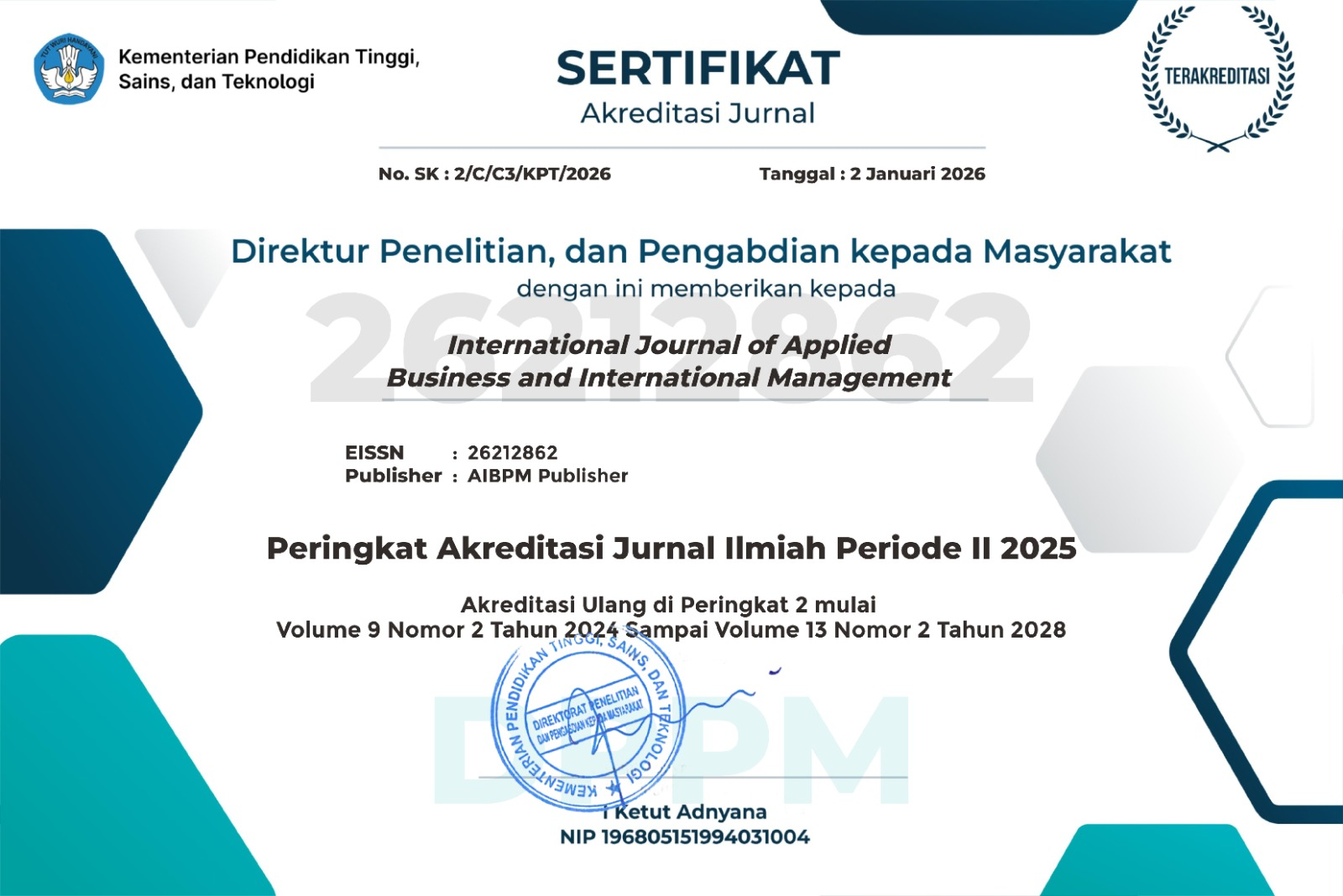
International Journal of Applied Business and International Management (IJABIM)
ISSN 2614-7432 (Print) | ISSN 2621-2862 (Online)
DOI Prefix: 10.32535 by CrossRef
Published by AIBPM Publisher
JL. Kawi No. 23, Bareng, Kec. Klojen, Kota Malang, Jawa Timur, Indonesia
Email: journal.ijabim@gmail.com
Phone: +62 341 366222
Website: https://aibpmpublisher.com/
Governed by
Association of International Business and Professional Management
Email: admin@aibpm.org
Website: https://www.aibpm.org/


Licensing Information

The International Journal of Applied Business and International Management (IJABIM) is licensed under a Creative Commons Attribution-NonCommercial-ShareAlike 4.0 International License .
Follow Us:

