






 Email this article
 Digital Transformation, HR Upskilling, and Digital Performance: The Moderating Role of Individual Readiness
Abstract
Digital transformation has become essential for competitiveness; however, its effectiveness depends on employees' digital competencies and readiness for change. This study examines the effects of digital transformation and HR upskilling on employees' digital performance and investigates the moderating role of individual readiness in the hospitality industry in Bali, Indonesia. A quantitative explanatory approach was employed using survey data collected from 200 hospitality employees. The data were analyzed using Partial Least Squares Structural Equation Modeling (PLS-SEM). The results indicate that digital transformation significantly improves digital performance (b = 0.412, p < 0.001), while HR upskilling also has a positive and significant effect (b = 0.356, p < 0.001). Furthermore, individual readiness strengthens the relationship between digital transformation and digital performance (b = 0.167, p = 0.009) as well as the relationship between HR upskilling and digital performance (b = 0.142, p = 0.035). These findings highlight that technological investment should be accompanied by continuous competency development and employee readiness to maximize digital performance, while offering theoretical and managerial insights for effective digital transformation strategies in hospitality organizations.
Keywords
Full Text:
PDFReferences
Alshagawi, M., & Mabkhot, H. (2024). The impact of strategic entrepreneurship, entrepreneurial marketing, and entrepreneurship values on small and medium enterprises' performance: Evidence from Saudi Arabia. Cogent Business & Management, 11(1), 2316947. https://doi.org/10.1080/23311975.2024.2316947
Becker, G. S. (1964). Human Capital: A Theoretical and Empirical Analysis, With Special Reference to Education. National Bureau of Economic Research.
Binsar, F., Mursitama, T. N., Hamsal, M., & Rahim, C. W. (2024). Determinants of digital adoption capability for service performance in Indonesian hospitals: A conceptual model. Journal of Systems and Management Sciences, 14(2), 188–213. https://doi.org/10.33168/JSMS.2024.0212
Gana, F., Lay, E., Dethan, F. M., & Foeh, R. (2024). Service digitalization innovation model as development strategy and policy at Bank NTT Indonesia. Journal of Infrastructure, Policy and Development, 8(8), 3053. https://doi.org/10.24294/jipd.v8i8.3053
Gkika, E. C., & Kargas, A. (2025). Unveiling digital maturity: Key drivers of digital transformation in the Greek business ecosystem. Administrative Sciences, 15(3), 96. https://doi.org/10.3390/admsci15030096
Gontur, S., Seyi, A. O., Bakshak, Y. S., & Awoena, F. D. (2023). Do digital marketing impact business performance? Emerging views from managers and owners of micro, small and medium-scale enterprises in Nigeria. Journal of Business & Management, 1(3), 206–224. https://doi.org/10.47747/jbm.v1i3.1143
Hair, J. F., Hult, G. T. M., Ringle, C. M., Sarstedt, M., Danks, N. P., & Ray, S. (2021). Partial Least Squares Structural Equation Modeling (PLS-SEM) Using R: A Workbook. Springer Nature.
Hanandeh, A., Haddad, E., Najdawi, S., & Kilani, Q. (2024). The impact of digital marketing, social media, and digital transformation on the development of digital leadership abilities and the enhancement of employee performance: A case study of the Amman Stock Exchange. International Journal of Data and Network Science, 8(3), 1915–1928. https://doi.org/10.5267/j.ijdns.2024.1.021
Hasani, T., Rezania, D., & Mohammadi, M. (2024). Towards a framework for successful metaverse adoption in small and medium-sized enterprises: An exploratory study. International Journal of Engineering Business Management, 16, 1–34. https://doi.org/10.1177/18479790241257118
Hendijani, R. B., & Jaszus, K. (2024). The rise of virtual food tourism experiences: Integrating diffusion of innovation theory and self-determination theory. Tourism and Hospitality Management, 30(2), 249–258. https://doi.org/10.20867/thm.30.2.8
Jamil, M. I. M. (2024). A discourse of the underlying concepts of digital transformation for MSMEs. In Digital Technologies in Modeling and Management: Insights in Education and Industry (pp. 1–20). IGI Global. https://doi.org/10.4018/978-1-6684-9576-6.ch001
Jara-Amézaga, C. (2023). The impact of YouTube in tourism destinations: A methodological proposal to qualitatively measure image positioning—Case: Saudi Arabia. Sustainability, 15(13), 9879. https://doi.org/10.3390/su15139879
Jia, Y., Cui, L., Su, J., Wu, L., Akter, S., & Kumar, A. (2024). Digital servitization in digital enterprise: Leveraging digital platform capabilities to unlock data value. International Journal of Production Economics, 278, 109434. https://doi.org/10.1016/j.ijpe.2024.109434
Komala, A. R., & Firdaus, D. W. (2023). Improving the quality of financial statements and the survival of MSMEs through the digital economy: The case of Indonesia and Malaysia. Journal of Eastern European and Central Asian Research, 10(5), 752–763. https://doi.org/10.15549/jeecar.v10i5.1435
Lazzeretti, L., Oliva, S., Innocenti, N., & Capone, F. (2025). Rethinking culture and creativity in the digital transformation. European Planning Studies, 33(5), 671–679. https://doi.org/10.1080/09654313.2022.2052018
Lee, C., & Hallak, R. (2020). Investigating the effects of offline and online social capital on tourism SME performance: A mixed-methods study of New Zealand entrepreneurs. Tourism Management, 80, 104128. https://doi.org/10.1016/j.tourman.2020.104128
Li, J., Zhang, G., Ned, J. P., & Sui, L. (2023). How does digital finance affect green technology innovation in the polluting industry? Based on the serial two-mediator model of financing constraints and research and development (R&D) investments. Environmental Science and Pollution Research, 30(29), 74141–74152. https://doi.org/10.1007/s11356-023-27593-y.
Martadiani, A. A. M., Setini, M., Asih, D., & Wiradarma, M. P. S. (2026). Moderating role of Tri Hita Karana on work systems, engagement, and turnover intention in Bali hospitals. International Journal of Applied Business & International Management, 11(1), 86–102. https://doi.org/10.32535/ijabim.v11i1.4348
Mollah, M. A., Amin, M. B., Debnath, G. C., Hosain, M. S., Rahaman, M. A., & Abdullah, M. (2024). Nexus among digital leadership, digital transformation, and digital innovation for sustainable financial performance: Revealing the influence of environmental dynamism. Sustainability, 16(18), 8023. https://doi.org/10.3390/su16188023
Mushi, H. M. (2024). Digital marketing strategies and SMEs performance in Tanzania: insights, impact, and implications. Cogent Business and Management, 11(1), 2415533. https://doi.org/10.1080/23311975.2024.2415533
Putra, I. B. U., Setini, M., Udayana, I. B. N., Soelton, M., & Sarmento, O. I. R. (2026). Artificial intelligence in HRM: Threat or opportunity for employee engagement? Asia Pacific Journal of Management and Education, 9(1), 39–56. https://doi.org/10.32535/apjme.v9i1.4346
Sarala, R. M., Post, C., Doh, J., & Muzio, D. (2025). Advancing research on the future of work in the age of artificial intelligence (AI). Journal of Management Studies, 62(5), 1863–1884. https://doi.org/10.1111/joms.13195
Setia, P., Venkatesh, V., & Joglekar, S. (2013). Leveraging digital technologies: How information quality leads to localized capabilities and customer service performance. MIS Quarterly: Management Information Systems, 37(2), 565–590. https://doi.org/10.25300/MISQ/2013/37.2.11
Shebeen, T. M., Shanthi, R., & Mathiyarasan, M. (2024). Navigating industry 4.0: Skill development strategies for empowering MSMEs in the digital age. In Anticipating Future Business Trends: Navigating Artificial Intelligence Innovations: Volume 2 (pp. 453-462). Springer Nature Switzerland. https://doi.org/10.1007/978-3-031-63402-4_38
Siddiqui, F., Yusheng, K., Ravina-Ripoll, R., & Aden, A. S. (2024). Dynamic firm performance: Entrepreneurship, knowledge, social media, customer relationship management, environment. South African Journal of Business Management, 55(1), 4346. https://doi.org/10.4102/sajbm.v55i1.4346
Sitiari, N. W., Setini, M., Ningsih, A. P., & Yuda, C. K. (2026). Integrating Tri Hita Karana into entrepreneurial orientation for business sustainability in Balinese MSMEs. International Journal of Applied Business & International Management, 11(1), 62–85. https://doi.org/10.32535/ijabim.v11i1.4521
Sultana, R., Alam, M. Z., & Hasan, N. (2025). Understanding the emerging success factors gap of accounting information systems in developing countries – A systematic literature review. Journal of Accounting Literature. https://doi.org/10.1108/JAL-05-2024-0086
Tornatzky, L. G., & Fleischer, M. (1990). The Processes of Technological Innovation. Lexington Books.
DOI: https://doi.org/10.32535/ijabim.v11i2.4523
Refbacks
- There are currently no refbacks.

Copyright (c) 2026 Gede Suardana, Made Setini, Sukmawati Sukmawati, Ahmad Soleh, I Dewa Nyoman Arta Jiwa

This work is licensed under a Creative Commons Attribution-NonCommercial-ShareAlike 4.0 International License.
International Journal of Applied Business and International Management (IJABIM)
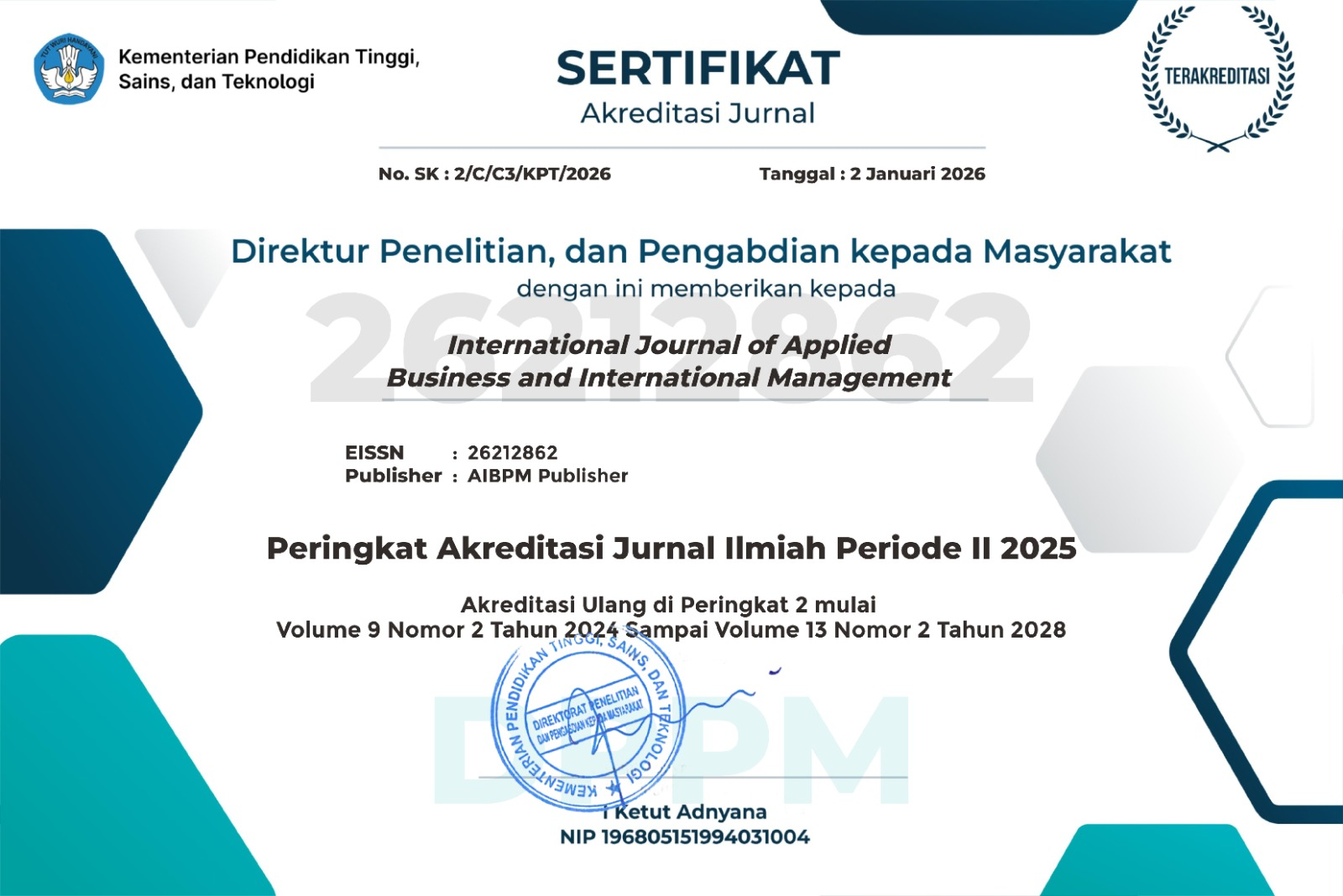
ISSN 2614-7432 (Print) | ISSN 2621-2862 (Online)
DOI Prefix: 10.32535 by CrossRef
Published by AIBPM Publisher
JL. Kawi No. 23, Bareng, Kec. Klojen, Kota Malang, Jawa Timur, Indonesia
Email: journal.ijabim@gmail.com
Phone: +62 341 366222
Website: https://aibpmpublisher.com/
Governed by
Association of International Business and Professional Management
Email: admin@aibpm.org
Website: https://www.aibpm.org/


Licensing Information

The International Journal of Applied Business and International Management (IJABIM) is licensed under a Creative Commons Attribution-NonCommercial-ShareAlike 4.0 International License .
Follow Us:

