






 Email this article
 Leverage and Firm Size Moderate ESG Financial Distress Nexus in Developing Asia Pacific Energy Firm
Abstract
The relationship between ESG performance and financial distress remains underexplored in developing Asia?Pacific energy markets, particularly regarding the contextual factors that may strengthen or weaken this link.
This study examines the direct effect of ESG on financial distress and investigates the moderating roles of leverage and firm size.
Using a sample of 88 energy companies from 12 developing Asia?Pacific economies over 2019–2024, panel data from LSEG are analysed with fixed effects regression. Financial distress is measured by Altman’s Z”?Score, ESG by the Refinitiv ESG Combined Score (lagged one year), leverage by debt?to?assets ratio, and firm size by natural log of total assets.
ESG performance has a positive and significant direct effect on Z”?Score, indicating reduced financial distress. Leverage negatively moderates this relationship (ESG×Leverage: ? = –0.0451, p < 0.01), meaning that high debt weakens the protective effect of ESG. Firm size positively moderates the relationship (ESG×Size: ? = 0.0204, p < 0.05); larger firms benefit more from ESG in lowering distress risk.
ESG reduces financial distress, but the effect is conditional on capital structure and scale. Managers should integrate ESG with deleveraging strategies, especially for smaller firms. Investors and policymakers in developing Asia?Pacific countries should consider these moderators when evaluating ESG?related risk and designing sustainability incentives.
Keywords
Full Text:
PDFReferences
Aiken, L. S., & West, S. G. (1991). Multiple regression: Testing and interpreting interactions. Sage Publications.
Alareeni, B. A., & Hamdan, A. (2020). ESG impact on performance of US S&P 500-listed firms. Corporate Governance: The International Journal of Business in Society, 20(7), 1409–1428. https://doi.org/10.1108/CG-06-2020-0258
Altman, E. I., Hartzell, J., & Peck, M. (1995). Emerging markets corporate bonds: A scoring system. Salomon Brothers Inc.
https://doi.org/10.1007/978-1-4615-6197-2_25
Altman, E. I., & Hotchkiss, E. (2006). Corporate financial distress and bankruptcy: Predict and avoid bankruptcy, analyze and invest in distressed debt (3rd ed.). John Wiley & Sons.https://doi.org/10.1002/9781118267806
Arouri, M., El Ghoul, S., & Gomes, M. (2021). ESG performance and firm value: The moderating role of board diversity. Journal of Business Ethics, 168(3), 481–502. https://doi.org/10.1007/s10551-019-04172-5
Aswani, J., Raghunandan, A., & Rajgopal, S. (2024). Are ESG shareholders sacrificing returns? Review of Accounting Studies, 29(1), 123–167.
Atan, R., Alam, M. M., Said, J., & Zamri, M. (2018). The impacts of environmental, social, and governance factors on firm performance: Panel study of Malaysian companies. Management of Environmental Quality: An International Journal, 29(2), 182–194.https://doi.org/10.1108/MEQ-03-2017-0033
Baltagi, B. H. (2021). Econometric analysis of panel data (6th ed.). Springer.https://doi.org/10.1007/978-3-030-53953-5
Beaver, W. H., McNichols, M. F., & Rhie, J. W. (2005). Have financial statements become less informative? Evidence from the ability of financial ratios to predict bankruptcy. Review of Accounting Studies, 10(1), 9–40.
Berg, F., Kölbel, J. F., & Rigobon, R. (2022). Aggregate confusion: The divergence of ESG ratings. Review of Finance, 26(6), 1315–1344.https://doi.org/10.1093/rof/rfac033
Boubaker, S., Cellier, A., Manita, R., & Saeed, A. (2020). Does corporate social responsibility reduce financial distress risk? Economic Modelling, 91, 835–851.https://doi.org/10.1016/j.econmod.2020.05.012
Christensen, D. M., Serafeim, G., & Sikochi, A. (2022). Why is corporate virtue in the eye of the beholder? The case of ESG ratings. The Accounting Review, 97(1), 147–175. https://doi.org/10.2308/TAR-2019-0506
Connelly, B. L., Certo, S. T., Ireland, R. D., & Reutzel, C. R. (2011). Signaling theory: A review and assessment. Journal of Management, 37(1), 39–67.https://doi.org/10.1177/0149206310388419
Dang, C., Li, Z. F., & Yang, C. (2018). Measuring firm size in empirical corporate finance. Journal of Banking & Finance, 86, 159–176.https://doi.org/10.1016/j.jbankfin.2017.09.006
Deegan, C. (2002). Introduction: The legitimising effect of social and environmental disclosures – a theoretical foundation. Accounting, Auditing & Accountability Journal, 15(3), 282–311.https://doi.org/10.1108/09513570210435852
Duan, Y., El Ghoul, S., Guedhami, O., Li, H., & Li, X. (2023). Corporate social responsibility and bank risk. Journal of Financial Stability, 64, 101105.
Duque-Grisales, E., & Aguilera-Caracuel, J. (2021). Environmental, social and governance (ESG) scores and financial performance of multilatinas: Moderating effects of geographic international diversification and financial slack. Journal of Business Ethics, 168(2), 315–334.
Frank, M. Z., & Goyal, V. K. (2009). Capital structure decisions: Which factors are reliably important? Financial Management, 38(1), 1–37.https://doi.org/10.1111/j.1755-053X.2009.01026.x
Freeman, R. E. (1984). Strategic management: A stakeholder approach. Pitman.https://doi.org/10.1017/CBO9780511815768
Friede, G., Busch, T., & Bassen, A. (2015). ESG and financial performance: Aggregated evidence from more than 2000 empirical studies. Journal of Sustainable Finance & Investment, 5(4), 210–233.https://doi.org/10.1080/20430795.2015.1118917
Saini, M., & Aggarwal, V. (2023). ESG and financial variables: a systematic review. International Journal of Law and Management, 65(6), 663–682.https://doi.org/10.1108/IJLMA-02-2023-0033
Shumway, T. (2001). Forecasting bankruptcy more accurately: A simple hazard model. The Journal of Business, 74(1), 101–124.http://dx.doi.org/10.2139/ssrn.171436)
Spence, M. (1973). Job market signaling. The Quarterly Journal of Economics, 87(3), 355–374.https://doi.org/10.2307/1882010
Suchman, M. C. (1995). Managing legitimacy: Strategic and institutional approaches. Academy of Management Review, 20(3), 571–610.https://doi.org/10.5465/amr.1995.9508080331
Trisnawati, R., Mardiyah, A. A., & Harymawan, I. (2022). ESG disclosure and financial performance in ASEAN energy companies. Jurnal Akuntansi dan Keuangan Indonesia, 19(1), 45–62.
Wooldridge, J. M. (2010). Econometric analysis of cross section and panel data (2nd ed.). MIT Press.https://doi.org/10.1111/j.1368-423X.2011.00351.x
DOI: https://doi.org/10.32535/ijabim.v11i2.4604
Refbacks
- There are currently no refbacks.

Copyright (c) 2026 Budi Rustandi Kartawinata, Dian Kurnianingrum, Diki Wahyu Nugraha

This work is licensed under a Creative Commons Attribution-NonCommercial-ShareAlike 4.0 International License.
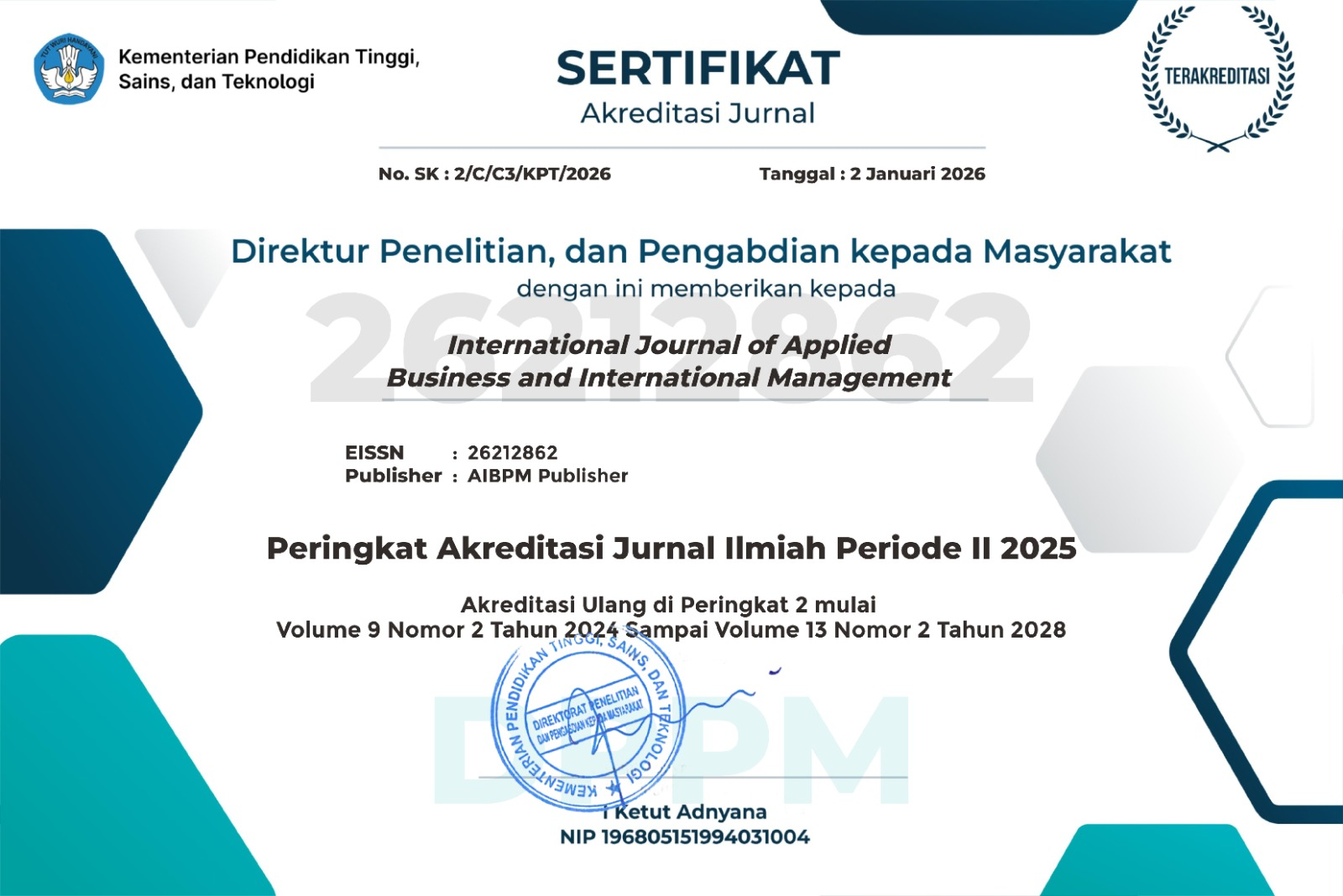
International Journal of Applied Business and International Management (IJABIM)
ISSN 2614-7432 (Print) | ISSN 2621-2862 (Online)
DOI Prefix: 10.32535 by CrossRef
Published by AIBPM Publisher
JL. Kawi No. 23, Bareng, Kec. Klojen, Kota Malang, Jawa Timur, Indonesia
Email: journal.ijabim@gmail.com
Phone: +62 341 366222
Website: https://aibpmpublisher.com/
Governed by
Association of International Business and Professional Management
Email: admin@aibpm.org
Website: https://www.aibpm.org/


Licensing Information

The International Journal of Applied Business and International Management (IJABIM) is licensed under a Creative Commons Attribution-NonCommercial-ShareAlike 4.0 International License .
Follow Us:

