






 Email this article
 An Exploration of Indonesian Generation Z's Values Toward Cruelty-Free Cosmetics
Abstract
Despite the growing popularity of ethical consumption, limited research has examined how Indonesian Generation Z perceives cruelty-free cosmetics. This study explores the values associated with cruelty-free cosmetics among Indonesian Generation Z using the Theory of Consumption Values. An exploratory qualitative approach was employed through purposive and snowball sampling. In-depth interviews with eleven participants investigated their perceptions of cruelty-free cosmetics and related brands. The findings reveal ethical value as an important context-specific consideration extending beyond the original dimensions of the theory, particularly regarding animal welfare and responsible consumption. Emotional value reflects personal feelings and alignment with ethical beliefs, while functional value emphasizes product quality, suitability, and price. Social media plays an important role in disseminating information and raising awareness, with influencers and government initiatives complementing consumer understanding. These findings offer practical insights for marketers and policymakers promoting cruelty-free cosmetics among younger consumers in emerging markets.
Keywords
Full Text:
PDFReferences
Amalia, F. R., & Darmawan, A. (2023). Exploring consumer purchase intention towards cruelty-free personal care products in Indonesia. Cleaner and Responsible Consumption, 11, 100136. https://doi.org/10.1016/j.clrc.2023.100136
Atay, A. & Ashlock, M. Z. (2022). Social media, technology and new generations: digital millennial generation and generation Z. Lexington Books. Retrieved from https://books.google.co.id/books?id=c6Z1EAAAQBAJ&printsec=frontcover&hl=id&source=gbs_ge_summary_r&cad=0#v=onepage&q&f=false
Berg, A., Hudson, A., Weaver, K., Pacchia, M. & Amed, I. (2023). The beauty market in 2023: A special State of Fashion report. McKinsey & Company. Retrieved from https://www.mckinsey.com/industries/retail/our-insights/the-beauty-market-in-2023-a-special-state-of-fashion-report
Bilgin, Y. (2018). The Effect of Social Media Marketing Activities on Brand Awareness, Brand Image and Brand Loyalty. Business & Management Studies: An International Journal, 6(1), 128-148. Retrieved from https://www.bmij.org/index.php/1/article/download/839.1/904/841
Blanco-Davila, F. (2000). Beauty and the Body: The Origins of Cosmetics. Plastic & Reconstructive Surgery, 105(3), 1196–1204. Retrieved from https://doi.org/10.1097/00006534-200003000-00058
Carroza, R. (2023). Understanding and reaching the new Gen Z & Millennial pet parents. Nova School of Business and Economics. 3. Retrieved from https://run.unl.pt/bitstream/10362/174315/1/2024_Fall_53715.pdf
Dakshayani, B. V. & Rajendran, M. (2024). A Study on Generation Z Consumer Buying Behavior Towards Green Cosmetic Products. Educational Administration: Theory and Practice, 30(4), 1260-1266. Retrieved from https://kuey.net/index.php/kuey/article/view/1645/812
Enginkaya, E. and Sa?lam, M.H. (2026) Exploring the ethical values and social drivers behind consumer preferences for cruelty-free products, Frontiers in Psychology https://doi.10.3389/fpsyg.2025.1660619
Grappe, C. G., Lombart, C., Louis, D., & Durif, F. (2021). “Not tested on animals”: How consumers react to cruelty-free cosmetics proposed by manufacturers and retailers? International Journal of Retail & Distribution Management, 49(11), 1532–1553. https://doi.org/10.1108/IJRDM-12-2020-0489
Halla, N., Fernandes, I. P., Heleno, S. A., Costa, P., Boucherit-Otmani, Z., Boucherit, K., Rodrigues, A. E., Ferreira, I. C. F. R. & Barreiro, M. F. (2018). Cosmetics Preservation: A Review on Present Strategies. Molecules, 23(7), 1571. Retrieved from https://doi.org/10.3390/molecules23071571
Khurana, T., Pannu, S., Dalal, G., Vyas, P., & Rani, P. (2025). How do social media influencers’ credibility and brand trust drive purchase intentions for green cosmetics? Insights from SOBC approach. NMIMS Management Review, 33(3), 171–185. https://doi.org/10.1177/09711023251352318
Kiger, M. E. & Varpio, L. (2020). Thematic analysis of qualitative data: AMEE Guide No. 131. Medical Teacher. Retrieved from https://doi.org/10.1080/0142159X.2020.1755030
Krosofsky, A. (2021). These Brutals Cosmetic Testing Methods Are Why We Need Cruelty Free Makeup. Green matters. Retrieved from https://www.greenmatters.com/p/how-is-makeup-tested-on-animals
Le-Hoang, P. V., & Nguyen, H. H. (2025). Key drivers of cruelty-free cosmetics: Mediating role of purchase intention. Emerging Science Journal, 9(2), 640–658. http://dx.doi.org/10.28991/ESJ-2025-09-02-08
Magano, J., Au-Yong-Oliveira, M., Ferreira, B., & Leite, A. (2022). A cross-sectional study on ethical buyer behavior towards cruelty-free cosmetics: What consequences for female leadership practices? Sustainability, 14(13), Artikel 7786. https://doi.org/10.3390/su14137786
Morel, S., Mura, G., Gallarate, M. & Sapino, S. (2024). Cosmetic Packaging: European Regulatory Aspects and Sustainability. Cosmetics, 11(10). Retrieved from https://doi.org/10.3390/
Mwita, K. M. (2022). Factors to consider when choosing data collection methods. International Journal of Research in Business and Social Science, 11(5), 532-538. Retrieved from https://doi.org/10.20525/ijrbs.v11i5.1842
Pettetta, F. & Ciccocioppo, R. (2020). Public perception of laboratory animal testing: Historical, philosophical and ethical view. Addiction Biology. Retrieved from https://doi.org/10.1111/adb.12991
Saunders, M., Lewis, P. & Thornhill, A. (2012). Research Methods for Business Students (6th ed). Harlow: Pearson Education Limited.
Sheth, J. N., Newman, B. I. & Gross, B. L. (1991). Why We Buy What We Buy: A Theory of Consumption Values. Journal of Business Research, 22, 159-170. Retrieved from http://dx.doi.org/10.1016/0148-2963(91)90050-8
Sun, J., Safdar, H., Jaffri, Z. A., Ibn-ul-Hassan, S. & Ozturk, I. (2022). Substantiating Nexus Between Consumption Values and Sustainable Consumption Behavior: A Way Toward Sustainable Business. Sec. Organizational Psychology, 13. Retrieved from https://doi.org/10.3389/fpsyg.2022.908391
Taima, A., Robin, G. & Nathalie, S. (2019). Factors Driving Purchase Intention for Cruelty-Free Cosmetics: A Study of Female Millennials in Jönköping, Sweden. International Management. Retrieved from https://www.diva-portal.org/smash/get/diva2:1320983/FULLTEXT01.pdf
Uusitalo, O. & Oksanen, R. (2004). Ethical consumerism: A view from Finland. International Journal of Consumer Studies, 28(3), 214-221. Retrieved from https://doi.org/10.1111/j.1470-6431.2003.00339.x
DOI: https://doi.org/10.32535/ijabim.v11i2.4751
Refbacks
- There are currently no refbacks.

Copyright (c) 2026 Dahlia Darmayanti

This work is licensed under a Creative Commons Attribution-NonCommercial-ShareAlike 4.0 International License.
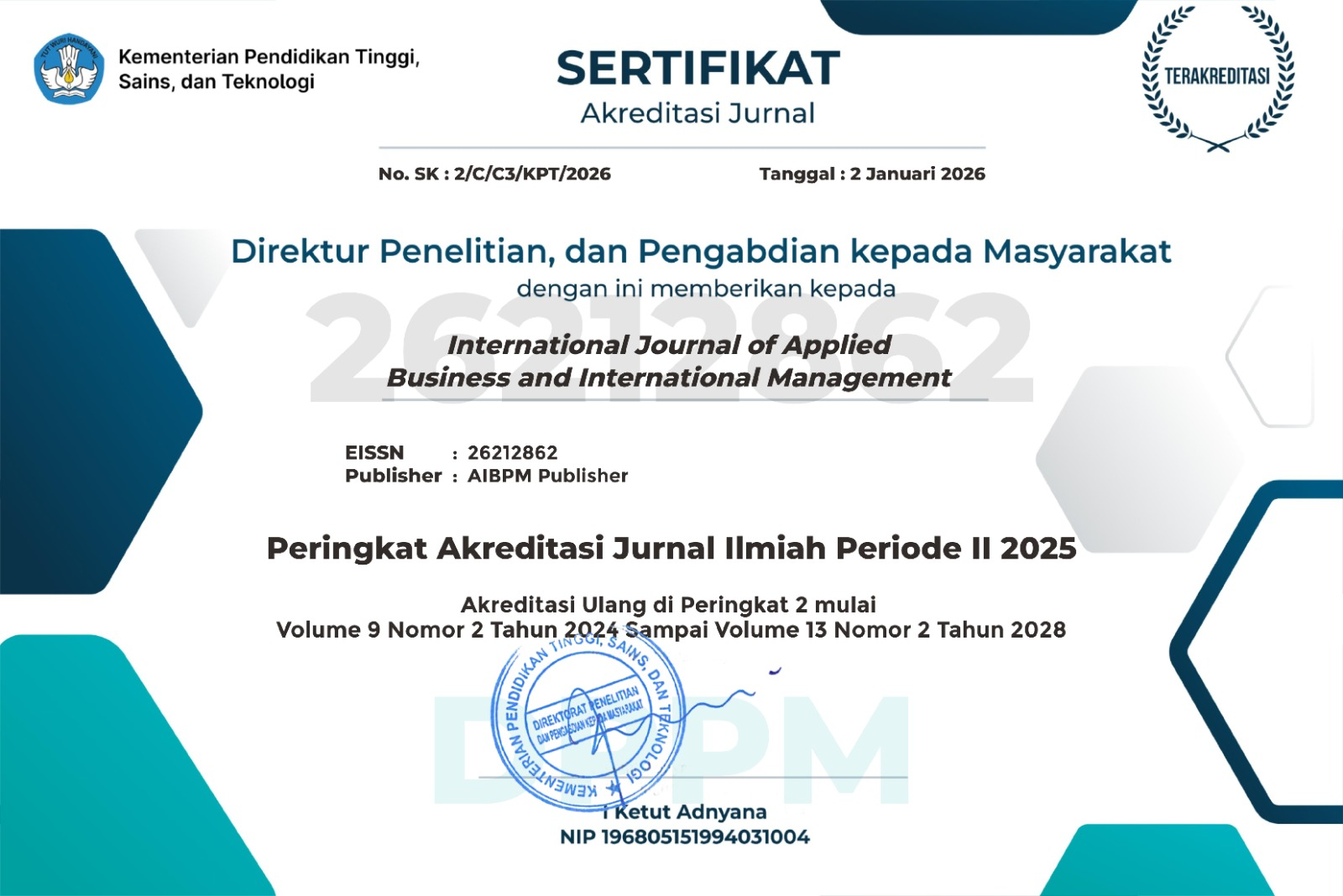
International Journal of Applied Business and International Management (IJABIM)
ISSN 2614-7432 (Print) | ISSN 2621-2862 (Online)
DOI Prefix: 10.32535 by CrossRef
Published by AIBPM Publisher
JL. Kawi No. 23, Bareng, Kec. Klojen, Kota Malang, Jawa Timur, Indonesia
Email: journal.ijabim@gmail.com
Phone: +62 341 366222
Website: https://aibpmpublisher.com/
Governed by
Association of International Business and Professional Management
Email: admin@aibpm.org
Website: https://www.aibpm.org/


Licensing Information

The International Journal of Applied Business and International Management (IJABIM) is licensed under a Creative Commons Attribution-NonCommercial-ShareAlike 4.0 International License .
Follow Us:

