






 Email this article
 Reframing Environmental Accounting Through Indigenous-Based Asset Valuation and Socio-Ecological Integration
Abstract
Conventional environmental accounting practices still have significant limitations because they mainly emphasize monetary valuation while neglecting the socio-cultural and ecological dimensions embedded in indigenous asset systems. This research aims to develop an indigenous-based asset valuation and environmental accounting model that integrates economic, ecological, and socio-cultural values within indigenous community enterprises. This study employs a mixed-methods approach using Participatory Action Research (PAR), combining qualitative techniques (in-depth interviews, participatory observation, and collective reflection) with quantitative valuation based on the Total Economic Value (TEV) framework. The findings reveal that indigenous assets are perceived as collective socio-ecological trusts, where non-use values, especially existence and bequest values, are central alongside direct and indirect use values. The study proposes an indigenous-based environmental accounting model that generates ecological financial statements covering natural resource assets, social and environmental liabilities, and non-financial reports. This model has practical implications for improving accountability, sustainability, and policy formulation in indigenous economic governance, but it is context-specific and requires adaptation for broader application in different indigenous settings.
Keywords
Full Text:
PDFReferences
Abhishek, N., Rahiman, H. U., Kulal, A., Kambali, U., & Panakaje, N. (2024). Sustainable strategies and business responsibility practices: An evidence from India. In Information and Communication Technology in Technical and Vocational Education and Training for Sustainable and Equal Opportunity (pp. 41–58). Springer Nature Singapore. https://doi.org/10.1007/978-981-99-6909-8_4
Abhishek, N., Suraj, N., Nayak, M., Kumar, K., Bhadeshiya, H., Kulal, A., & Divyashree, M. S. (2025). Carbon management accounting an evolving approach to enhance transparency and accountability in accounting and reporting practices. Journal of Accounting & Organizational Change, 21(3), 535-566. https://doi.org/10.1108/JAOC-05-2024-0156
Agrawal, A., & Benson, C. S. (2011). Common property theory and resource governance institutions: strengthening explanations of multiple outcomes. Environmental Conservation, 38(2), 199-210. https://doi.org/10.1017/S0376892910000925
Ashok, M. L., Abhishek, N., & Divyashree, M. S. (2019). Accounting for corporate social responsibility in India: An analysis of selected companies in India. Indian Journal of Accounting, 51(2), 19–26.
Bebbington, J., & Campbell, D. (2015). Economic democracy: Exploring ramifications for social and environmental accountants. Social and Environmental Accountability Journal, 35(2), 77-85. https://doi.org/10.1080/0969160X.2015.1054590
Burritt, R. L., Herzig, C., Schaltegger, S., & Viere, T. (2019). Diffusion of environmental management accounting for cleaner production: Evidence from some case studies. Journal of Cleaner Production, 224, 479–491. https://doi.org/10.1016/j.jclepro.2019.03.227
Bustos-Contell, E., Porcuna-Enguix, L., Serrano-Madrid, J., & Labatut-Serer, G. (2022). The influence of environmental accounting on business value. Journal of Business Research, 140, 324–331. https://doi.org/10.1016/j.jbusres.2021.11.003
Cerciello, M., Busato, F., & Taddeo, S. (2023). The effect of sustainable business practices on profitability: Accounting for strategic disclosure. Corporate Social Responsibility and Environmental Management, 30(2), 802–819. https://doi.org/10.1002/csr.2389
Chen, X., Weerathunga, P. R., Nurunnabi, M., Kulathunga, K. M. M. C. B., & Samarathunga, W. H. M. S. (2020). Influences of behavioral intention to engage in environmental accounting practices for corporate sustainability: Managerial perspectives from a developing country. Sustainability, 12(13), 5266. https://doi.org/10.3390/su12135266
Chowdhury, R. H. (2020). Accounting for data: A framework for valuing and reporting digital intangible assets. Journal of Frontiers in Multidisciplinary Research, 1(1), 16-23. https://doi.org/10.54660/.IJFMR.2020.1.1.16-23
Christensen, H. B., Hail, L., & Leuz, C. (2021). Mandatory CSR and sustainability reporting: Economic analysis and literature review. Review of Accounting Studies, 26(3), 1176–1248. https://doi.org/10.1007/s11142-021-09609-5
Comello, S. D., Reichelstein, J., & Reichelstein, S. (2023). Corporate carbon reporting: Improving transparency and accountability. One Earth, 6(7), 803–810. https://doi.org/10.1016/j.oneear.2023.06.002
Costanza, R., Groot, R. D., Sutton, P., Ploeg, S. V. D., Anderson, S. J., Kubiszewski, I., ... & Turner, R. K. (2014). Changes in the global value of ecosystem services. Global Environmental Change, 26, 152-158. https://doi.org/10.1016/j.gloenvcha.2014.04.002
Dhar, B. K., Sarkar, S. M., & Ayittey, F. K. (2022). Impact of social responsibility disclosure between implementation of green accounting and sustainable development: A study on heavily polluting companies in Bangladesh. Corporate Social Responsibility and Environmental Management, 29(1), 71-78. https://doi.org/10.1002/csr.2174
Folke, C., Polasky, S., Rockström, J., Galaz, V., Westley, F., Lamont, M., ... & Walker, B. H. (2021). Our future in the Anthropocene biosphere. Ambio, 50(4), 834-869. https://doi.org/10.1007/s13280-021-01544-8
Fondevila, M. M., Moneva, J. M., & Scarpellini, S. (2019). Environmental disclosure and eco-innovation interrelation: The case of Spanish firms. Spanish Accounting Review, 22(1), 71–78. https://doi.org/10.6018/rcsar.22.1.354321
Hazaea, S. A., Al-Matari, E. M., Alosaimi, M. H., Farhan, N. H., Abubakar, A., & Zhu, J. (2023). Past, present, and future of carbon accounting: Insights from scholarly research. Frontiers in Energy Research, 10, 958362. https://doi.org/10.3389/fenrg.2022.958362
Khan, S., & Gupta, S. (2024). The interplay of sustainability, corporate green accounting and firm financial performance: A meta-analytical investigation. Sustainability Accounting, Management and Policy Journal, 15(5), 1038–1066. https://doi.org/10.1108/SAMPJ-01-2022-0016
Li, H., Kuo, Y. K., Mir, M. M., & Omar, M. (2022). Corporate social responsibility and environmental sustainability: Achieving firms sustainable performance supported by plant capability. Economic Research-Ekonomska Istraživanja, 35(1), 4580–4602. https://doi.org/10.1080/1331677X.2021.2015612
Maulana, M. F., & Prasetio, J. E. (2025). The effect of sustainability report, green accounting, and leverage on corporate values in energy sector companies. International Journal of Applied Business & International Management, 10(1), 36-51. https://doi.org/10.32535/ijabim.v10i1.3813
Milne, M. J., & Gray, R. (2013). W(h)ither ecology? The triple bottom line, the global reporting initiative, and corporate sustainability reporting. Journal of Business Ethics, 118(1), 13-29. https://doi.org/10.1007/s10551-012-1543-8
Mishra, T., Datta, P., & Behera, B. (2024). Corporate environmental responsibility, financial performance and environmental outcomes in India: A review. Discover Sustainability, 5(1), 213. https://doi.org/10.1007/s43621-024-00421-0
Mondal, M. S. A., Akter, N., Moni, S. J., & Polas, M. R. H. (2023). Financial and non-financial disclosures on sustainable development: The mediating role of environmental accounting disclosure practices. International Journal of Financial, Accounting, and Management, 5(3), 387–406. https://doi.org/10.35912/ijfam.v5i3.1702
Patma, K., & Kambuaya, M. K. P. (2024). Philosophy of Egek culture from the Moi tribe of Papua in exposing the concept of environmental accounting: A phenomenological study. International Journal of Tourism & Hospitality in Asia Pasific, 7(1), 126-140. https://doi.org/10.32535/ijthap.v7i1.2879
Patma, K., Sutapa, I. D. A., & Agustini, M. Y. D. H. (2025). Designing agroecology-based environmental accounting disclosures through agricultural asset valuation in indigenous community-owned business entities. Journal of the Community Development in Asia, 8(3), 506-522. https://doi.org/10.32535/jcda.v8i3.4155
Sameer, I. (2021). Impact of corporate social responsibility on organization’s financial performance: Evidence from Maldives public limited companies. Future Business Journal, 7(1), 29. https://doi.org/10.1186/s43093-021-00075-8
Scarpellini, S., Marín-Vinuesa, L. M., Aranda-Usón, A., & Portillo-Tarragona, P. (2020). Dynamic capabilities and environmental accounting for the circular economy in businesses. Sustainability Accounting, Management and Policy Journal, 11(7), 1129-1158. https://doi.org/10.1108/SAMPJ-04-2019-0150
Shakil, M. H., Mahmood, N., Tasnia, M., & Munim, Z. H. (2019). Do environmental, social and governance performance affect the financial performance of banks? A cross-country study of emerging market banks. Management of Environmental Quality: An International Journal, 30(6), 1331-1344. https://doi.org/10.1108/MEQ-08-2018-0155
Soomro, B. A., Elhag, G. M., Bhatti, M. K., Abdelwahed, N. A. A., & Shah, N. (2024). Developing environmental performance through sustainable practices, environmental CSR and behavioural intentions: An online approach during the COVID-19 pandemic. Social Responsibility Journal, 20(1), 59–80. https://doi.org/10.1108/SRJ-11-2021-0481
Sundarasen, S., Rajagopalan, U., & Alsmady, A. A. (2024). Environmental accounting and sustainability: A meta-synthesis. Sustainability, 16(21), 9341. https://doi.org/10.3390/su16219341
Weerathunga, P. R., Xiaofang, C., Nurunnabi, M., Kulathunga, K. M. M. C. B., & Swarnapali, R. M. N. C. (2020). Do the IFRS promote corporate social responsibility reporting? Evidence from IFRS convergence in India. Journal of International Accounting, Auditing and Taxation, 40, 100336. https://doi.org/10.1016/j.intaccaudtax.2020.100336
World Resources Institute. (2023). Indonesia’s Indigenous People Secure Forest and Land Rights. World Resources Institute. https://www.wri.org/outcomes/indonesias-indigenous-people-secure-forest-and-land-rights
DOI: https://doi.org/10.32535/ijabim.v11i1.4427
Refbacks
- There are currently no refbacks.

Copyright (c) 2026 Kurniawan Patma

This work is licensed under a Creative Commons Attribution-NonCommercial-ShareAlike 4.0 International License.
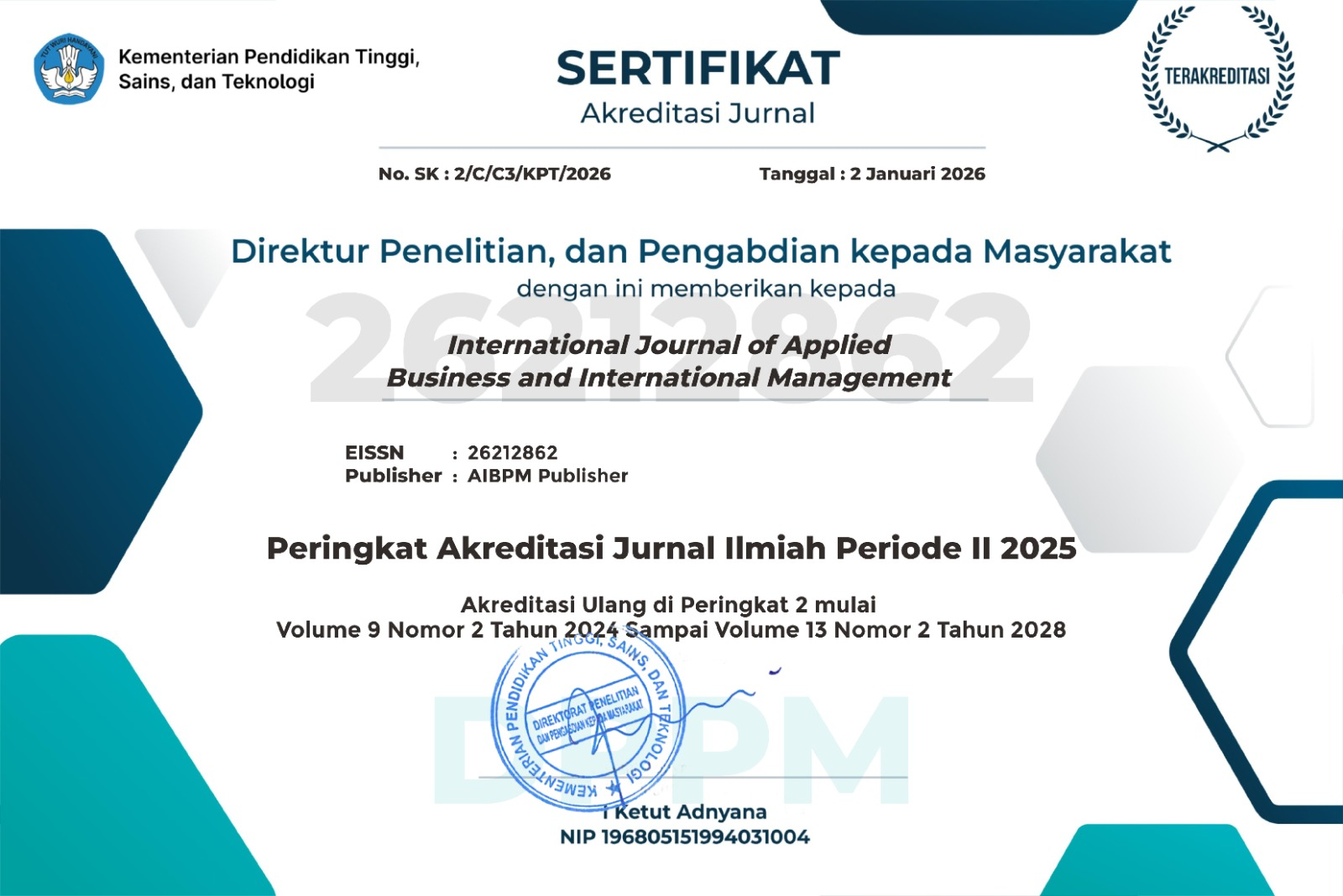
International Journal of Applied Business and International Management (IJABIM)
ISSN 2614-7432 (Print) | ISSN 2621-2862 (Online)
DOI Prefix: 10.32535 by CrossRef
Published by AIBPM Publisher
JL. Kawi No. 23, Bareng, Kec. Klojen, Kota Malang, Jawa Timur, Indonesia
Email: journal.ijabim@gmail.com
Phone: +62 341 366222
Website: https://aibpmpublisher.com/
Governed by
Association of International Business and Professional Management
Email: admin@aibpm.org
Website: https://www.aibpm.org/


Licensing Information

The International Journal of Applied Business and International Management (IJABIM) is licensed under a Creative Commons Attribution-NonCommercial-ShareAlike 4.0 International License .
Follow Us:

