






 Email this article
 Building Employee Performance through Ethical Leadership and Organizational Culture: The Mediating Role of Employee Ethical Behavior
Abstract
Employee performance is increasingly vital for organizations in the global era. This study investigates how ethical leadership and organizational culture influence employee performance, with employee ethical behaviour serving as a mediating variable. A quantitative approach was adopted, employing a survey method. The research population included all UT employees, and a sample of 175 respondents was drawn from the UT head office, UT Bandung, Jember, and Serang. Data analysis was conducted using Structural Equation Modelling (SEM) with Smart Partial Least Squares (SmartPLS). The results reveal that organisational culture has a positive and significant impact on employee ethical behaviour, whereas ethical leadership does not have a significant effect. Both employee ethical behaviour and organisational culture are found to enhance employee performance, while ethical leadership does not show a significant contribution. Additionally, organisational culture influences employee performance both directly and indirectly through ethical behaviour, while ethical leadership lacks a significant mediating effect. This study contributes new insights to the development of social learning and social exchange-based models by highlighting employee ethical behaviour as a key mechanism that elucidates the relationships among ethical leadership, organisational culture, and employee performance.
Keywords
Full Text:
PDFReferences
Adhari, I. Z. (2021). Optimalisasi kinerja karyawan menggunakan pendekatan knowledge management & motivasi kerja (Vol. 1). CV. Penerbit Qiara Media.
Afandi, P. (2021). Manajemen Sumber Daya Manusia; Teori, Konsep dan Indikator, Yogyakarta: Zanafa Publishing.
Alawiyah, D., Rahmat, H. K., & Pernanda, S. (2020). Menemukenali Konsep Etika dan Sikap Konselor Profesional dalam Bimbingan dan Konseling. Jurnal Mimbar: Media Intelektual Muslim Dan Bimbingan Rohani, 6(2), 84–101. https://doi.org/10.47435/mimbar.v6i2.457
Allaire, Y., & Firsirotu, M. E. (1984). Theories of Organizational Culture. Organization Studies, 5, 193-226.
Brown, M. E., Trevin˜o, L. K., & Harrison, D. A. (2005). Ethical leadership: A social learning perspective for construct development and testing. Organizational Behavior and Human Decision Processes, 97, 117–134.
Dessler, G. (2008). Manajemen Sumber Daya Manusia, Jilid 2. Alih Bahasa Paramita Rahayu.
Efendi, R. (2023). The Effect of Leadership Ethics and Organizational Culture. Inisiatif: Jurnal Ekonomi, Akuntansi dan Manajemen ??????????: Universitas 45 Surabaya, 2(2), 279-292.
Firmansyah, H., Gunarto, M., & Andriyansah. (2024). Synergy of Occupational Safety and Work Environment to Support Productivity and Sustainable Well-Being in the Port Sector. Society, 12(2), 859-882.
Fornell, C. & Bookstein, F.L. (1982). Two Structural Equation Models: LISREL and PLS Applied to Consumer Exit-Voice Theory. Journal of Marketing Research. Vol.19, pp. 440-452. https://doi.org/10.2307/3151718
Gunawan, A., Rahim, A. R., Andriyansah, A., & Fatimah, F. (2025). Organizational Agility Based on Automatic Patch Work Behavior in the Era of Environmental Uncertainty. Journal of Applied Science, Engineering, Technology, and Education, 7(3), 392-410. https://doi.org/https://doi.org/10.35877/454RI.asci4192
Hair, J. F., Sarstedt, M., & Ringle, C. M. (2019). Rethinking some of the rethinking of partial least squares. European journal of marketing, 53(4), 566-584. https://doi.org/10.1108/EJM-10-2018-0665
Maslikha, I., Maharani, A., & Andriyansah, A. (2025). Pengaruh Organizational Trust dan Job Satisfaction terhadap Employee Engagement dan Dampaknya pada Job Performance Guru di Sekolah Alam Insan Mulia Surabaya. Jurnal Ekonomi Manajemen Sistem Informasi, 7(2), 1378–1388. https://doi.org/https://doi.org/10.38035/jemsi.v7i2.6915
Michael E. Brown, Linda K. Treviño, & David A. Harrison. (2005). Ethical leadership: A social learning perspective for construct development and testing. Organizational Behavior and Human Decision Processes. Volume 97. Issue 2. Pages 117-134. https://doi.org/10.1016/j.obhdp.2005.03.002
Muchsinati, E. S., & Mea, Y. L. (2022). Pengaruh kepemimpinan etik dan budaya organisasi dengan komitmen sebagai variabel mediasi terhadap kinerja organisasi. Maker: Jurnal Manajemen, 8(1), 56-66. https://doi.org/10.37403/mjm.v8i1.439
Pio, R. J., Nimran, U., Alhabsji, T., & Hamid, D. (2015). Pengaruh Kepemimpinan Spiritual terhadap Perilaku Etis, Kualitas Kehidupan Kerja, Kepuasan Kerja, Komitmen Organisasional, dan Kinerja Karyawan. DeReMa Jurnal Manajemen. 10 (1): 22-60. https://doi.org/10.19166/derema.v10i1.173
Piwowar-Sulej, K., & Iqbal, Q. (2024). A systematic literature review on spiritual leadership: antecedents, mechanism, moderators and outcomes. Journal of Organizational Change Management, 37(8), 18-35. https://doi.org/10.1108/JOCM-11-2023-0483
Pomo, N. S., Pio, R. J., & Asaloei, S. (2023). Pengaruh Kepemimpinan Etis dan Nilai-Nilai Organisasi Terhadap Kinerja Karyawan PT. Pegadaian (Persero) Cabang Bisnis Mikro Manado Selatan. Productivity. Vol 4. 197-206.
Pudjiarti, E. S., Suharnomo, Firmanto, A. D., & Andriyansah. (2024). Spirituality as a bridge towards excellence: a study on the mediating role of technology-enabled employee engagement, in the relationship between spirituality leadership and lecturer performance. EuroMed Journal of Management, 6(3), 239-260.
Rahman, R. A., & Tiorida, E. (2023). Pengaruh Gaya Kepemimpinan Transformasional Terhadap Kinerja Karyawan. Jurnal Riset Bisnis Dan Investasi, 2(1), 54. https://doi.org/10.35697/jrbi.v2i1.64
Ricky, W. G., & Ronald, J. E. (2006). Bisnis Edisi Kedelapan. Jakarta Timur: Erlangga.
Sarstedt, M., Ringle, C. M., Cheah, J. H., Ting, H., Moisescu, O. I., & Radomir, L. (2020). Structural model robustness checks in PLS-SEM. Tourism Economics, 26(4), 531-554. https://doi.org/10.1177/1354816618823921
Schein, E. H. (2010). Organizational culture and leadership (Vol. 2). John Wiley & Sons.
Sunarsih, N., Irmawaty, I., & Andriyansah, A. (2025). Optimizing Human Capital in Industry 5.0: A Structural Analysis of the Effects of Work Ethics, Motivation, and Job Satisfaction on Employee Performance. Society, 13(1), 114-131. https://doi.org/https://doi.org/10.33019/society.v13i1.791
Uhl-Bien, M. (2021). Complexity Leadership and Followership: Changed Leadership in a Changed World. Journal of Change Management: Reframing Leadership and Organizational Practice, 21(2). https://doi:10.1080/14697017.2021.1917490
Wibowo. 2010. Budaya Organisasi: Sebuah Kebutuhan Untuk Meningkatkan Kinerja Jangka Panjang. Jakarta: PT Raja Grafindo Persada.
Wirawan, D. (2013). Kepemimpinan: Teori, Psikologi, Perilaku Organisasi, Aplikasi dan Penelitian. Jakarta: Raja Grafindo Persada.
Zega, Y. (2022). Pengaruh Kinerja Kepegawaian Dalam Administrasi Perkantoran. Jurnal Akuntansi, Manajemen dan Ekonomi, 1(1), Page 63–69. https://doi.org/10.56248/jamane.v1i1.14
DOI: https://doi.org/10.32535/ijabim.v11i1.4487
Refbacks
- There are currently no refbacks.

Copyright (c) 2026 Nenah Sunarsih, Irmawaty Irmawaty, Andriyansah Andriyansah

This work is licensed under a Creative Commons Attribution-NonCommercial-ShareAlike 4.0 International License.
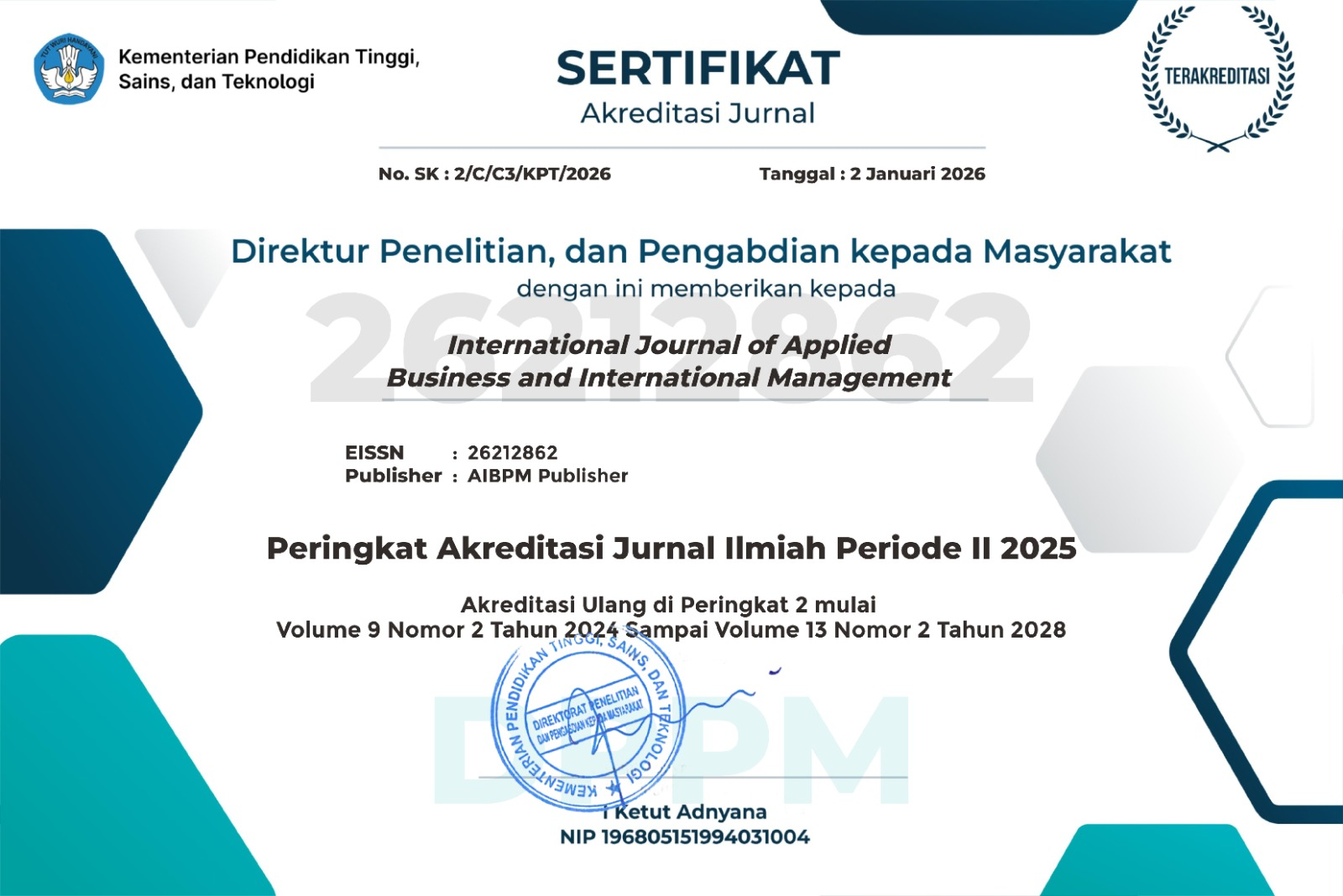
International Journal of Applied Business and International Management (IJABIM)
ISSN 2614-7432 (Print) | ISSN 2621-2862 (Online)
DOI Prefix: 10.32535 by CrossRef
Published by AIBPM Publisher
JL. Kawi No. 23, Bareng, Kec. Klojen, Kota Malang, Jawa Timur, Indonesia
Email: journal.ijabim@gmail.com
Phone: +62 341 366222
Website: https://aibpmpublisher.com/
Governed by
Association of International Business and Professional Management
Email: admin@aibpm.org
Website: https://www.aibpm.org/


Licensing Information

The International Journal of Applied Business and International Management (IJABIM) is licensed under a Creative Commons Attribution-NonCommercial-ShareAlike 4.0 International License .
Follow Us:

