






 Email this article
 Autoethnographic Evaluation of Insurance Web Accessibility in Indonesia Using WCAG 2.2 and SETARA
Abstract
This study employs autoethnography to evaluate the accessibility of insurance websites in Indonesia, guided by WCAG 2.2 and the national SETARA OJK framework. Autoethnography was chosen to foreground the lived experiences of blind users, including the researcher as an active participant, thereby bridging technical compliance with human-centered realities. Nineteen insurance websites were examined through WCAG compliance testing and focus group discussions with blind participants, analyzed using weighted criteria for navigation, screen reader readability, language clarity, and registration inclusivity. The autoethnographic lens revealed barriers invisible to automated tools, such as inconsistent headings, inaccessible CAPTCHA, and ambiguous registration language, while also capturing moments of successful navigation. Findings highlight paradoxical outcomes: Astra Life and PLN Insurance achieved AAA experiential accessibility despite low WCAG scores, whereas Allianz Life demonstrated high WCAG compliance but only moderate usability. Most companies remained at AA or A levels, confirming that compliance alone does not guarantee accessibility. By situating personal navigation experiences within broader debates on digital inclusion, the study contributes methodological transparency, integrates international and national frameworks, and offers practical recommendations for insurers and regulators. Ultimately, the research underscores that accessibility must be evaluated not only through compliance checklists but through the lived realities of blind users.
Keywords
Full Text:
PDFReferences
Almeraj, Z., Alhuwail, D., Qadri, R., Shama, S., & Crabb, M. (2023). Understanding mindsets , skills , current practices , and barriers of adoption of digital accessibility in Kuwait ’ s software development landscape. Universal Access in the Information Society, 0123456789. https://doi.org/10.1007/s10209-023-00980-5
Ara, J., Sik-lanyi, C., Kelemen, A., & Guzsvinecz, T. (2025). An inclusive framework for automated web content accessibility evaluation National Center for Accessible Media. Universal Access in the Information Society, 1581–1607.
Aung, K. W. I. N., Soubutts, E., & Singh, A. (2024). “ What a stupid way to do business ”: Towards an Understanding of Older Adults ’ Perceptions of Deceptive Patterns and Ways to Develop Resistance. Proceedings of the ACM on Human-Computer InteractionVolume 8, Issue CHI PLAY: CHI PLAY.
Borodin, Y., Bigham, J. P., Dausch, G., & Ramakrishnan, I. V. (2010). More than Meets the Eye : A Survey of Screen-Reader Browsing Strategies. W4A ’10: Proceedings of the 2010 International Cross Disciplinary Conference on Web Accessibility (W4A).
Chiriboga-Casanova, W., Mmedina-Medina, N., & Paderewski-Rodriguez, P. (2025). Accessible Web Design for Older Adults : Challenges and Solutions. ACM Transactions on Accessible Computing, 18(3). https://doi.org/10.1145/3763243
Diniz, I. V., Mendonça, A. E. O. de, Almeida, A. M. de, Oliveira, S. H. D. S., Silva, I. P. da, Costa, I. K. F., & Soares, M. J. G. O. (2025). Quality of Life and Adaptation of People With a Colostomy Plug: A Before-After Interventional Study. Journal of Wound Ostomy & Continence Nursing, 52(1), 54–57. https://doi.org/10.1097/WON.0000000000001145
Djatmiko, G. H., Sinaga, O., & Pawirosumarto, S. (2025). Digital Transformation and Social Inclusion in Public Services : A Qualitative Analysis of E-Government Adoption for Marginalized Communities in Sustainable Governance. Sustainability, 17, 1–28.
Doan, T., & Darcy, S. (2025). Autoethnographic Disability-Related Research in Hospitality and Tourism Journals : Empowering Marginalized Identity Scholars ’ Voices. Journal of Travel Research, 64(1), 238–244. https://doi.org/10.1177/00472875241257270
Dobbala, M., Shankar, M., & Lingolu, S. (2024). Enhancing Usability for Everyone Through Web Accessibility Compliance. Journal of Computer Science and Software Development Research Article Open, 3.
Donafeby Widyani. (2023). The Impact of Insurtech On The Insurance Business Model In Indonesia. International Journal of Financial Systems, 1(2), 151–184.
Droutsas, N., Spyridonis, F., Daylamani-zad, D., & Ghinea, G. (2025). Computer Standards & Interfaces Web Accessibility Barriers and Their Cross-Disability Impact in eSystems : A Scoping Review. Computer Standards & Interfaces, 92(July 2024), 103923. https://doi.org/10.1016/j.csi.2024.103923
Emara, I. (2023). Evaluation of Qualitative Data Analysis Software by a Visually Impaired Researcher : An Autoethnographic Study. International Journal of Qualitative Methods, 22, 1–11. https://doi.org/10.1177/16094069231214390
Exercise, G. M. (2025, December). Global Insurance Market Report (GIMAR). International Association of Insurance Supervisors, December. The objects of study were nineteen official websites of life and general insurance companies, selected based on their ranking among the top ten by gross premium in 2024, as reported by Bisnis.com (2025).
Feghali, J. M., Feng, C., & Majumdar, A. (2024). Comprehensive Review : High-Performance Positioning Systems for Navigation and Wayfinding for Visually Impaired People. Sensors, 24.
H, M. H. A. (2020). The Effects of Usability and Accessibility for E-Government Services on the End-User Satisfaction. International Journal of Interactive Mobile Technologies (IJIM), 14(13), 78–90.
Hardik Shah. (2024). Enhancing Web Accessibility - Navigating The Upgrade Of Design Systems From WCAG 2.0 TO WCAG 2.1. International Journal of Web & Semantic Technology (IJWesT), 15(1), 1–16. https://doi.org/10.5121/ijwest.2024.15101
Hedvall, P., Ståhl, A., & Iwarsson, S. (2025). Accessibility, Usability and Universal Design – Still Confusing ? Harmonisation of Key Concepts Describing Person-Environment Interaction to Create Conditions for Participation. Disability and Rehabilitation, 47(25), 6750–6759. https://doi.org/10.1080/09638288.2025.2491831
Henni, S. H., Maurud, S., Fuglerud, K. S., & Moen, A. (2022). The Experiences, Needs and Barriers of People with Impairments Related to Usability and Accessibility of Digital Health Solutions , Levels of Involvement in the Design Process and Strategies for Participatory and Universal Design : A Scoping Review. BMC Public Health, 22(35), 1–18. https://doi.org/10.1186/s12889-021-12393-1
Jayasiri, Mudiyanselage Jayani SandamaliJayalal, S. (2025). IMPROVING ACCESSIBILITY OF E-LEARNING SYSTEMS FOR VISUALLY IMPAIRED STUDENTS IN SRI LANKA. Journal Vallis Aurea (Journal of Sustainable Development and Innovation), 11(1), 1–16.
Keles, U. (2022). Autoethnography as a Recent Methodology in Applied Linguistics : A Methodological Review Autoethnography as a Recent Methodology in Applied Linguistics : A. The Qualitative Report, 27(2), 448–474.
Keuangan, O. J. (2024). Pedoman Akses Pelayanan Keuangan untuk Disabilitas Berdaya (Pedoman SETARA). In Pedoman SETARA.
Koopman, W. J., Watling, C. J., & Ladonna, K. A. (2020). Autoethnography as a Strategy for Engaging in Reflexivity. Global Qualitative Nursing Research, 7, 1–9. https://doi.org/10.1177/2333393620970508
Manca, M., Palumbo, V., Paternò, F., & Santoro, C. (2023). The Transparency of Automatic Web Accessibility Evaluation Tools : Design Criteria , State of the Art , and User Perception. ACM Transactions on Accessible Computing, 16(1), 1–36.
Markey, P. C. (2025). Centring the Self in Participatory Research : Approach to Research for Those Conducting Collaborative Research With Hard-To-Reach Groups. International Journal of Qualitative Methods, 24, 1–12. https://doi.org/10.1177/16094069251354901
Martin, A. (2025). Autoethnography : Narrative Research or Legacy Memoirs ? International Journal of Qualitative Methods, 24. https://doi.org/10.1177/16094069251364620
Martius, F., Jansen, L., Struck, L., Arumugam, A., Geierhaas, L., Ortloff, A., Smith, M., & Tiefenau, C. (2025). Out of Sight, Out of Mind ? Exploring Data Protection Practices for Personal Data in Usable Security & Privacy Studies. CHI Conference on Human Factors in Computing Systems (CHI ’25), April 26â•?May 01, 2025, Yokohama, Japan. https://doi.org/10.1145/3706598.3713654
Mateus, D. A., Silve, F. A. C. da, Rigatto, S. H., Silva, T. S. da, Júnior, P. P. A., Souza, M. R. de A., & Freire, A. P. (2024). The Legal Handling of Digital Accessibility : a Comparison of Evaluation and Policy Approaches in Federal-Level Cases in Brazil and the United States. Journal Ofthe Brazilian Computer Society, 20(1). https://doi.org/10.5753/jbcs.2024.3259
Matraf, M. S. B., Hashim, N. L., & Hussain, A. (2023). Visually Impaired Usability Requirements for Accessible Mobile Applications: A Checklist for Mobile E-book Applications. Journal of Information and Communication Technology, 22(3), 421–447.
Mourad, M. B. Al, Hussein, M., Kamoun, F., & Wattar, Z. (2019). Analysis of WCAG 2.0 Data Accessibility Success Criterion of E-government Websites. 7(1), 496–503.
Nasution, E. R. (2023). The role of regulatory authority in maintaining financial security in the Indonesian banking sector : A legal framework analysis. IJOBSOR, 11(3), 386–397.
Nasution, H., Muafi, M., El-qadri, Z. M., & Suprihanto, J. (2025). Impact of digital business transformation on organizational ambidexterity and performance in Indonesian insurance firms. Intangible Capital, 21(1), 1–20.
O’Sullivan, T. A., PharmD, & Jefferson, C. G. (2020). QUALITATIVE RESEARCH IN PHARMACY EDUCATION: A Review of Strategies for Enhancing Clarity and Reader Accessibility of Qualitative Research Results. American Journal OfPharmaceutical Education, 84(1). https://doi.org/10.5688/ajpe7124
Orme˜no, Y. I., Panach, J. I., & Pastor, O. (2023). An Empirical Experiment of a Usability Requirements Elicitation Method to Design GUIs Based on Interviews. Information and Software Technology, 164(August). https://doi.org/10.1016/j.infsof.2023.107324
Othman, A., Chemnad, K., Hassanien, A. E., Tlili, A., Zhang, C. Y., Al-thani, D., Alt?nay, F., Chalghoumi, H., Al-khalifa, H. S., Obeid, M., Jemni, M., Al-Hadhrami, T., & Alt?nay, Z. (2024). Accessible Metaverse : A Theoretical Framework for Accessibility and Inclusion in the Metaverse. Multimodal Technologies and Interaction, 8(21).
Parmanto, B., & Zeng, X. (2005). Metric for Web Accessibility Evaluation. JOURNAL OF THE AMERICAN SOCIETY FOR INFORMATION SCIENCE AND TECHNOLOGY, 56(13), 1394–1404. https://doi.org/10.1002/asi.20233
Persson, H., Hman, H. A., Yngling, A. A., & Gulliksen, J. (2014). Universal Design, Inclusive Design, Accessible Design, Design for All : Different Concepts — One Goal ? On the Concept of Accessibility — Historical, Methodological and Philosophical Aspects. Universal Acces in the Information Society, 14. https://doi.org/10.1007/s10209-014-0358-z
Poedjadi, M. R., Lestari, G. C., & Lisnarini, N. (2026). Implementing Web Content Accessibility Guidelines for Disability-Friendly Scholarship Websites in Indonesia. PRofesi Humas, 10(2), 215–235.
Porter, J. R., & Kientz, J. A. (2013). An Empirical Study of Issues and Barriers to Mainstream Video Game Accessibility. ASSETS ’13: Proceedings of the 15th International ACM SIGACCESS Conference on Computers and Accessibility.
Pratama, A., Ratna, D., Hapsari, I., & Wulandari, L. (2025). Bridging Regulation and Reality : A Comparative Study of Artificial Intelligence Regulation in the Financial Sectors. LEGALITY: Jurnal Ilmiah Hukum, 33(2), 307–333.
Raharjo, C. A., Priyatna, C. C., Yunita, R., Perwata, P., & Ratnasari, E. (2023). Analisis aksesibilitas website Shopee Indonesia menggunakan pedoman Web Content Accessibility Guidelines. Comdent: Communication Student Journal, 1(2), 340–354.
Rajapakshe, W., Wickramaarachchi, C., Alwis, M. K. S. S., Amarasinghe, A. A. M. L., Jayasekara, P. N., & Jayasekara, P. T. (2026). Social Sciences & Humanities Open Accessibility and usability of virtual learning platforms : Lived experiences of visually impaired undergraduates in Sri Lanka. Social Sciences & Humanities Open, 13(March), 102621. https://doi.org/10.1016/j.ssaho.2026.102621
Reuschel, W., Mcdonnall, M., & Burton, D. (2023). The Accessibility and Usability of Online Job Applications for Screen Reader Users. J Vis Impair Blind, 117(6), 479–490. https://doi.org/10.1177/0145482x231216757.The
Schwartz, R. X., Roffarello, A. M., & Russis, L. De. (2025). Bridging Digital Wellbeing and Accessibility : An Analysis of the W3C Web Content Accessibility Guidelines. Extended Abstracts of the CHI Conference on Human Factors in Computing Systems (CHI EA ’25), April 26â•?May 01, 2025, Yokohama, Japan. https://doi.org/10.1145/3706599.3719974
Shi, S. (2025). Inclusive Education in the Digital Era : Improving University Website Accessibility for Students with Disabilities. INTERNATIONAL JOURNAL OF RESEARCH AND INNOVATION IN SOCIAL SCIENCE (IJRISS), IX(IIIS). https://doi.org/10.47772/IJRISS
Souza, A., Filho, J. C. de S., Bezerra, C., Alves, V. A., Lima, L., Marques, A. B., & Monteiro, I. T. (2024). Accessibility Evaluation of Web Systems for People with Visual Impairments : Findings from a Literature Survey. Conference: IHC 2024: XXIII Brazilian Symposium on Human Factors in Computing Systems. https://doi.org/10.1145/3702038.3702090
Suhendri. (2020). The Challenges of Inclusive Education in Indonesia. Journal of Reseacrh in Business, Economics, and Education, 2(5).
Tang, Q., Kamarudin, S., Nujaimi, S., Rahman, A., & Zhang, X. (2025). Bridging Gaps in Online Learning : A Systematic Literature Review on the Digital Divide. Journal of Education and Learning, 14(1), 161–176. https://doi.org/10.5539/jel.v14n1p161
Trifan, C., Waegh, R. de, Zhang, Y., & Ooi, C.-S. (2024). Autoethnographic Reflections on Creating Inclusive and Collaborative Virtual Places for Academic Research. Journal of Organizational Ethnography, 13(2), 176–195. https://doi.org/10.1108/JOE-06-2023-0037
Vollenwyder, B., Petralito, S., Iten, G. H., Brühlmann, F., Opwis, K., & Mekler, E. D. (2023). How compliance with web accessibility standards shapes the experiences of users with and without disabilities. International Journal of Human - Computer Studies, 170(August 2022), 102956. https://doi.org/10.1016/j.ijhcs.2022.102956
Wang, Y. Y., Jiang, M., Liu, Q., & Jin, T. (2026). Navigating Boundaries in International and Interdisciplinary Research Collaboration : Insights from a Collaborative Autoethnographic Exploration. European Journal of Education, 61(2). https://doi.org/10.1111/ejed.70612
DOI: https://doi.org/10.32535/ijabim.v11i2.4599
Refbacks
- There are currently no refbacks.

Copyright (c) 2026 Bagus Suhendar

This work is licensed under a Creative Commons Attribution-NonCommercial-ShareAlike 4.0 International License.
International Journal of Applied Business and International Management (IJABIM)
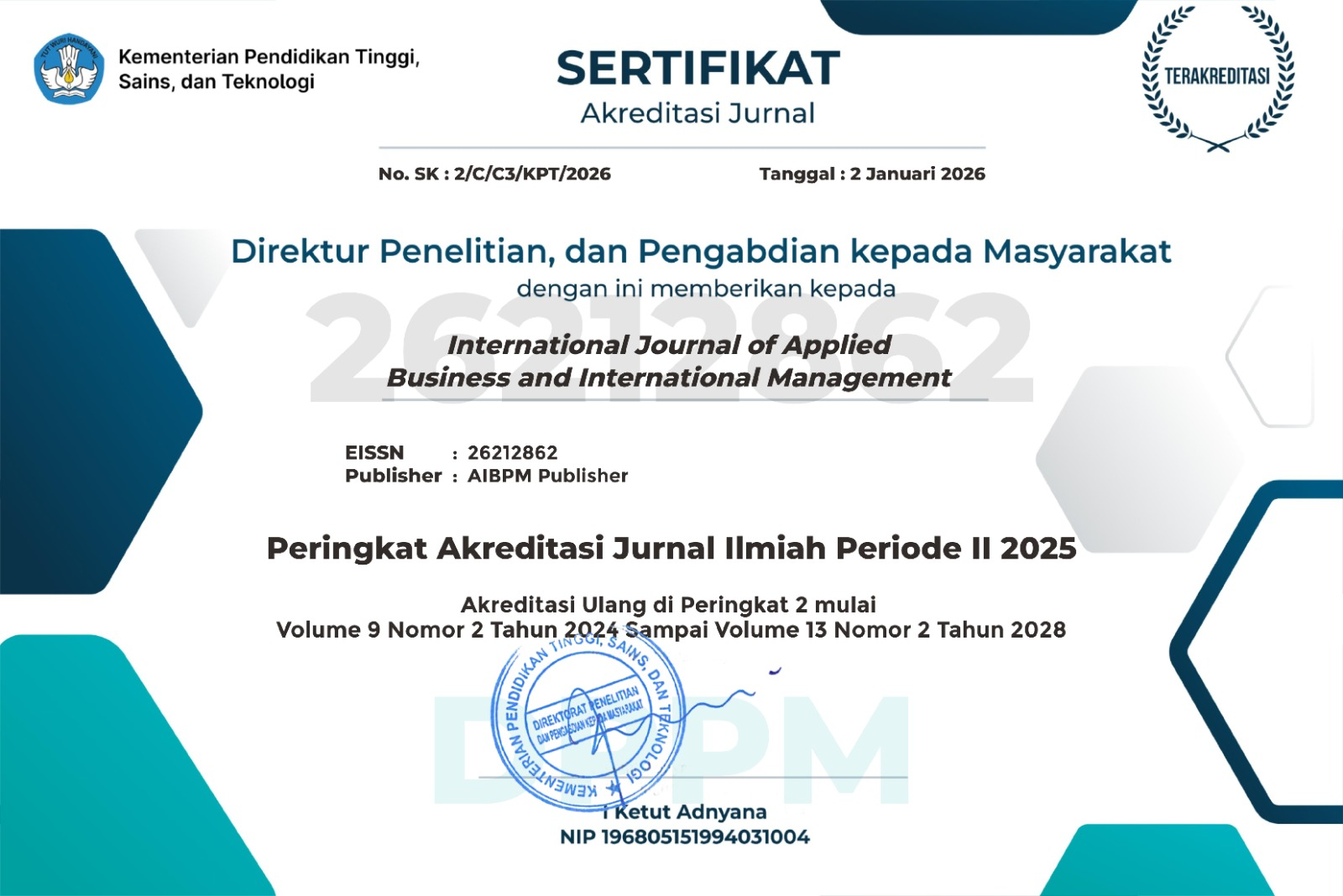
ISSN 2614-7432 (Print) | ISSN 2621-2862 (Online)
DOI Prefix: 10.32535 by CrossRef
Published by AIBPM Publisher
JL. Kawi No. 23, Bareng, Kec. Klojen, Kota Malang, Jawa Timur, Indonesia
Email: journal.ijabim@gmail.com
Phone: +62 341 366222
Website: https://aibpmpublisher.com/
Governed by
Association of International Business and Professional Management
Email: admin@aibpm.org
Website: https://www.aibpm.org/


Licensing Information

The International Journal of Applied Business and International Management (IJABIM) is licensed under a Creative Commons Attribution-NonCommercial-ShareAlike 4.0 International License .
Follow Us:

