






 Email this article
 Tourist-Centric Service Quality and Sustainable Tourism Development: Evidence from Indonesian Small Island Destinations
Abstract
Small island destinations in Indonesia have substantial tourism potential but face significant sustainability challenges. This study aims to examine the effect of tourist-centric service quality (TCSQ) on sustainable tourism development (STD) through tourist perception and to investigate the moderating role of environmental concern in this relationship. Data were collected from 477 domestic and international tourists visiting selected Indonesian small islands and analyzed using Partial Least Squares Structural Equation Modeling (PLS-SEM). The results indicate that TCSQ significantly enhances STD both directly and indirectly through tourist perception (p < 0.001), highlighting the importance of positive environmental perceptions in encouraging sustainable tourism. However, the moderating effects of environmental concern on responsiveness (b = 0.029, t = 1.851, p = 0.064) and tangibility (b = ?0.021, t = 1.330, p = 0.183) were not statistically significant, suggesting that environmentally concerned tourists value long-term sustainability commitments over operational service attributes. This study extends sustainable tourism literature by proposing an integrated moderated-mediation framework and offers practical guidance for destination management organizations to align service quality with environmental sustainability in small island destinations.
Keywords
Full Text:
PDFReferences
Alsiehemy, A. (2023). Events-based service quality and tourism sustainability: The mediating and moderating role of value-based tourist behavior. Sustainability, 15(21), 15303. https://doi.org/10.3390/su152115303
Birinci, H., Esenyel, I., & Obeng, H. A. (2025). Sustainable destination management in luxury tourism: Balancing economic development and environmental responsibility. Sustainability, 17(15), 6815. https://doi.org/10.3390/su17156815
Bramwell, B., & Lane, B. (2023). The Routledge Handbook of Sustainable Tourism. Routledge.
Buhalis, D., Leung, D., & Lin, M. S. (2024). Artificial intelligence and big data analytics in destination management: Transforming small island tourism experiences. Journal of Destination Marketing & Management, 31, 100842. https://doi.org/10.1016/j.jdmm.2023.100842
Chen, T., Liu, G., Sui, X., & Solangi, Y. A. (2025). Influencing consumer perceptions in green tourism: criteria and strategies for effective destination branding. PloS one, 20(2), e0319254. https://doi.org/10.1371/journal.pone.0319254
Dunlap, R. E., Van Liere, K. D., Mertig, A. G., & Jones, R. E. (2000). Measuring endorsement of the New Ecological Paradigm: A revised NEP scale. Journal of Social Issues, 56(3), 425–442. https://doi.org/10.1111/0022-4537.00176
Dwyer, L., & Kim, C. (2003). Destination competitiveness: Determinants and indicators. Current Issues in Tourism, 6(5), 369–414. https://doi.org/10.1080/13683500308667962
Elkington, J. (1997). Cannibals with Forks: The Triple Bottom Line of 21st Century Business. Capstone.
Font, X., & McCabe, S. (2017). Sustainability and marketing in tourism: Its contexts, paradoxes, approaches, challenges and potential. Journal of Sustainable Tourism, 25(7), 869-883. https://doi.org/10.1080/09669582.2017.1301721
Gössling, S., & Higham, J. (2021). The low-carbon imperative: Destination management under urgent climate change. Journal of Travel Research, 60(6), 1167-1179. https://doi.org/10.1177/0047287520933679
Hair, J. F., Jr., Hult, G. T. M., Ringle, C. M., & Sarstedt, M. (2022). A Primer on Partial Least Squares Structural Equation Modeling (PLS-SEM) (3rd ed.). SAGE
Hall, C. M. (2019). Constructing sustainable tourism development: The 2030 agenda and the managerial ecology of sustainable tourism. Journal of Sustainable Tourism, 27(7), 1044-1060. https://doi.org/10.1080/09669582.2018.1560456
Han, H. (2021). Consumer behavior and environmental sustainability in tourism and hospitality: A review of theories, concepts, and latest research. Journal of Sustainable Tourism, 29(7), 1021-1042. https://doi.org/10.1080/09669582.2021.1903019
Hu, M., Li, H., Song, H., Li, X., & Law, R. (2022). Tourism demand forecasting using tourist-generated online review data. Tourism management, 90, 104490. https://doi.org/10.1016/j.tourman.2022.104490
Intergovernmental Panel on Climate Change (IPCC). (2023). Climate change 2023: Synthesis report. Contribution of Working Groups I, II and III to the Sixth Assessment Report of the Intergovernmental Panel on Climate Change (Core Writing Team, H. Lee, & J. Romero, Eds.). IPCC. https://doi.org/10.59327/IPCC/AR6-9789291691647
Ismulyati, S., Ngarbingan, H. K., Janita, I., & Ginting, G. (2026). Understanding the antecedents and consequences of residents' attitudes toward tourism development and environmental responsibility in community-based tourism villages: A sustainable tourism perspective. International Journal of Tourism and Hospitality in Asia Pasific, 9(1), 1-22. https://doi.org/10.32535/ijthap.v9i1.4316
Karim, R. A., & Rabiul, M. K. (2024). The relationships of corporate sustainability, customer loyalty, and word of mouth: the mediating role of corporate image and customer satisfaction. Journal of Quality Assurance in Hospitality & Tourism, 25(3), 421-441. https://doi.org/10.1080/1528008X.2022.2135054
Lee, C. K., Olya, H., Ahmad, M. S., Kim, K. H., & Oh, M. J. (2021). Sustainable intelligence, destination social responsibility, and pro-environmental behaviour of visitors: Evidence from an eco-tourism site. Journal of Hospitality and Tourism Management, 47, 365-376. https://doi.org/10.1016/j.jhtm.2021.04.010
Li, J., & Huang, J. (2026). Assessing the inbound tourism service quality and competitiveness under the concept of sustainable development. Sustainability, 18(13), 6607. https://doi.org/10.3390/su18136607
Liu, X. (2025). Research on the coupled dynamics and prediction of island tourism-economy-ecosystem from a policy perspective. PLOS ONE, 20(2), e0321957. https://doi.org/10.1371/journal.pone.0321957
Maesaroh, I., Ngarbingan, H. K., Dewi, I. J., & Ginting, G. (2026). External support and supply-side strategies for sustaining halal tourism: An integrated analysis. International Journal of Tourism & Hospitality in Asia Pasific, 9(1), 23–49. https://doi.org/10.32535/ijthap.v9i1.4317
Mandi?, A., Knight, D. W., Vukovi?, M., & Thomsen, B. (2025). Place attachment, awareness of environmental responsibility and pro-environmental behaviour of visitors in protected natural areas. Tourism Planning & Development, 22(5), 705-730. https://doi.org/10.1080/21568316.2024.2353596
Maria, M., Akbara, A. Z., Ngarbingan, H. K., & Ginting, G. (2023). Strategies to encourage the acceleration of circular economic practices among youth play as agents of change. International Journal of Applied Business and International Management, 8(3), 322–340. https://doi.org/10.32535/ijabim.v8i3.2529
Mehrabian, A., & Russell, J. A. (1974). An Approach to Environmental Psychology. MIT Press.
Ministry of Tourism and Creative Economy of the Republic of Indonesia. (2022). Rencana Strategis Kementerian Pariwisata dan Ekonomi Kreatif/Badan Pariwisata dan Ekonomi Kreatif Tahun 2020–2024. Kementerian Pariwisata dan Ekonomi Kreatif/Badan Pariwisata dan Ekonomi Kreatif. https://api.kemenpar.go.id/storage/app/uploads/public/67d/92a/fde/67d92afde231c904840769.pdf
Nasoha, M., Ngarbingan, H. K., Ginting, G., Maria, M., & Zulfahmi, Z. (2024). Optimizing the use of social crowdfunding in SMEs to encourage the implementation of circular economy (CE) practices. International Journal of Applied Business and International Management, 9(2), 164–181. https://doi.org/10.32535/ijabim.v9i2.3401
Parasuraman, A., Zeithaml, V. A., & Berry, L. L. (1988). SERVQUAL: A multiple-item scale for measuring consumer perceptions of service quality. Journal of Retailing, 64(1), 12–40.
Paul, I., & Roy, G. (2025). How eco-service quality affects tourist engagement behaviour in ecotourism: Eco-consciousness, eco activity-based learning, and S-O-R theory. Tourism Recreation Research, 50(2), 385–401. https://doi.org/10.1080/02508281.2023.2275240
Prayag, G., Ryan, C. (2022). Antecedents of tourists' loyalty to Mauritius: The role and influence of destination image, place attachment, personal involvement, and satisfaction. Journal of Travel Research, 51(3), 342–356. https://doi.org/10.1177/0047287511410321
Ru-Zhue, J., Rakangthong, N. K., Kim, L., & Issayeva, G. (2025). Green service quality and tourist engagement: Moderating impacts of social influence in green hotels. Cleaner and Responsible Consumption, 100385. https://doi.org/10.1016/j.clrc.2025.100385
Sahabuddin, M., Alam, M. S., & Nekmahmud, M. (2026). How do perceived and environmental values influence tourist satisfaction, loyalty, and environmental awareness?. Environment, Development and Sustainability, 28(3), 7817-7840. https://doi.org/10.1007/s10668-024-05094-3
Sharma, G. D., Thomas, A., & Paul, J. (2021). Reviving tourism industry post-COVID-19: A resilience-based framework. Tourism Management Perspectives, 37, 100786.
Sharpley, R. (2022). Sustainable Tourism: A Global Perspective (3rd ed.). Routledge.
Sharpley, R. (2023). Tourism Development and the Environment: Beyond Sustainability? (2nd ed.). Routledge.
Sihombing, J. R. (2026). The influence of environmental certification and waste management practices on tourist preferences at green hotels. Journal of Environment and Sustainability Education, 4(1), 131–143. https://doi.org/10.62672/joease.v4i1.129
Stern, P. C. (2000). New environmental theories: toward a coherent theory of environmentally significant behavior. Journal of Social Issues, 56(3), 407-424. https://doi.org/10.1111/0022-4537.00175
Su, L., Swanson, S. R., & Chen, X. (2016). The impact of perceived service fairness and quality on the behavioral intentions of Chinese hotel guests: the mediating role of consumption emotions. Journal of Travel & Tourism Marketing, 33(sup1), 88-102. https://doi.org/10.1080/10548408.2015.1008668
United Nations (UN) Tourism. (2024a). Tourism for People and Planet: Annual Report 2024. UN Tourism. https://annualreport.jointsdgfund.org/2024-accelerating-together-our-collective-journey-in-2024/
United Nations (UN) Tourism. (2024a). World Tourism Barometer. UN Tourism. https://www.untourism.int/un-tourism-world-tourism-barometer-data
United Nations Environment Programme (UNEP). (2023). Global Environment Outlook 7: Healthy Planet, Healthy People. UNEP. https://www.unep.org/geo/global-environment-outlook-7
Wang, X., Wang, L. J., Wu, W., Chen, Y., & Tian, R. (2024). Tourists' environmentally responsible behavior: A new path of sustainable development of grassland tourism. Business Strategy and the Environment, 33(3), 2143-2158. https://doi.org/10.1002/bse.3590
World Travel & Tourism Council (WTTC). (2024). Economic Impact Research 2024. WTTC. https://wttc.org/research/economic-impact
Wu, Y., & Yao, R. (2025). Supporting sustainable island tourism through infrastructuring co-design: A case study from Mayu Island. Island Studies Journal, 21(1). https://doi.org/10.24043/001c.142953
Zeithaml, V. A., Bitner, M. J., & Gremler, D. D. (2020). Services Marketing: Integrating Customer Focus Across the Firm (8th ed.). McGraw-Hill.
Zulfahmi, Z., Radeswandri, R., Ngarbingan, H. K., & Ginting, G. (2022). A comprehensive structural model of online/website experience. International Journal of Applied Business and International Management, 7(3), 83–96. https://doi.org/10.32535/ijabim.v7i3.1965
DOI: https://doi.org/10.32535/ijabim.v11i2.4715
Refbacks
- There are currently no refbacks.

Copyright (c) 2026 Yusuf Yusuf, sri Ismulyati, Hubertina Karolina Ngarbingan, Ginta Ginting

This work is licensed under a Creative Commons Attribution-NonCommercial-ShareAlike 4.0 International License.
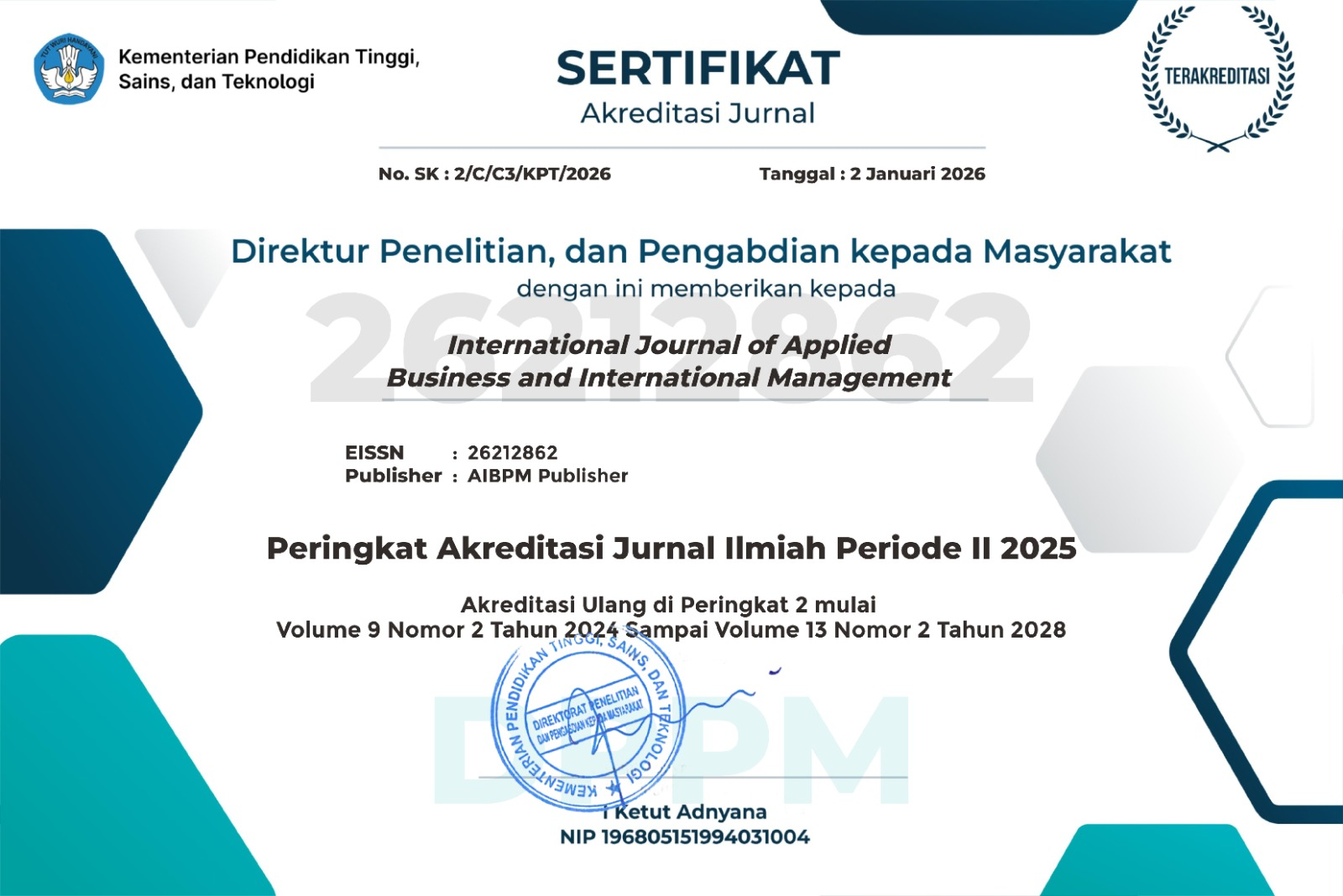
International Journal of Applied Business and International Management (IJABIM)
ISSN 2614-7432 (Print) | ISSN 2621-2862 (Online)
DOI Prefix: 10.32535 by CrossRef
Published by AIBPM Publisher
JL. Kawi No. 23, Bareng, Kec. Klojen, Kota Malang, Jawa Timur, Indonesia
Email: journal.ijabim@gmail.com
Phone: +62 341 366222
Website: https://aibpmpublisher.com/
Governed by
Association of International Business and Professional Management
Email: admin@aibpm.org
Website: https://www.aibpm.org/


Licensing Information

The International Journal of Applied Business and International Management (IJABIM) is licensed under a Creative Commons Attribution-NonCommercial-ShareAlike 4.0 International License .
Follow Us:

