






 Email this article
 Ergo-Iconic Value and Local Products as Media of Generation Z Consumption Identity
Abstract
Keywords
Full Text:
PDFReferences
Andriyansah, A., & Saputra, N. (2025). Product values in the digital era and the quest for sustainable competitive advantage: A bibliometric mapping of trends. International Review of Management and Marketing, 15(6), 252–268. https://doi.org/10.32479/irmm.20334
Andriyansah, A., Fatimah, F., Hermajiwandini, C. M. D. W., Nurhayati, S., Graciafernandy, M. A., & Nurdiyah, N. (2026). Integrating circular economy and sustainable innovation to drive value in ergo-iconic agricultural products. Ilomata International Journal of Management, 7(2), 612–619. https://doi.org/10.61194/ijjm.v7i2.2152
Andriyansah, Fatimah, F., Hidayah, Z., & Daud, A. (2020). Meningkatkan kinerja pemasaran hotel dengan memanfaatkan nilai pelayanan ergo-ikonik. JBMP: Jurnal Bisnis, Manajemen dan Perbankan, 6(1), 63–68. https://doi.org/10.21070/jbmp.v6i1.438
Andriyansah, Ginting, G., & Rahim, A. R. (2023). Developing the competitive advantage of small and medium enterprises through an ergo-iconic value approach in Indonesia. International Journal of Applied Economics, Finance and Accounting, 17(2), 436–444. https://doi.org/10.33094/ijaefa.v17i2.1196
Andriyansah. (2025). Ecological identity and social representation of green MSMEs: Ergo-iconic value, performativity, and representational resistance in the platform economy. Society, 13(2), 877–894. https://doi.org/10.33019/society.v13i2.815
Andriyansyah, A. (2018). Keunggulan posisional nilai produk ergo-ikonik untuk meningkatkan kinerja pemasaran [Doctoral dissertation, Diponegoro University]. Diponegoro University Institutional Repository.
Arnould, E. J., & Thompson, C. J. (2005). Consumer culture theory twenty years of research. Journal of Consumer Research, 31(4), 868–882. https://doi.org/10.1086/426626
Badan Pusat Statistik. (2025). Statistik e-commerce 2024. Badan Pusat Statistik.
Bank Indonesia. (2025). QRIS Jelajah Indonesia 2025 dorong digitalisasi dengan perluasan akseptasi QRIS antarnegara. Bank Indonesia.
Belk, R. W. (1988). Possessions and the extended self. Journal of Consumer Research, 15(2), 139–168. https://doi.org/10.1086/209154
DataReportal. (2025). Digital 2025: Indonesia. DataReportal.
Djafarova, E., & Bowes, T. (2021). “Instagram made me buy it”: Generation Z impulse purchases in fashion industry. Journal of Retailing and Consumer Services, 59, 102345. https://doi.org/10.1016/j.jretconser.2020.102345
Hennig-Thurau, T., Gwinner, K. P., Walsh, G., & Gremler, D. D. (2004). Electronic word-of-mouth via consumer-opinion platforms: What motivates consumers to articulate themselves on the internet? Journal of Interactive Marketing, 18(1), 38–52. https://doi.org/10.1002/dir.10073
Holt, D. B. (2004). How brands become icons: The principles of cultural branding. Harvard Business School Press.
Jaakkola, E. (2020). Designing conceptual articles: Four approaches. AMS Review, 10, 18–26. https://doi.org/10.1007/s13162-020-00161-0
Priporas, C.-V., Stylos, N., & Fotiadis, A. K. (2017). Generation Z consumers’ expectations of interactions in smart retailing: A future agenda. Computers in Human Behavior, 77, 374–381. https://doi.org/10.1016/j.chb.2017.01.058
Schau, H. J., & Gilly, M. C. (2003). We are what we post? Self-presentation in personal web space. Journal of Consumer Research, 30(3), 385–404. https://doi.org/10.1086/378616
Sheth, J. N., Newman, B. I., & Gross, B. L. (1991). Why we buy what we buy: A theory of consumption values. Journal of Business Research, 22(2), 159–170. https://doi.org/10.1016/0148-2963(91)90050-8
Snyder, H. (2019). Literature review as a research methodology: An overview and guidelines. Journal of Business Research, 104, 333–339. https://doi.org/10.1016/j.jbusres.2019.07.039
Suchman, M. C. (1995). Managing legitimacy: Strategic and institutional approaches. Academy of Management Review, 20(3), 571–610. https://doi.org/10.2307/258788
Sukendri, N., Andriyansah, Hermajiwandini, C. M. D. W., Lestari, D. A., & Karmanto, G. D. (2025). Viralitas konten media sosial melalui penerapan nilai ergo-ikonik dan dampaknya terhadap pertumbuhan finansial. Waisya: Jurnal Ekonomi Hindu, 4(2), 160–171. https://doi.org/10.53977/jw.v4i2.3162
Sweeney, J. C., & Soutar, G. N. (2001). Consumer perceived value: The development of a multiple item scale. Journal of Retailing, 77(2), 203–220. https://doi.org/10.1016/S0022-4359(01)00041-0
Torraco, R. J. (2005). Writing integrative literature reviews: Guidelines and examples. Human Resource Development Review, 4(3), 356–367. https://doi.org/10.1177/1534484305278283
Zeithaml, V. A. (1988). Consumer perceptions of price, quality, and value: A means-end model and synthesis of evidence. Journal of Marketing, 52(3), 2–22. https://doi.org/10.1177/002224298805200302
DOI: https://doi.org/10.32535/ijabim.v9i3.4812
Refbacks
- There are currently no refbacks.

Copyright (c) 2026 Andriyansah Andriyansah

This work is licensed under a Creative Commons Attribution-NonCommercial-ShareAlike 4.0 International License.
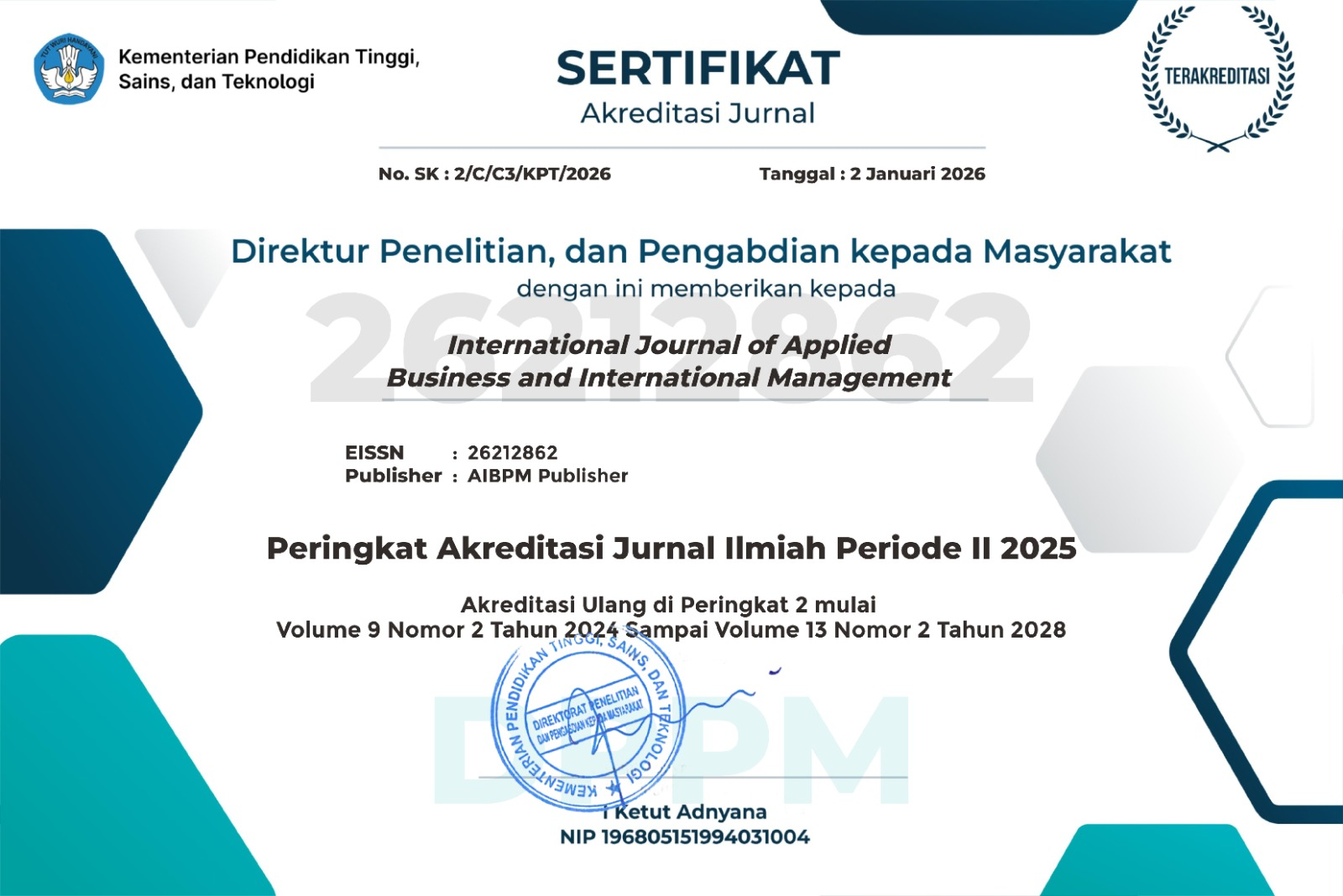
International Journal of Applied Business and International Management (IJABIM)
ISSN 2614-7432 (Print) | ISSN 2621-2862 (Online)
DOI Prefix: 10.32535 by CrossRef
Published by AIBPM Publisher
JL. Kawi No. 23, Bareng, Kec. Klojen, Kota Malang, Jawa Timur, Indonesia
Email: journal.ijabim@gmail.com
Phone: +62 341 366222
Website: https://aibpmpublisher.com/
Governed by
Association of International Business and Professional Management
Email: admin@aibpm.org
Website: https://www.aibpm.org/


Licensing Information

The International Journal of Applied Business and International Management (IJABIM) is licensed under a Creative Commons Attribution-NonCommercial-ShareAlike 4.0 International License .
Follow Us:

