






 Email this article
 Green Value Creation Through Ethical Halal Supply Chain Management for Small and Medium Enterprises: An Ergo-Iconic Branding Framework
Abstract
Keywords
Full Text:
PDFReferences
Ali, M. H., Chung, L., Tan, K. H., Makhbul, Z. M., & Zhan, Y. (2023). Investigating blockchain technology adoption intention model in halal food small and medium enterprises: Moderating role of supply chain integration. International Journal of Logistics Research and Applications, 1-25. https://doi.org/10.1080/13675567.2023.2217772
Andriyansah, A. (2025). Ecological identity and social representation of green MSMEs: Ergo-iconic value, performativity, and representational resistance in the platform economy. Society, 13(2), 815-835. https://doi.org/10.33019/society.v13i2.815
Andriyansah, A., Sukmana, O., & Fauzi, A. (2023). Green ergo-iconic value: Bridging functional sustainability and aesthetic appeal in MSME branding. Journal of Small Business Management, 61(4), 1245-1268.
Anisah, D. (2024). Green halal: Sinergi industri halal dan pembangunan berkelanjutan. An-Natiq, 4(2), 215-234. https://doi.org/10.33474/an-natiq.v4i2.21491
Anwar, S. (2025). Digital trust mechanisms in halal tourism: The role of blockchain verification. Journal of Islamic Marketing, 16(3), 445-462.
Cahyanto, I. (2024). The global halal economy: Trends, challenges, and opportunities for Indonesia. State of the Global Islamic Economy Report 2024. DinarStandard.
Cascavilla, A., De Chiara, A., & Iannuzzi, E. (2025). Perceived value and willingness to pay for sustainable halal products: Evidence from European Muslim consumers. Journal of Islamic Marketing, 16(1), 89-107.
Gunawan, A., & Bata Ilyas, G. (2026). Social media influence on halal product purchase decisions: The mediating role of brand trust. Journal of Islamic Marketing, 17(2), 234-251.
Harsanto, B., Mulyana, A., Faisal, Y. A., & Shankar, K. (2024). Digital technology 4.0 on halal supply chain: A systematic review. Logistics, 8(1), 21. https://doi.org/10.3390/logistics8010021
Hew, J.-J., Wong, L.-W., Tan, G. W.-H., Ooi, K.-B., & Lin, B. (2020). The blockchain-based halal traceability systems: A hype or reality? Supply Chain Management: An International Journal, 25(6), 863-879. https://doi.org/10.1108/SCM-01-2020-0044
Indra, S., Kusuma, A., & Wijaya, T. (2026). Challenges and opportunities of mandatory halal certification for Indonesian MSMEs. Journal of Small Business and Enterprise Development, 33(1), 45-63.
Kshetri, N., & Dwivedi, Y. K. (2024). Blockchain and global supply chain transparency: Implications for halal product authentication. International Journal of Information Management, 74, 102-118.
Mingxian, L., Zhang, Y., & Wang, H. (2025). Digital influencer marketing in halal industries: A cross-cultural perspective. Journal of International Marketing, 33(2), 178-195.
Nazarenko, A., & Saleh, M. (2024). Perceived economic value of sustainable halal products: A multi-country study. Sustainability, 16(8), 3245.
Olivieri, M., & Testa, F. (2024). Green purchase intention in emerging markets: The role of certification and brand origin. Journal of Cleaner Production, 412, 137-152.
Priyatno, P. D., & Sayuti, M. N. (2025). Pengembangan model bisnis berkelanjutan untuk produk halal. Islamic Economics and Business Review, 4(1), 89-107. https://doi.org/10.59580/iesbir.v4i1.12092
Qizwini, M., & Purnama, A. (2025). Digital literacy barriers for Indonesian MSMEs in e-commerce adoption. Journal of Entrepreneurship in Emerging Economies, 17(2), 234-251.
Razali, N., & Samori, Z. (2025). Halal integrity in digital platforms: Consumer trust and verification mechanisms. Journal of Islamic Marketing, 16(4), 567-584.
Salisu, M. A., Showole, R. K., & Moyosore, T. U. (2023). Green marketing as an ethical practice for halal entrepreneurs for a sustainable ecosystem. In Green Entrepreneurship and Sustainable Development (pp. 289-308). Springer. https://doi.org/10.1007/978-981-99-6427-7_16
Sukoso, S. (2020). Halal product assurance in Indonesia: Implementation challenges and opportunities. Journal of Islamic Law and Culture, 22(3), 345-362.
Sun, Y., & Xing, J. (2022). The impact of social media information sharing on the green purchase intention among Generation Z. Sustainability, 14(11), 6879. https://doi.org/10.3390/su14116879
Surjandari, I., Yusuf, H., Laoh, E., & Maulida, R. (2021). Designing a permissioned blockchain network for the halal industry using Hyperledger Fabric. Journal of Big Data, 8(1), 1-16. https://doi.org/10.1186/s40537-020-00405-7
Syarifah, N., Kusuma, D., & Rahman, A. (2026). Consumer trust dynamics in e-commerce halal products: The role of reviews and certification transparency. Electronic Commerce Research, 26(1), 123-145.
Wicahyono, B., Santoso, A., & Prasetyo, D. (2026). The influence of halal labels on consumer purchase decisions: Evidence from Indonesian Muslim consumers. Journal of Islamic Marketing, 17(1), 78-95.
Yang, K., Chen, L., & Zhang, W. (2024). Ecological aesthetics in digital marketing: Visual communication of sustainability values. Journal of Business Research, 168, 114-128.
DOI: https://doi.org/10.32535/ijabim.v11i2.5063
Refbacks
- There are currently no refbacks.

Copyright (c) 2026 Andriyansah Andriyansah, Ledy Yolanda, Nur Ambia Arma, Dwi Ayu Lestari, Annisa Lailatul Badriyah, Altri Nurgiana

This work is licensed under a Creative Commons Attribution-NonCommercial-ShareAlike 4.0 International License.
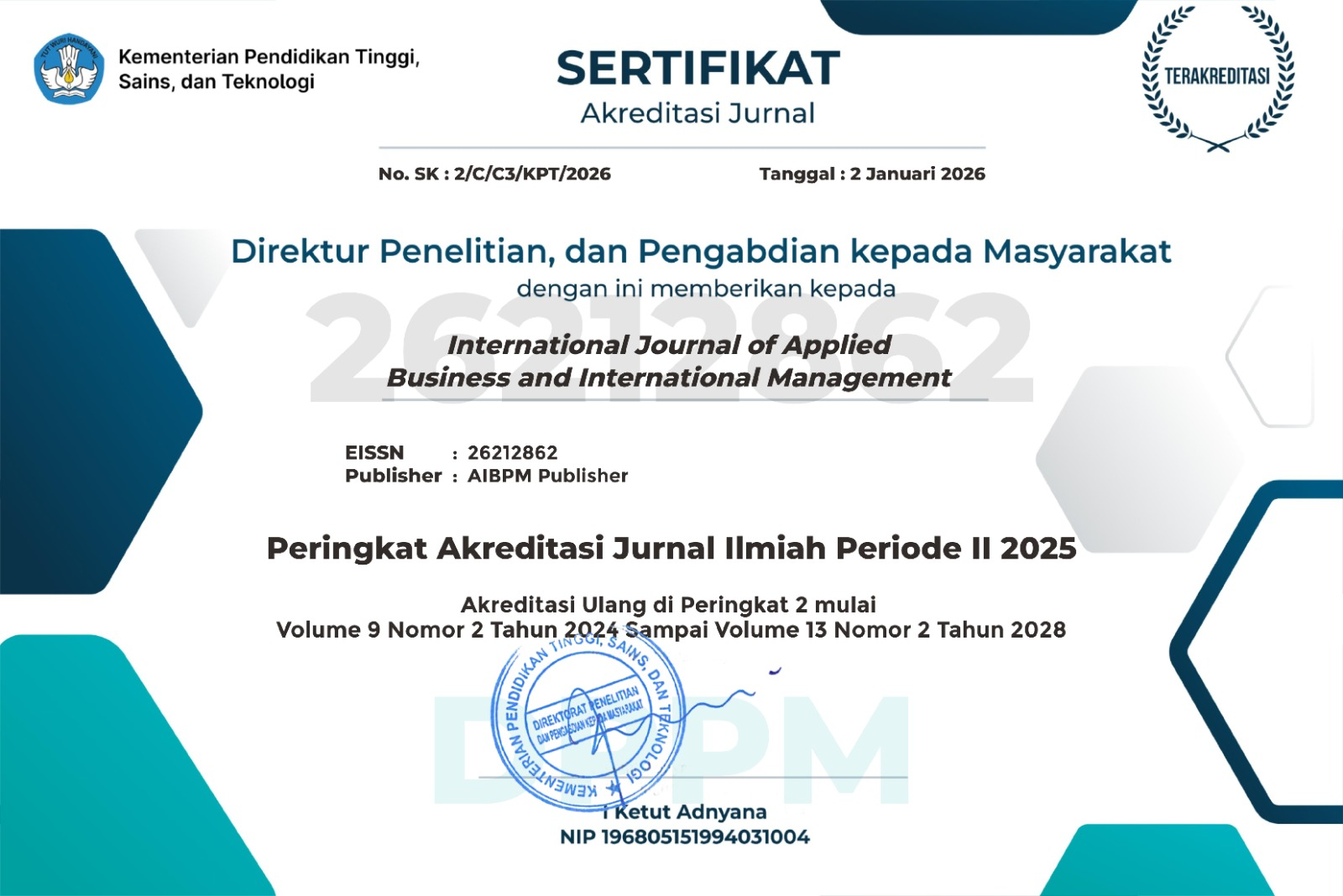
International Journal of Applied Business and International Management (IJABIM)
ISSN 2614-7432 (Print) | ISSN 2621-2862 (Online)
DOI Prefix: 10.32535 by CrossRef
Published by AIBPM Publisher
JL. Kawi No. 23, Bareng, Kec. Klojen, Kota Malang, Jawa Timur, Indonesia
Email: journal.ijabim@gmail.com
Phone: +62 341 366222
Website: https://aibpmpublisher.com/
Governed by
Association of International Business and Professional Management
Email: admin@aibpm.org
Website: https://www.aibpm.org/


Licensing Information

The International Journal of Applied Business and International Management (IJABIM) is licensed under a Creative Commons Attribution-NonCommercial-ShareAlike 4.0 International License .
Follow Us:

